Meera Subramanian
  • Home
  • Books
  • Writing
  • Bio
  • Blog
  • Photos
  • Events
  • Speaking
  • Contact

exception to the rule

September 13, 2008 By Meera 1 Comment

Curses. Every time I set a rule for myself, the heavens conspire to make me rationally and consciously decide to break it. So that thing I said about glow sticks…

After camping under the stars somewhere around Mt. Shasta (once covered with ice, but now bare rock), and moving up the spine of the I-5 corridor, I arrived in Eugene last night. The sun was still blazing hot upon this funky college town as the riff and the raff came to the  downtown mall area for the annual Eugene Celebration. Yes, there were glow sticks, but we went for the fire. My friend was spinning poi, great balls of fire that she twirled deftly on the ends of chain. She performed with Warning: Clowns Ahead, a ragamuffin group of fire-jugging, unicycle-riding, gravity-defying (well, most of the time), face-painted revelers. Children covered their mouths, gasping with delight, spotters caught wayward juggling torches as they veered towards the large crowd.

They did two shows and then we wandered through the melee. If New York City is a place where everyone is too cool to dance, Eugene is the exact opposite. A mobile disco ball was set up in one street intersection and one block down, Samba Ja — a twenty-odd piece marching band of sorts — filled another with their bass drums and multiple forms of percussion. Everyone was dancing, or at least bouncing, playing out a life of eternal childhood and silliness and fun, where self-consciousness is a forgotten concept and the body is built for movement and freedom.

Filed Under: Uncategorized

Frisco on high

September 11, 2008 By Meera 1 Comment

Bernal Heights Park, SF

Bernal Heights Park, SF

San Francisco! Greg and I get chinese food at a place that Bill Clinton had take out – twice, they brag – and then climb up the hill to Bernal Hights Park. As we circle ’round the grassy knob, a falcon flashes across the sky. I grab Greg’s arm – friends of mine are getting used to this, maybe – look! The pointed wings, the fast movement. We stop to talk about the life stuff that friends with only a few hours try to squeeze in, at the top of the hill, where a chain link fence toped with a layer of barbed wire protects a cluster of antennae and a few scattered trees. A shadow catches my eye and I look up to see the kestrel fly to the fence not fifteen feet from us, bobbing its tail distinctively. Red tails ride thermals in the distance, the Golden Gate Bridge just emerging from some clouds beyond them. The sun is hot, and the air is cold, and my time in this city is limited. It’s time to head north, leaving summer and the south behind. Into the trees. Into the past, that has become the future.

Filed Under: Uncategorized

wind water sky

September 11, 2008 By Meera 1 Comment

Jersey has its shore. Here, in California, it’s the coast, and it’s rocky and wild, even in the most inhabited places. The rocks are monolithic boulders topped with a drizzle of bird guano like a sea sundae, cormorants as cherries. Pelicans move in groups aross grey skies with a movement neither clumsy nor graceful, but merely miraculous. Look out upon the water as waves crash in, the great breathing rhythm of an immortal earth, and see surfers and sea lions. The air is damp, the eucalyptus leaves falling from the trees as the west coast monarchs find their way to their wintering grounds. A friend has dove into the waters here and tells me of flying through underwater kelp forests with the sea lions. I am moving quickly, hardly in a place for more than a day or two on this trip, and I too feel like i am flying.

Filed Under: Uncategorized

saint somewhere

September 10, 2008 By Meera Leave a Comment

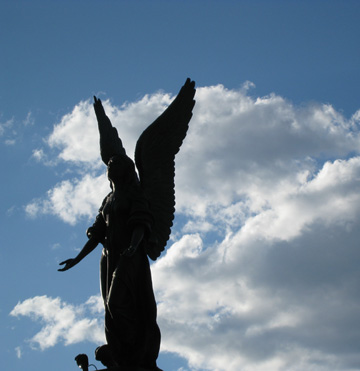
The angel, on the street where I stayed in Santa Fe. The poem, on the wall of the man I interviewed today here in Santa Cruz. He looked out of the window, his eyes focused on a point in time thirty years ago, as he recalled memories of falcons hunting and the impatience of young men eager to see the sleek form fill the sky once more. I looked up the poem when I got back to my friend Doug’s house, and we read it aloud, anew. Santa Fe, Santa Cruz, Saints abound….

The Stolen Child

by William Butler Yeats

Where dips the rocky highland
Of Sleuth Wood in the lake,
There lies a leafy island
Where flapping herons wake
The drowsy water rats;
There we’ve hid our faery vats,
Full of berrys
And of reddest stolen cherries.
Come away, O human child!
To the waters and the wild
With a faery, hand in hand,
For the world’s more full of weeping than you can understand.

Where the wave of moonlight glosses
The dim gray sands with light,
Far off by furthest Rosses
We foot it all the night,
Weaving olden dances
Mingling hands and mingling glances
Till the moon has taken flight;
To and fro we leap
And chase the frothy bubbles,
While the world is full of troubles
And anxious in its sleep.
Come away, O human child!
To the waters and the wild
With a faery, hand in hand,
For the world’s more full of weeping than you can understand.

Where the wandering water gushes
From the hills above Glen-Car,
In pools among the rushes
That scare could bathe a star,
We seek for slumbering trout
And whispering in their ears
Give them unquiet dreams;
Leaning softly out
From ferns that drop their tears
Over the young streams.
Come away, O human child!
To the waters and the wild
With a faery, hand in hand,
For the world’s more full of weeping than you can understand.

Away with us he’s going,
The solemn-eyed:
He’ll hear no more the lowing
Of the calves on the warm hillside
Or the kettle on the hob
Sing peace into his breast,
Or see the brown mice bob
Round and round the oatmeal chest.
For he comes, the human child,
To the waters and the wild
With a faery, hand in hand,
For the world’s more full of weeping than he can understand.

Filed Under: Uncategorized

run away from glow sticks

September 7, 2008 By Meera 2 Comments

Here’s a rule to live by: avoid any event at which glow sticks are sold. My friend Matty, who hosted me in Santa Fe, and I were momentarily excited by the fact that the annual Zozobra event was happening while I was there. It seemed a lucky coincidence. A great mannequin had been erected in the center of town, and it would be burned, along with all the bad thoughts from the year, down to the ground that night. Until we started realizing that there would actually be a lot of people there. People. To quote Georgia O’Keeffe again, “I wish people were like trees and I think I could enjoy them.” Because if they were, then Zozobra would have been like being in a forest in downtown Santa Fe. Maybe it’s the fact that I live in New York City, but I find that when I leave, the last thing I want to do is surround myself with lots of people, no matter how empty their heads are of bad thoughts, or soon-to-be-excised bad thoughts.

“Aren’t there hot springs around here?’ I asked Matty. Next thing you knew, we were heading through the crowds, a flowing mass moving unidirectionally, glow sticks their guiding wands, as we traveled in the opposite direction, out of town to the hills and the Ten Thousand Waves Spa, where 20 bucks got us a good long soak in a hot tub under ten thousand stars. We leaned our heads back and watched the swath of the Milky Way, the glow of what we think was Jupiter, and shooting stars, one..two…three! Each streak of light would be enough of a taste to make me continue to stare up into the clear desert sky, waiting for the next one. The joy of celestial mechanics never ends.

The next day, I’m on the road again, crossing the blazing desert and heading to Tuba City, Arizona.

Filed Under: Uncategorized

Georgia O’Keeffe Museum, Santa Fe

September 6, 2008 By Meera 1 Comment

Oriental Poppies (1928)

Oriental Poppies (1928)

“Nothing is less real than realism. Details are confusing. It is only by selection, by elimination by emphasis, that we get at the real meaning of things.”

– Georgia O’Keeeffe

I quit everything. I quit soccer and flute by fifth grade. I quit softball and piano by 8th. I quit church the same year. The one thing I began and stuck with all the way through high school was art lessons. My teacher’s name rolled off the tongue like a catchy song, Evelyn Leavens. She was the one who taught me about Georgia O’Keeffe, and showed me how to play with watercolors, and pastel, and simple ink on paper. When O’Keeffe died, we mourned, through art, together.Now I play with words more than images, but really is there any difference? Nothing is less real than realism…

Filed Under: Uncategorized

Llano Estacado

September 5, 2008 By Meera Leave a Comment

Weaver Ranch, New Mexico

Weaver Ranch, New Mexico

Somewhere around Lubbock , Texas, on my way from Austin, I climbed onto the Llano Estacado, a broad expanse of grassland plains that spreads across Texas, New Mexico and Oklahoma’s panhandle. It is a place where Comanches used to roam, and long before them, wooly mammoth and giant sloths. The matates and the bones remain to prove their passing. Jim Weaver finds them on his ranch, which I’m on my way to.

I know I’m on the right road — the red sand muddy from recent rain and thick enough in spots to make my car dance from side to side — because I start to see kestrels. First one lifts off the telephone wire, then another, then a third. I stop among the flat fields ripe with wild sunflowers and Indian grass and big blue stem to look closer, one of the small falcons hovering fifty feet over the ground like a suspended comma in the air, until it drops down to take a small creature, flashing its distinct blue and ruddy red back markings in my direction. It misses, and flies on.

I continue as well, arriving at the Weaver Ranch on the western edge of the estacado, where Jim Weaver and Willard Heck raise grass-fed Mashona cattle while managing 24,000 acres to restore the native high-elevation grasslands, their “A-number-one priority” to create prime habitat for the prairie chicken, a large grouse with an elaborate mating dance that was once abundant across the Plains but now is extremely rare. The grasslands they depend on have vanished. On the Weaver Ranch, they are trying to save what’s left.

Jim and Willard go way back. I’m here because they were two of the people working at Cornell University in upstate New York in the early 1970s, living in a large barn and breeding peregrine falcons to reintroduce into the wild. They took showers with a garden hose and cooked meals on a small burner. They worked out of a windowless room and slept in a hidden space behind a false wall to fool the fire marshals. They weren’t allowed to live in what became known as the Hawk Barn, working with the project that soon evolved into the Peregrine Fund. But they had to be there. How else to monitor 40 pairs of falcons, encourage them to copulate, with each other, or with the special semen-collecting hats they wore upon their heads once the birds had imprinted upon their human caregivers? How else to watch over the eggs during incubation or feed the young until they were ready to be hacked, the months-long process of adjusting them into life in the wild? It was a grand experiment, with many advances and almost as many setbacks, but it was a success.

The falcons I have been following around New York City for three years, the ones I’m looking for over your shoulder as you talk to me, my face turned to the sky, are the descendants of those releases thirty years ago. They are thriving in the metropolis, as though there were no other place they’d like to be.

Up here on the estacado, riding with Jim Weaver in his pickup across his land, I’m thinking the same thing. Our tires find their way in the hidden ruts as large grasshoppers land on the windshield, hitch a ride for a moment and then leap off in a great bound. We pass dogtowns, a dozen prairie dogs sitting upright and attentive like miniature versions of the statues on Easter Island, until they scurry into their holes. We pass burrowing owls, diurnal birds standing on their long legs among the sage as the truck passes by, watching us.

There was once soil here, a thick layer of topsoil bound to the earth with the roots of grasses that grew taller than a tall man. When Spanish conquistador Francisco Coronado came here in 1541, he described a “sea of grass” lacking trees, mountains, or any distinctive mark by which a traveler could mark his passage. This was a place where large creatures ruled the Pleistocene, where buffalo crossed, land that Indians lived upon, all the while the soil building upon itself, inch by inch, eon after eon.

The plough is a simple enough device. Metal and ropes and a beast of burden is all you need. The Homestead Act of 1862 and decrees from newly formed states telling you the land is yours if you make your mark upon it — “improved it” — encouraged the liberal use of the tool. This was a common story here in New Mexico, as in Texas, in Kansas, in the Dakotas, across the Great Plains. The grass was cut. The roots tilled under. Crops were planted. It didn’t last but a generation or two. The 1930s brought the Dust Bowl and the exposed earth blew east right off into the Atlantic Ocean, carrying with it settlers’ dreams.  They headed west.

“They sold the mineral rights for enough money to get them out of here,” Weaver says, and I have seen the oil wells pumping, the web of roads leading to natural gas wells, between the tilled fields eeking out their product.

In another millennium, the soil will return. Especially if what Jim Weaver is doing on his ranch catches on. [Read more here] Maybe, then, there will also be prairie chickens hiding amid the tall grass, fleeing from the shadows of falcons flying overhead. 

Filed Under: Uncategorized

spider house rules

September 5, 2008 By Meera 1 Comment

It’s true what they say about Austin, that it’s a “cool town.” Despite the temperature. My brother and I needed a few laughs after the trauma of the Snake Farm and other not-so-fun family adventures during a side trip to San Antonio. The Alamo Drafthouse Cinema fixed us good. In the spirit of Mystery Science Theater, the Alamo showed Jurassic Park as three comedians sat in the front row with microphones providing a running commentary that made me choke on my pizza and beer. As the cup of water reverberates with each distant-yet-getting-closer thud, and the tension builds in true Spielberg form, the camera pans to the goat that had been tethered to a post to feed the Tyrannosaurus Rex. It’s gone! “The goat is loose!” Laughter is good and necessary.

The Spider House Cafe was a good staging ground for some work we needed to do on a sunny Saturday afternoon. As the rest of the world went to cheer on the UT football team, we hunkered down with our computers and coffee with the other misfits in the large courtyard. Space, delicious space, the one thing New York does not have going for it, spread out around us.

Sunday was a Labor Day barbeque, a delicious Texas meat-fest with home-brewed beer to boot. An eclectic mix of ballistics engineers and musicians. We stayed up too late and had too much fun. Wait, is there such a thing?

One more day in San Antonio and then, unfortunately, I had to leave. There is a city ordinance about having tatoos, and i have yet to ink my body. And so, with mixed feelings, I climbed into the car and headed northwest to New Mexico. I realize, as the trip progresses, that the anticipation of all the places to come soon gets replaced with the memories of what has happened once I got there. That each arrival necessitates a departure. This is elemental. This shouldn’t be a new realization, but it sits with me anew as I move across the landscape, thoughts tumbling in my head.

blessed be the cafes. blessed be the coffee, cold-pressed and iced. blessed be my brother, who stays and does what needs to be done. blessed be the small towns with their freaks and fancies. blessed be the road.

Filed Under: Uncategorized

speeding tickets…

September 4, 2008 By Meera 1 Comment

…suck.

Filed Under: Uncategorized

where have all the fishes gone?

September 3, 2008 By Meera Leave a Comment

mega sushi in San Antonio

prime parking in front of a mega sushi restaurant in San Antonio

They’ve come here, to Sushi Zushi in San Antonio, and to the other super-sized sushi restaurant I went to in Birmingham. After years of sushi being the food of elite New Yorkers and swank Los Angelitos, sushi has reached the masses. Children are acquiring a taste for it at a tender young age, and across America — apparently — these strip mall sushi restaurants are the place to take a date, or visitors from out of town, or just to go to for no particular reason at all other than a nice meal.

How will this effect the already stresed underwater world of fish populations, steadily depleted as harest methods advance and demand grows? Just like the developing world’s (legitimate) argument that we First Worlders had our day of wild abandon, so now it’s their turn, how are we to deny middle America the joy of sweet vinegared rice, the salt sea taste of seaweed, the fresh energy of a pink slab of salmon?  We can’t. So let’s enjoy, until we scrape the the ocean’s floor for the last bit of life. Itadakimasu!

Filed Under: Uncategorized

  • « Previous Page
  • 1
  • …
  • 8
  • 9
  • 10
  • 11
  • Next Page »

Follow Meera on Substack

for the very occasional bit of news.

Categories

Tags

Alaska anthology A River Runs Again Art awards birds birds of prey books book tour Cambridge cape cod climate change conservation death dissent Elemental India energy events Fulbright india InsideClimate News journalism kenya Knight Science Journalism Nature New York City organic farming Orion peregrine falcon pesticides photography politics pollution environment Princeton University radio readings religion reviews science Society of Environmental Journalists teaching travel USA vulture water

Archives by Month

Connect

  • Bluesky
  • Facebook
  • Instagram
  • LinkedIn

© 2026 Meera Subramanian. | All Rights Reserved. | Mastodon | Website design by Sumy Designs, LLC

Green_14