When I first launched this Substack, I said something about including pieces from the archives and the moment has arrived when a particular piece holds a new relevance. I also made the comparison that Substack is just the latest iteration of something I’ve been doing in other forms for a very long time. In 2003, that meant creating a zine called rrrrl girlz that I did with my girlfriends out in Oregon. We kept it going for years, sketching and writing and cutting and pasting, creating covers like this:
Looking back on this cover I think about how much has changed. And how little.
No need for me to tell you what the zine was about. We had a manifesto:
And the piece that feels timely is one I wrote about a camping trip to the Rogue River in southern Oregon. Join me…
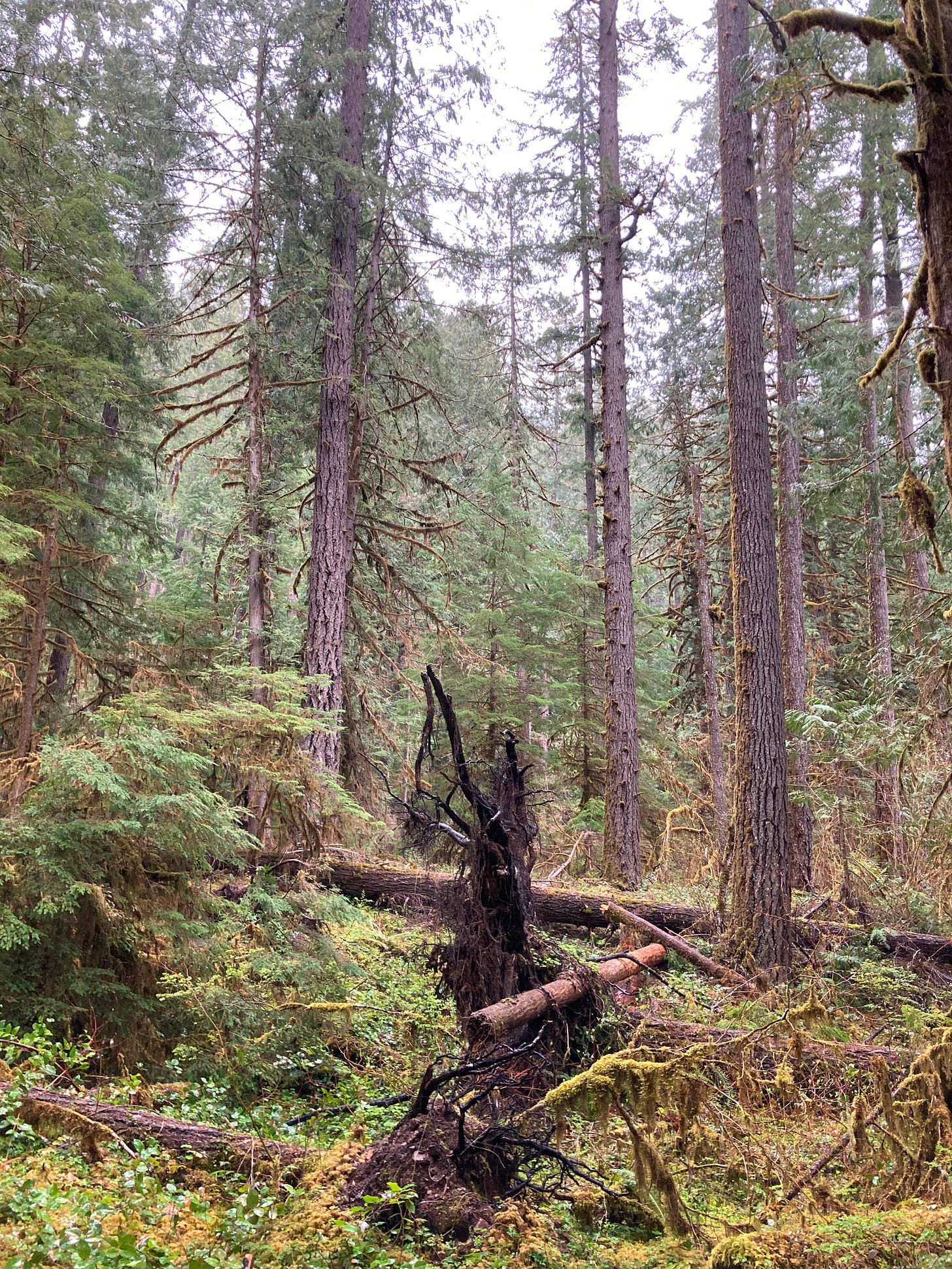
This ancient piece is timely because the Trump administration is currently proposing to eliminate the Roadless Area Conservation Rule, known as the Roadless Rule, that protects the wild places like Zane Grey. I haven’t been back to the banks of the Rogue River for too long, but the Zane Grey roadless area remains the largest of BLM roadless areas in the region that reaches across southern Oregon and northern California, a place where rare plants and animals still find a place to thrive. The proposed rollback would affect Forest Service lands, not BLM lands, but if it proceeds, nearly 45-million acres—nearly a third of the entire national forest system—of undeveloped public backcountry forestland is at risk.
Roads are human inroads to logging and mining, and with them come habitat shattered, water quality compromised, and the loss of pristine areas where more-than-human life can thrive. While reducing fire risk (ie logging) is the government’s reasoning, research has shown that humans on roads start a majority of fires. Losing these roadless areas is also an erosion of the conservation initiative proposed by the late biologist E.O. Wilson to protect half of the Earth’s surface, land and sea, to ensure that biodiversity remains.
This is the challenge with the work of conversation. It remains eternal. Fight to protect places and species, and every win is tentative. Every loss can be forever. Once an old growth forest is slashed, it will be generations before that intricate lace of an place might return, assuming all the pieces of the ecosystem—the northern spotted owl and marbled murrelet above and the Scott Bar salamander and forest sharp-tailed snake below—even remain to return.
And speaking of not harvesting what you did not plant, fare thee well, Wendell Berry. This, also from the pre-computer days when I worked with pen and paper, unable to adhere to Wendell’s steadfastness about resisting the shift to digital:
On the horizon: Feeling ambitious about a story? The Matthew Power Literary Reporting Award, a grant of $15,000 to support the work of a promising early-career nonfiction journalist on a story that uncovers truths about the human condition, will be taking applications in November.
I wish Danica Novgorodoff and I had written a book about climate change that became irrelevant. Quite the opposite.
Others seem to recognize the relevance. The second (paperback) and third (hardcover) printings are arriving to Macmillan soon. And we’re hearing reports of educators already using it in their classrooms, from a college class on resistance movements, where our graphic novel about youth activists sat alongside Gandhi and Adam Hochschild on the syllabus, to a middle-school classroom in Texas, where the teacher said, “There are so many unexpected impactful sections such as the timeline of climate events and the Interlude with world religions. Also, my students commented that the colorful pages are a nice contrast at times when the story feels dark.” We tried to bring the light to the tough but necessary subject of the climate crisis.
Please reach out to us if you’re an educator looking for compelling narrative about climate change that is also deeply researched and fact-checked, complete with Danica’s striking watercolor style that Booklist described as “absolutely perfect for this topic, showcasing both the power of visual comics metaphors and the beauty of the natural world.”
Close to home on Cape Cod, I’ve got two events coming up at my oldest new (newest old?) favorite place, The Old Village Store, in collaboration with the Barnstable Land Trust. It’s been around since the 1880s but is having a revival that includes great food, Guinness on tap, and a slew of live events. My first one, on Sept. 25, is live storytelling event—à la Moth—about survival and understanding in a climate-changed world. I’ll be sharing the stage with my BU MISI fellows from last year: Julia Cumes, Jaelynn Carr and Joanna Davidson. It’s a local redux version of a spring presentation we did in Boston at CitySpace in the spring. Free registration here.
The second event at The Old Village Store is on Oct. 3, when I’ll be in conversation about A Better World Is Possible with Katy Acheson, Executive Director of the Cape Cod Climate Leadership Council. After the talk, Kristie Kapp of Resilient Roots will lead a hands-on workshop to make seed bombs so participants can leave armed to make the world a better place by spreading beauty and life. YAY! Free registration here. [Earlier that day, check out the artist reception for the Julia Cumes & Lipe Borges exhibit, Invisible Threads: Portraits and Stories of Our Global Neighbors, at the Cahoon Museum.]
Between those two events, on Sunday, September 27, co-author Danica Novgorodoff and I will both be at the Brooklyn Book Festival. I will be on an Orion panel with the wonderful authors Maria Pinto and Nicholas Triolo at 11am. Danica will be on a panel for the book at 4pm, and I’ll be at book signings after both events.
Then…off to the West Coast, to that place where the salmon find their way home and I get to cheer. I’ll be doing an event on Orcas Island on Tuesday, Oct. 13. Mark your calendars. More info to come.
Thanks to all those who supported the Climate Ride that Steve and I did in August! Not big bikers, we were super jazzed to have finished our 54-mile, 2-day bike ride in the hilly Berkshires. No small feat when attempting to train on flat Cape Cod with our ole clunkers. I’m vehemently anti-matchy-matchy with S., but I was happy to mutually don our Green Fondo shirts, which we got for raising more than $2,000. The funds went equally and entirely to Earthjustice, Cafeteria Culture (which Rebeca Sabnam, one of the climate youth featured in our book is involved with) and Eco.logic (run by Chicago-based Rozina Kanchwala, who turned us on to this ride and led our fierce and friendly team, the Eco.cyclers). Thank you everyone who chipped in! And, yes, you can still contribute through December if you like.
I’m reading/listening/watching…
The bird migration here in the northern hemisphere is in full swing. Over at Cornell Lab’s Birdcast, you can see them move in real time. At night, I feel the dark skies overhead pulse; in the day I watch the swallows swirl in slow loops south. Since most songbird migration is at night, turn off those (damn) outdoor lights and help them along.
“City of Sweat” Climate journalist Aruna Chandrasekhar and photographer Ishan Tankha recognized the delusion of showing kids swimming to depict heatwaves, a typical visual accompaniment to the legions of stories about heatwaves across the globe this summer. “The impact of heat can be hard to see with the naked eye,” Aruna writes, “let alone capture on camera. But thermal imagery tells a story that ordinary pictures can’t,” which is exactly what they did in Mumbai. Published in Equator, the new magazine about politics, culture and art.
Covering Climate Now has a new Spanish-language bulletin: Radar Clima
Oh, I did love the layered storytelling of Valeria Luiselli’s novel Beginning Middle End. Then luxuriating in her conversation with David Naimon on Between the Covers.
Coda…
Another memoriam. Another loss of a giant. Thanks to Harriet at the Wellfleet book event for turning me onto this one…