When I first launched this Substack, I said something about including pieces from the archives and the moment has arrived when a particular piece holds a new relevance. I also made the comparison that Substack is just the latest iteration of something I’ve been doing in other forms for a very long time. In 2003, that meant creating a zine called rrrrl girlz that I did with my girlfriends out in Oregon. We kept it going for years, sketching and writing and cutting and pasting, creating covers like this:
Looking back on this cover I think about how much has changed. And how little.
No need for me to tell you what the zine was about. We had a manifesto:
And the piece that feels timely is one I wrote about a camping trip to the Rogue River in southern Oregon. Join me…
This ancient piece is timely because the Trump administration is currently proposing to eliminate the Roadless Area Conservation Rule, known as the Roadless Rule, that protects the wild places like Zane Grey. I haven’t been back to the banks of the Rogue River for too long, but the Zane Grey roadless area remains the largest of BLM roadless areas in the region that reaches across southern Oregon and northern California, a place where rare plants and animals still find a place to thrive. The proposed rollback would affect Forest Service lands, not BLM lands, but if it proceeds, nearly 45-million acres—nearly a third of the entire national forest system—of undeveloped public backcountry forestland is at risk.
Roads are human inroads to logging and mining, and with them come habitat shattered, water quality compromised, and the loss of pristine areas where more-than-human life can thrive. While reducing fire risk (ie logging) is the government’s reasoning, research has shown that humans on roads start a majority of fires. Losing these roadless areas is also an erosion of the conservation initiative proposed by the late biologist E.O. Wilson to protect half of the Earth’s surface, land and sea, to ensure that biodiversity remains.
This is the challenge with the work of conversation. It remains eternal. Fight to protect places and species, and every win is tentative. Every loss can be forever. Once an old growth forest is slashed, it will be generations before that intricate lace of an place might return, assuming all the pieces of the ecosystem—the northern spotted owl and marbled murrelet above and the Scott Bar salamander and forest sharp-tailed snake below—even remain to return.
And speaking of not harvesting what you did not plant, fare thee well, Wendell Berry. This, also from the pre-computer days when I worked with pen and paper, unable to adhere to Wendell’s steadfastness about resisting the shift to digital:
On the horizon: Feeling ambitious about a story? The Matthew Power Literary Reporting Award, a grant of $15,000 to support the work of a promising early-career nonfiction journalist on a story that uncovers truths about the human condition, will be taking applications in November.
I wish Danica Novgorodoff and I had written a book about climate change that became irrelevant. Quite the opposite.
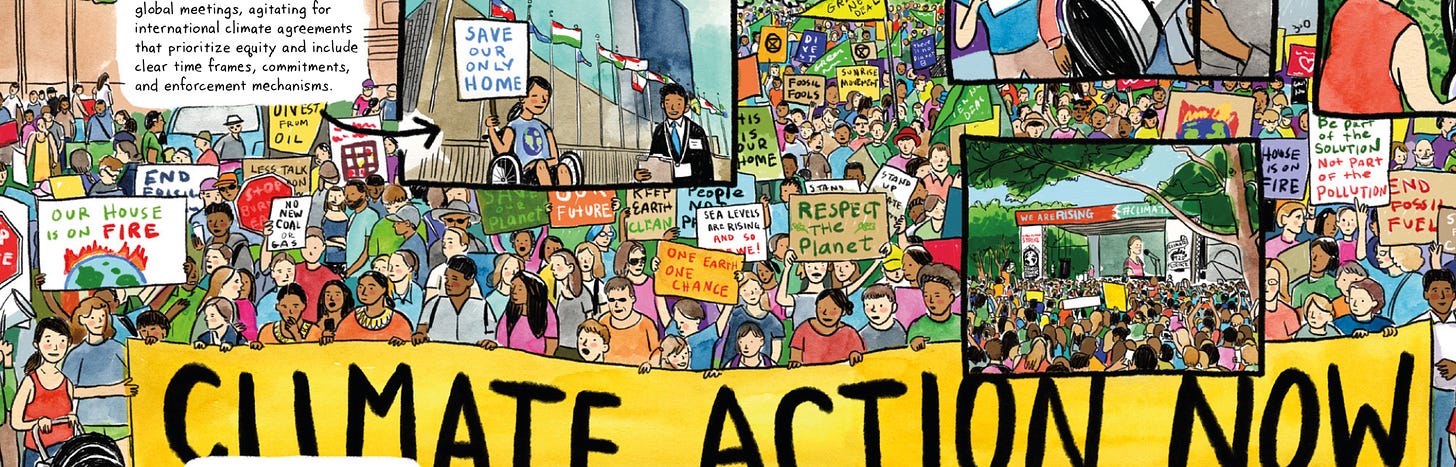
Others seem to recognize the relevance. The second (paperback) and third (hardcover) printings are arriving to Macmillan soon. And we’re hearing reports of educators already using it in their classrooms, from a college class on resistance movements, where our graphic novel about youth activists sat alongside Gandhi and Adam Hochschild on the syllabus, to a middle-school classroom in Texas, where the teacher said, “There are so many unexpected impactful sections such as the timeline of climate events and the Interlude with world religions. Also, my students commented that the colorful pages are a nice contrast at times when the story feels dark.” We tried to bring the light to the tough but necessary subject of the climate crisis.
Please reach out to us if you’re an educator looking for compelling narrative about climate change that is also deeply researched and fact-checked, complete with Danica’s striking watercolor style that Booklist described as “absolutely perfect for this topic, showcasing both the power of visual comics metaphors and the beauty of the natural world.”
Close to home on Cape Cod, I’ve got two events coming up at my oldest new (newest old?) favorite place, The Old Village Store, in collaboration with the Barnstable Land Trust. It’s been around since the 1880s but is having a revival that includes great food, Guinness on tap, and a slew of live events. My first one, on Sept. 25, is live storytelling event—à la Moth—about survival and understanding in a climate-changed world. I’ll be sharing the stage with my BU MISI fellows from last year: Julia Cumes, Jaelynn Carr and Joanna Davidson. It’s a local redux version of a spring presentation we did in Boston at CitySpace in the spring. Free registration here.
The second event at The Old Village Store is on Oct. 3, when I’ll be in conversation about A Better World Is Possible with Katy Acheson, Executive Director of the Cape Cod Climate Leadership Council. After the talk, Kristie Kapp of Resilient Roots will lead a hands-on workshop to make seed bombs so participants can leave armed to make the world a better place by spreading beauty and life. YAY! Free registration here. [Earlier that day, check out the artist reception for the Julia Cumes & Lipe Borges exhibit, Invisible Threads: Portraits and Stories of Our Global Neighbors, at the Cahoon Museum.]
Between those two events, on Sunday, September 27, co-author Danica Novgorodoff and I will both be at the Brooklyn Book Festival. I will be on an Orion panel with the wonderful authors Maria Pinto and Nicholas Triolo at 11am. Danica will be on a panel for the book at 4pm, and I’ll be at book signings after both events.
Then…off to the West Coast, to that place where the salmon find their way home and I get to cheer. I’ll be doing an event on Orcas Island on Tuesday, Oct. 13. Mark your calendars. More info to come.
Thanks to all those who supported the Climate Ride that Steve and I did in August! Not big bikers, we were super jazzed to have finished our 54-mile, 2-day bike ride in the hilly Berkshires. No small feat when attempting to train on flat Cape Cod with our ole clunkers. I’m vehemently anti-matchy-matchy with S., but I was happy to mutually don our Green Fondo shirts, which we got for raising more than $2,000. The funds went equally and entirely to Earthjustice, Cafeteria Culture (which Rebeca Sabnam, one of the climate youth featured in our book is involved with) and Eco.logic (run by Chicago-based Rozina Kanchwala, who turned us on to this ride and led our fierce and friendly team, the Eco.cyclers). Thank you everyone who chipped in! And, yes, you can still contribute through December if you like.
I’m reading/listening/watching…
The bird migration here in the northern hemisphere is in full swing. Over at Cornell Lab’s Birdcast, you can see them move in real time. At night, I feel the dark skies overhead pulse; in the day I watch the swallows swirl in slow loops south. Since most songbird migration is at night, turn off those (damn) outdoor lights and help them along.
“City of Sweat” Climate journalist Aruna Chandrasekhar and photographer Ishan Tankha recognized the delusion of showing kids swimming to depict heatwaves, a typical visual accompaniment to the legions of stories about heatwaves across the globe this summer. “The impact of heat can be hard to see with the naked eye,” Aruna writes, “let alone capture on camera. But thermal imagery tells a story that ordinary pictures can’t,” which is exactly what they did in Mumbai. Published in Equator, the new magazine about politics, culture and art.
Covering Climate Now has a new Spanish-language bulletin: Radar Clima
Oh, I did love the layered storytelling of Valeria Luiselli’s novel Beginning Middle End. Then luxuriating in her conversation with David Naimon on Between the Covers.
Coda…
Another memoriam. Another loss of a giant. Thanks to Harriet at the Wellfleet book event for turning me onto this one…
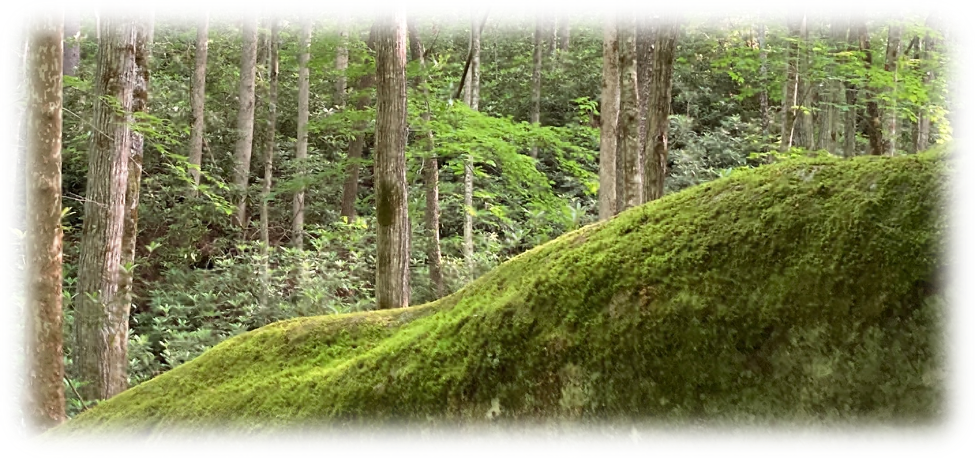
Cumberland Plateau, Sewanee, TN. By Meera Subramanian
It’s my seventh year teaching creative nonfiction at Sewanee School of Letters in eastern Tennessee, drawn back each year by the students so committed to improving their craft, by the stellar faculty, by the very land itself, alive with life. As I developed the syllabus this year, I leaned into two anniversaries, the 250th of this nation and the 20th of the Master’s writing program here, bringing a bit of history into the class to illuminate how the art of creative nonfiction metamorphosizes over time and in response to cultural contexts. What can we learn about craft from some of the best voices of creative non-fiction past and present? What can they tell us about our nation’s history and its relationship to the rest of the world today? What can they tell us about ourselves? Here’s the reading list, with some thoughts…
To get started:
“A Fortnight in the Wilderness” by Alexis de Tocqueville, an appendix to his two-volume Democracy in America (1835 and 1840). The Frenchman is sent by his governmment, along with Gustave de Beaumont, to study America’s prison system, but they go rogue and study all of American society (like James Agee veering from his Fortune assignment and ending up writing Let Us Now Praise Famous Men). “Man becomes accustomed to everything,” he writes, as he documents the felling of the forests and the eternal march west by a “nation of conquerors,” eliminating the native lives that once inhabited the landscape. “What is the life of an Indian?” he asks, seemingly sympathetically. It’s a question that we’ll echo later in the syllabus, when considering a Palestinian child.
How do writers capture the elusive element of time?
“Law of Acceleration” by Henry Adams, which was awarded the Pulitzer Prize in 1919, is a dense piece about how progress hurtles forward (Oh, Henry, if you only knew…). The “volume of coal power may serve as a dynamometer,” he writes, citing how coal output doubled every ten years between 1800 and 1900. Annual coal use had grown to 300 million tons. In 2024… 15 billion tons of coal, and that’s not counting the 18 billion tons of oil and gas.
“In Praise of Idleness” by Bertrand Russell, in which he “advances my own arguments for laziness.” Fuck progress.
“How to Wind the Clock of your Days: Notes on the Nature and Function of Time in the New Millennium” by Bob Shacochis, who reminds us we live in both Big Huge Time and Itsy-Bitsy Time, the chronos and kyros that Jeff Sharlet taught us about when I was in grad school.
What do different forms and structures of nonfiction offer to writers?
“The Fourth State of Matter” by Jo Ann Beard. One of the most brilliant braided essays ever written. Perfectly woven.
“Are We Racist?” by Mira Jacob, to show the power of the graphic novel form.
“Indianapolis” by John Green in his Anthropocene Reviewed podcast, to turn words into breath.
School of Letter Twentieth Anniversary
Sewanee School of Letters… Twenty years so far
A pause in the reading list to share a bit about the SSL 20th Anniversary, honoring what John Grammer brought into being, what Justin Taylor and April Alvarez sustain. Poet Laureate of the US, Natasha Tretheway, gave the keynote. She spoke of the beautiful skills her father, a poet, instilled in her, reading from books, teaching her about metaphor. She valued what she found within bound pages, believed books held truth. And then she told about when she was working her way through the World Book Encyclopedia. Came across the entry on races. Caucasoid, mongoloid, negroid. Measuring her femur and tibia as a girl, trying to figure out how she fit in the world, half white, half black. She spoke about the silences around race that, too often, hold the dominant “Caucasoid” vantage, unable to see people like her, people with more melanin in their skin. It was a perfect set up for the next day….
Students read Ely Green’s original manuscript at the archives. By Meera Subramanian
On Juneteenth, a trip to the University Archives & Special Collections
First two chapters of Ely Green’s Too Black, Too Whitewas the reading assignment, and then a visit to the archives to see the original handwritten manuscript by the bi-racial Sewanee native and hear about how Sewanee is reckoning with its racist roots from Woody Register of the Roberson Project, archivist Mandi Johnson, and podcast producer (and School of Letters Assistant Director) April Alvarez. It was the first time in an archive for many of them. Troves of history and stories and possibilities, many still unprocessed, far beyond the knowledge of seemingly all-knowing Google and AI searches. Go. Touch paper.
“This is Not Who We Are” by Naomi Shaibab Nye, a post 9/11 essay.
How can creative nonfiction writers bridge political divides, chasms created by geography, and other shifts in personal or place-based divisions?
“Compression Wood” by Frank Burroughs, which John Grammer believes Frank read here at School of Letters in its first year. Exquisite piece about how language elevates but also cleaves us from experience, about a friendship that lasts, about how to be from one place and also of another.
“American Grotesque” by John Jeremiah Sullivan
How does nationality shape the stories we tell?
One Day, Everyone Will Have Always Been Against This, by Omar El Akkad, won the National Book Award last year. It was described as “a chronicle of that painful realization, a moral grappling with what it means, as a citizen of the U.S., as a father, to carve out some sense of possibility in a time of carnage.” The carnage he writes about continues. Yesterday, Omar generously Zoomed into our classroom. It was the day after the one that marked a thousand days in which Israel has been trying to bomb Gaza out of existence. Not in (our) news much anymore, what with the Reflecting Pool and all, but the UN has stated that human development in Gaza has been set back 77 years, life expectancy now averages 40 years. So far, an estimated 73,066 Palestinians have been killed, include 21,000 children, a thousand babies. Nine thousand are still missing, likely buried in a place that is virtually all uncleared rubble. Bombings continue, in spite of a supposed ceasefire since October. I’ve written about this book before. It was so good to teach it. To examine the craft of writing into bewilderment and anger, the “scorch marks still on the page,” he told us. “Literature should be a vehicle against loneliness,” he said. He gives voice to all those who believe an unrelenting bombing of a people and blocking of all aid is wrong. Full stop.
We are in stormy times, and I am not just talking about the snow, which blankets the world into chiaroscuro. White men in black are murdering peaceful protesters on the streets of America. Ten shots. At least. We are witnessing, in real time, the deliberate unraveling of a developed nation into something barbaric and backwards. I hold onto two things from the past week. One is the speech by Canada’s PM Mark Carney in Davos, who spoke “about a rupture in the world order,” and beckoned the middle powers to unite against the hegemony. He invoked the Czech dissident Václav Havel and the power that emerges when the greengrocer takes down the propaganda sign of political support that he never believed in. “The system’s power comes not from its truth, but from everyone’s willingness to perform as if it were true,” Carney said, “and its fragility comes from the same source.”
The second shard of light comes from seeing the thousands of people in the frigid streets of Minneapolis. Each one a version of the greengrocer, taking down the sign and revealing the fragility. No more. The statement from Alex Pretti’s parents rings out: “The sickening lies told about our son by the administration are reprehensible and disgusting.” They are not just taking down the sign. They are setting it on fire.
Those of us who write about the climate crisis struggle when our work is to “direct your attention toward the horizon,” as Emily Atkins so eloquently put it in her latest Heated Substack. But, she reminds us, climate change is state violence, too. I think of the “slow violence,” as Robert Nixon coined it, that takes lives far from phone cameras and newsfeeds. This slow violence is not nearly as slow as it used to be. Climate is the undercurrent as the hegemon invades and threatens Venezuela and Greenland in a grab for resources. It’s the water crisis fueling the unrest in Iran, where protesters demand, “Water, electricity, life – our basic right.” It’s the storm covering the country that could be worsened by the conditions created by human-caused climate change.
Still, a new generation is rising into adulthood. People go into the streets to fight for their children’s future, maybe more than their own. It is dark, but we need color. We need to keep looking to the horizon. We need to hold on to the belief that…
Book promotion is tough at times like this, but I’m still hoping you’ll hit the button and pre-order our graphic novel, A Better World Is Possible: Global Youth Confront the Climate Crisis, so when it comes out in a month, you can immediately place it in the hands of a young person you adore. An antidote to everything they are absorbing from the news shaping their young lives. People are saying nice things:
“As this lovely book points out, ‘we don’t have the luxury of time anymore.’ This book is an urgent, helpful, and hopeful portrait of what’s possible when young people come together to fight for a better world.”
~John Green, author of The Fault in Our Stars
“Novgorodoff’s watercolor style is absolutely perfect for this topic, showcasing both the power of visual comics metaphors and the beauty of the natural world.”
~Booklist, starred review
“A heart-warming and planet-cooling book about how change happens–anyone reading this will be much better prepared to help in the fight for the planet’s future.”
~Bill McKibben, author of Here Comes the Sun
When does the idea of a book begin? Artist Danica Novgorodoff began thinking about a graphic novel for young adults about climate change many years ago. I joined her in 2020, when I reconnected with Danica at a book event of our mutual friend, Jeff Sharlet, on the eve of the pandemic shutting down world, and we decided to team up. But in some ways, seeds in my mind were planted lifetimes ago, maybe at the base of the maple tree in my front yard as a kid, or in the duff of Oregon’s old-growth forests, or on the streets of Seattle during the 1999 WTO protests.
The response to crisis is to gather. Find others. “We take care of each other,” as an elder in Alakanuk, Alaska told Emily Raboteau. Collaborating with Danica over the past handful of years and immersing myself in the stories of the four climate youth we feature in the book—Jamie Margolin, Xiye Bastida, Shiv Soin and Rebeca Sabnam—has kept the light on for me, added color to my concept of a future.
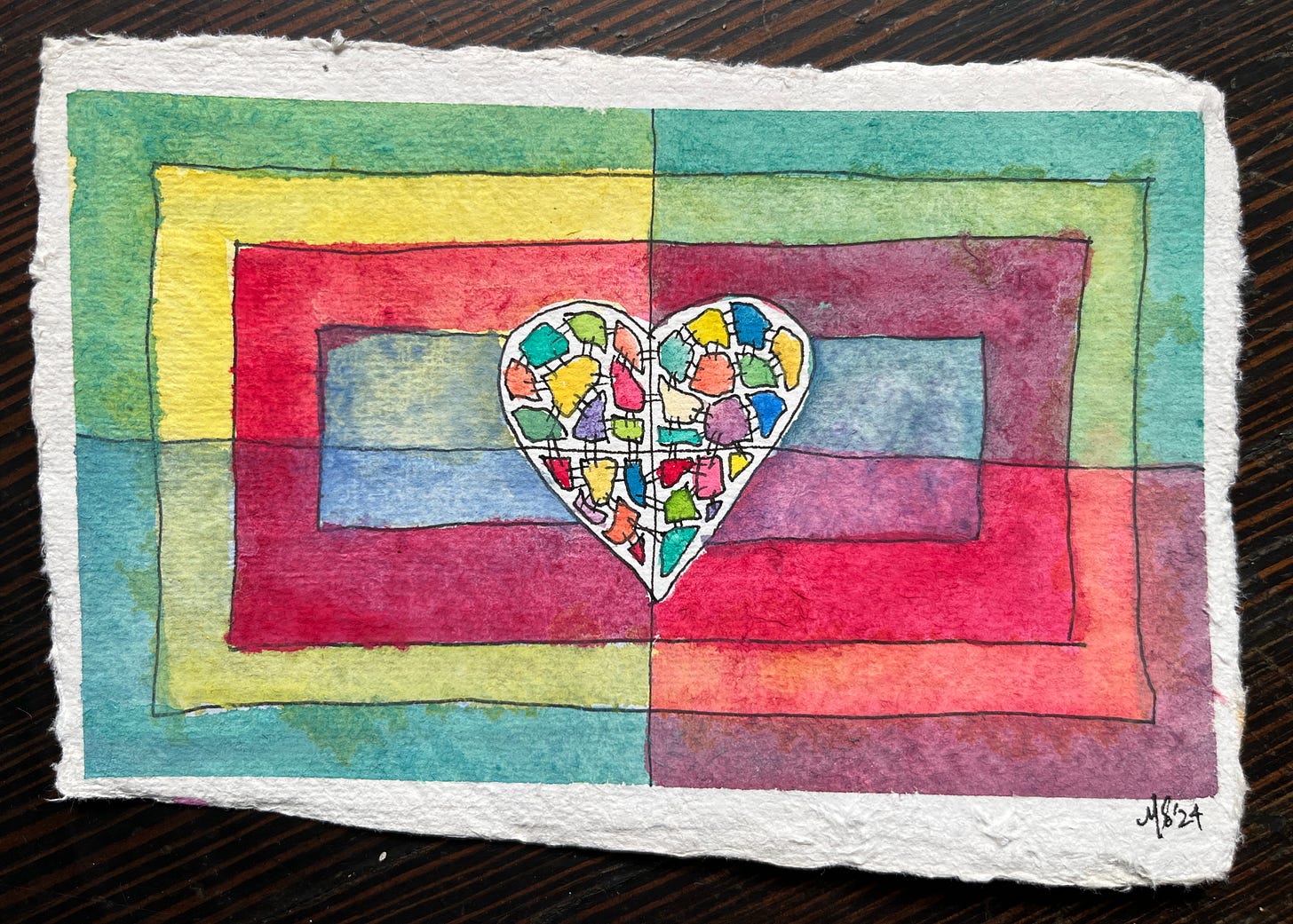
The process brought back the joy I felt when I did a zine with girlfriends years ago, back in Oregon, before the internet changed everything. When our collective of “city babes and country chicks with shit on their minds” stayed up late with pens and scissors and magazine clippings from the 1940s and a commandeered copy machine to be creative and map out the world we wanted to live in.
In these dark times, keep fighting the powers that be, find the slivers of light and bursts of color, gather with your comrades, and make the world you want to inhabit.
Journalists & writer friends, take note…
Come study with me. I have the great good fortune of going to Sewanee, Tennessee each summer to teach creative nonfiction for the School of Letters MFA program. The setting is stunning, and the community that forms when you bring together talented faculty and just the right number of students creates a certain alchemy where good writing emerges. Feel free to DM me or director Justin Taylor to learn more. Rolling application.
Mid-career journalists: applications now being accepted for the University of Colorado Ted Scripps Fellowship. You can spend a year in stunning Boulder, taking classes to deepen your understanding of environmental issues. Oh, also, get paid $80,000. I’m on the Advisory Board and this is truly an amazing opportunity. Deadline: March 1
The Institute for Independent Journalists, founded by former Knight Science Journalism Project Fellow Katherine Lewis, is having its 2026 Freelance Journalism Conference March 5-6, a “conference for independent journalists and creators to find community and build thriving businesses.”
Introducing the Science Reporting Navigator from the good folks at The Open Notebook. Believing “every story is a science story,” they partnered with Relief Applications and designed a resource to help reporters who might not always be on the science beat get quickly informed. Here you can find dozens of short lessons within ten topics, such as “how to find scientific sources,” “how to navigate scientific data,” and “how to critically evaluate claims.”
To balance most of my days, which revolve around the above, escaping into a novel is requisite. I thoroughly enjoyed the messages of loss, letting go, and transformation in Emily Habeck’s debut novel, Shark Heart. It’s a bittersweet love story that emerges when a newlywed couple faces a diagnosis: the husband is turning into a great white shark. Also, the wife makes friends with a woman pregnant with twin birds.
I saw the magnificent documentary Folktales at the Woods Hole about a traditional “folk school” in the Arctic wilds of Norway. The relationship between the struggling kids, their teachers and the sled dogs is breathtaking. It’s the visual version of Blair Braverman’s excellent memoir, Welcome to the Goddamn Ice Cube.
Coda…
With things on land being dire these days, I have been holding on to images of water during meditations (and three-in-the-morning-try-to-get-back-to-sleep moments). So I found this video of remoras enchanting, hypnotic. Imaging clinging, (how?!), steadfast, to the back of a humpback whale, and then—just at the moment she is about to breach—releasing yourself, racing along ‘til she returns to the water. Then, reattaching. Like skipping rope. Underwater. At speed. There’s a metaphor there, of holding on, of letting go, and holding on again. Steadfast.
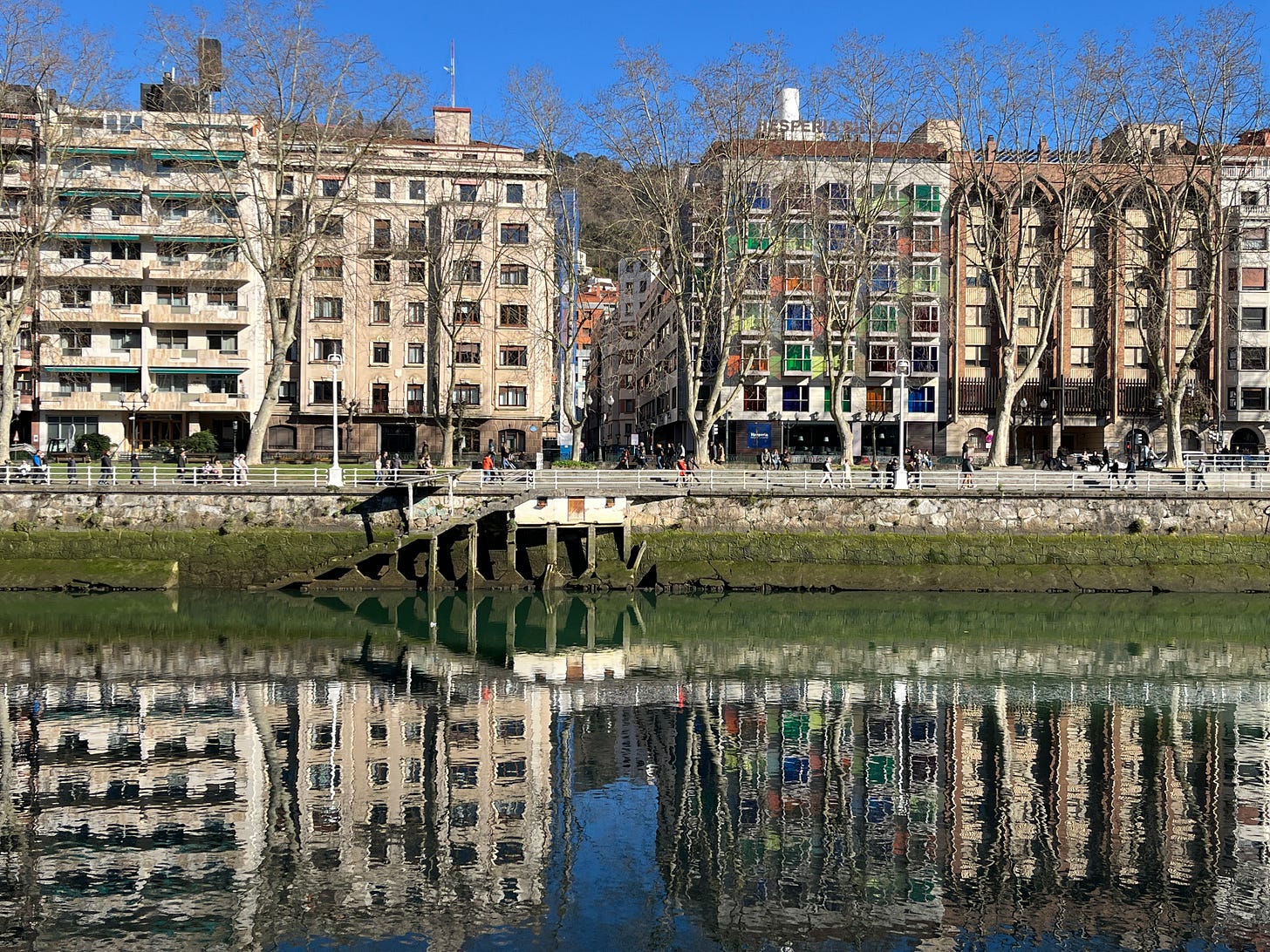
Peregrinations are underway. I’m more than two months into my FRONTIERS fellowship, the first half of which was spent in Bilbao at the Basque Center or Climate (BC3) Change. I came here with the question: can renewable energy projects be built in a way that’s better for biodiversity, people, and place?
It’s complicated.
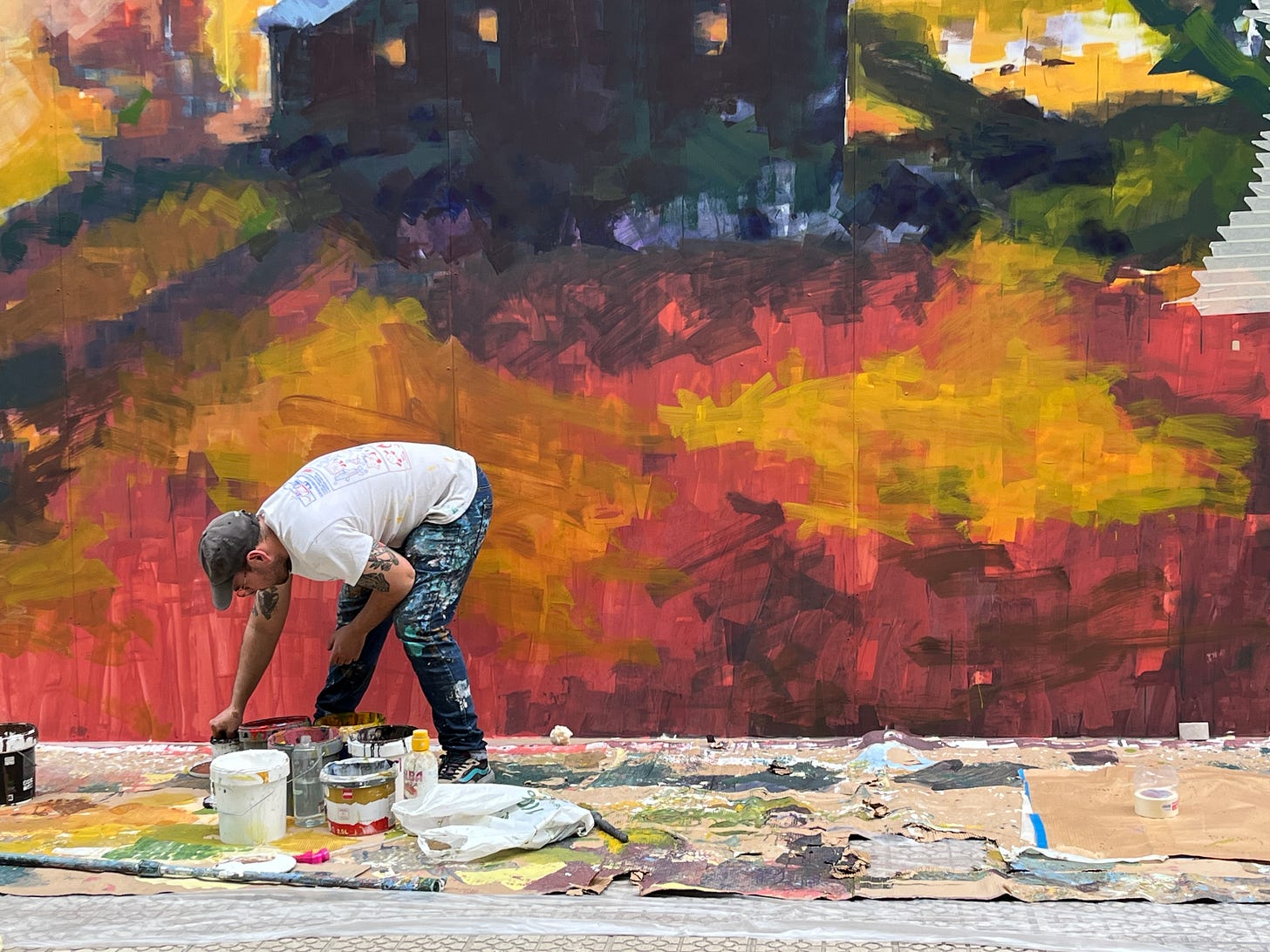
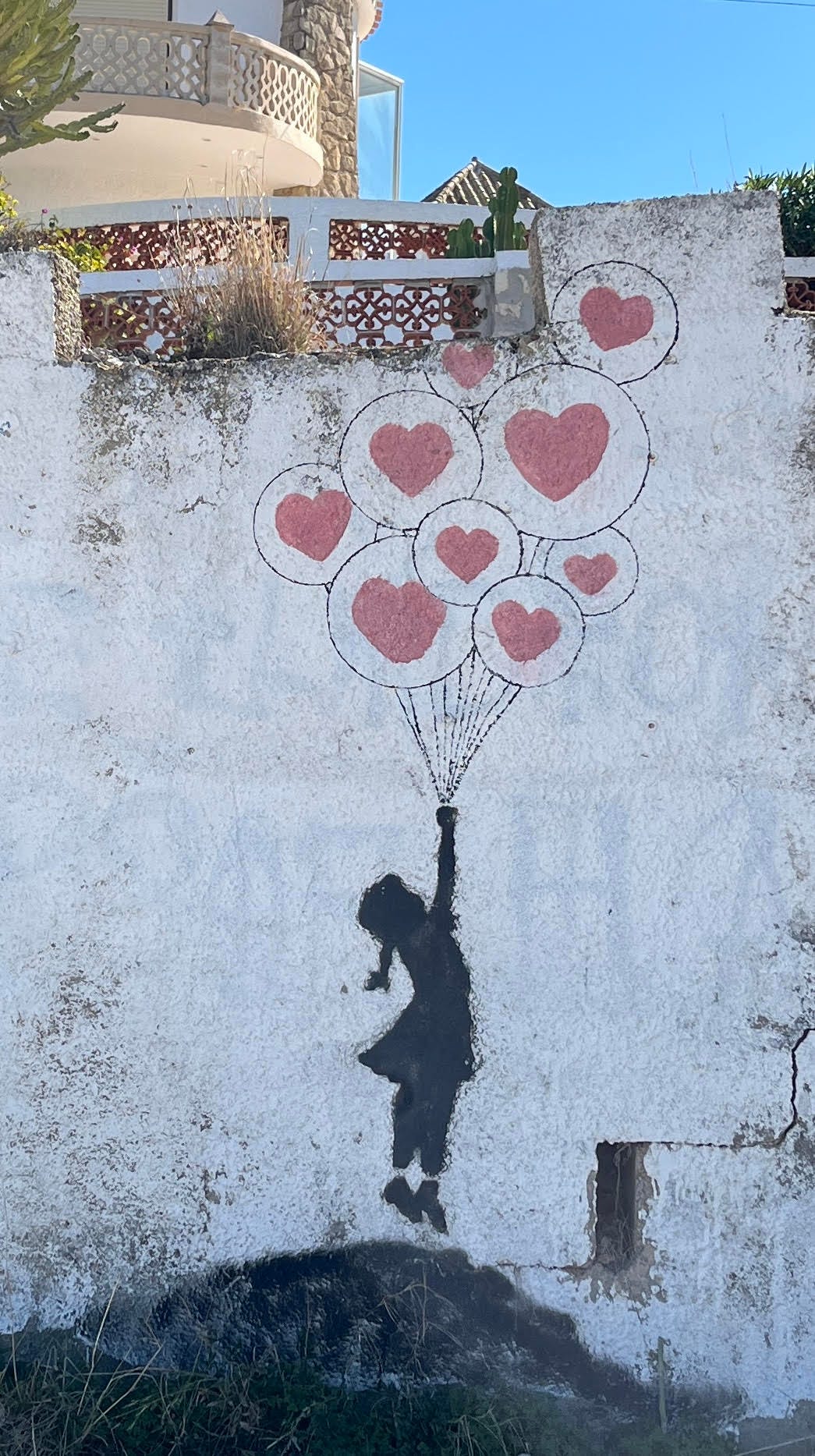
But like the muralist I caught mid-stream as he transformed a construction blind into a work of art, it takes layers of paint, layers of understanding. I’m thankful for the FRONTIERS grant to have the time to keep digging. The researchers at BC3 helped give me a crash course in understanding the renewable energy landscape, and I’ve been busy conducting dozens of interviews, in Spanish and English, with BC3 staff as well as people all over Spain and in France. They’ve included researchers in agrivoltaics, ornithology and environmental conflict; organizations such as Greenpeace, Eudemon and Renewable Energy Foundation; political representatives such as mayors of small towns with renewable energy projects; reps from renewable energy companies; and many others.
When I arrived in Spain, Biden was still president. A week later, he wasn’t. Nowhere is far enough away from the new president’s wrath. BC3 researchers lost US partners when funding was frozen. A cousin lost his job in Bangkok related to USAID. A friend lost a year’s worth of climate work on New Jersey organic farms. A niece’s new position at NOAA as a fledging applied ecologist feels tenuous. But also, my stepdaughter, who is an environmental lawyer for Earthjustice, was part of the team that just sued Trump and the USDA to release IRA funds that were contractually promised and are now frozen. The lawsuits against the administration are piling up.
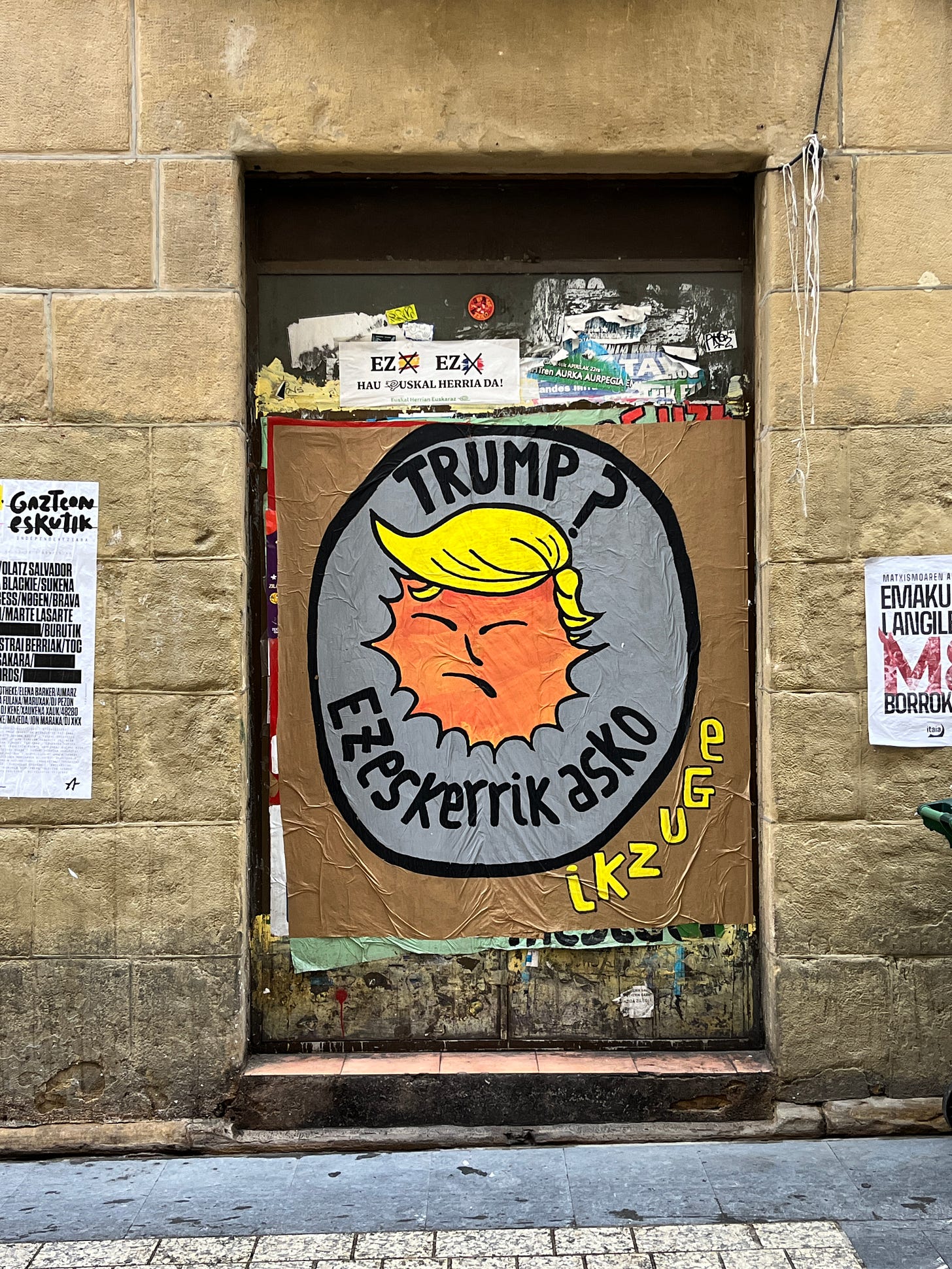
Here in Europe, the mood is jittery. (Also, I am fielding the repeated baffled question/accusation: how could you Americans have voted him in … again?!) I attended The Climate Agenda in the New European Legislature and Its Impact in the Basque Country, an event in Bilbao on January 31, when the wrecking ball was taking its first wild swings. Panelists included local politicians and journalists from other parts of Europe, offering a lens into the dynamics and tensions around renewable energy, especially in the wake of the inauguration of Donald Trump. Europe is readying itself for … well, just about anything. There is the tension between the desperate need to ramp up the clean energy transition to achieve energy independence butting against the need to divert resources to build war chests. Bolstering nuclear power keeps coming up. So does resistance:
Spotted on a wall in San Sebastian, a play on an anti-nukes image, “Nuclear power? No thanks,” in Basque. Photo by Meera Subramanian.
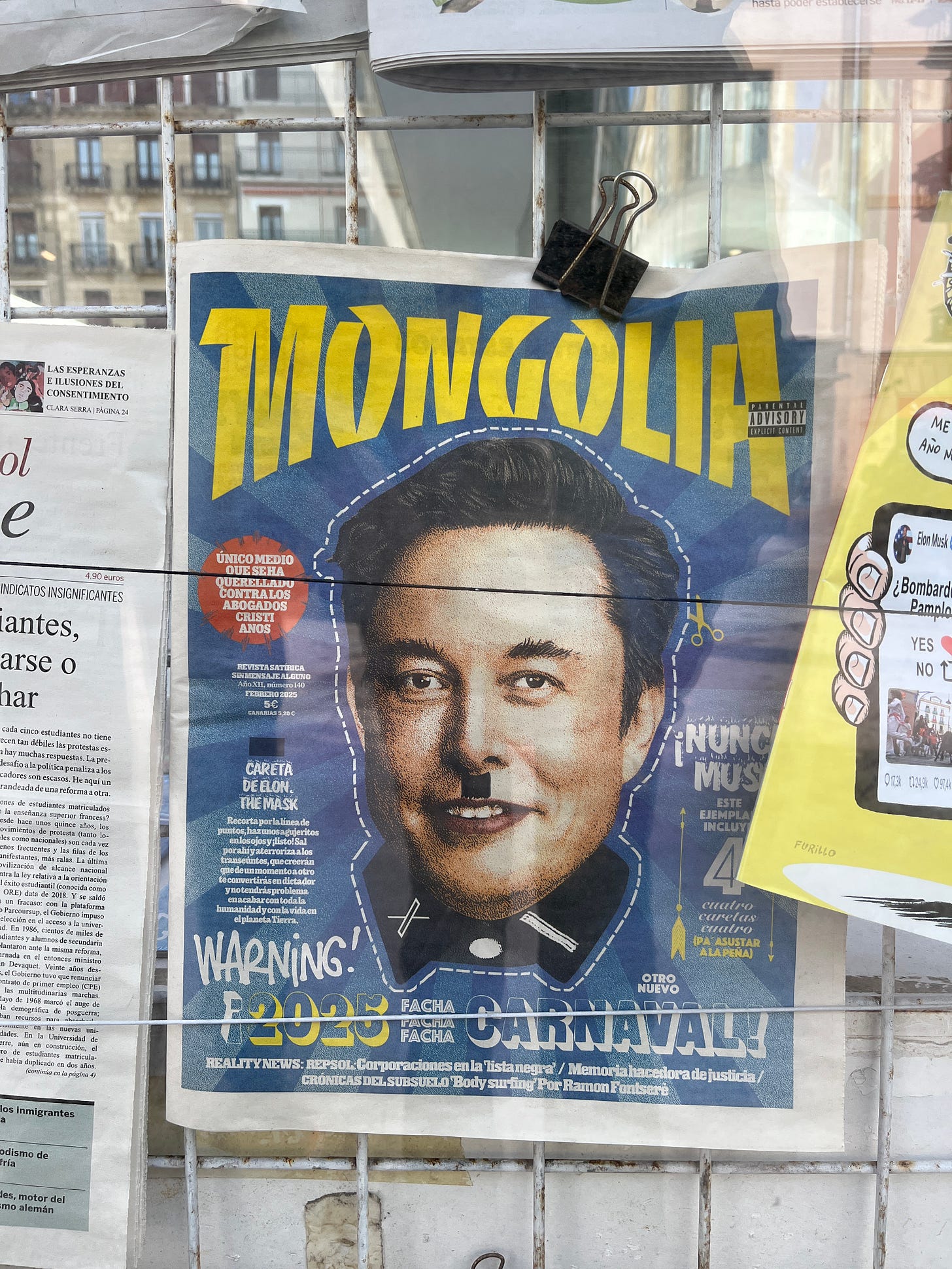
Also spotted at a news stand:
Photos by Meera Subramanian.
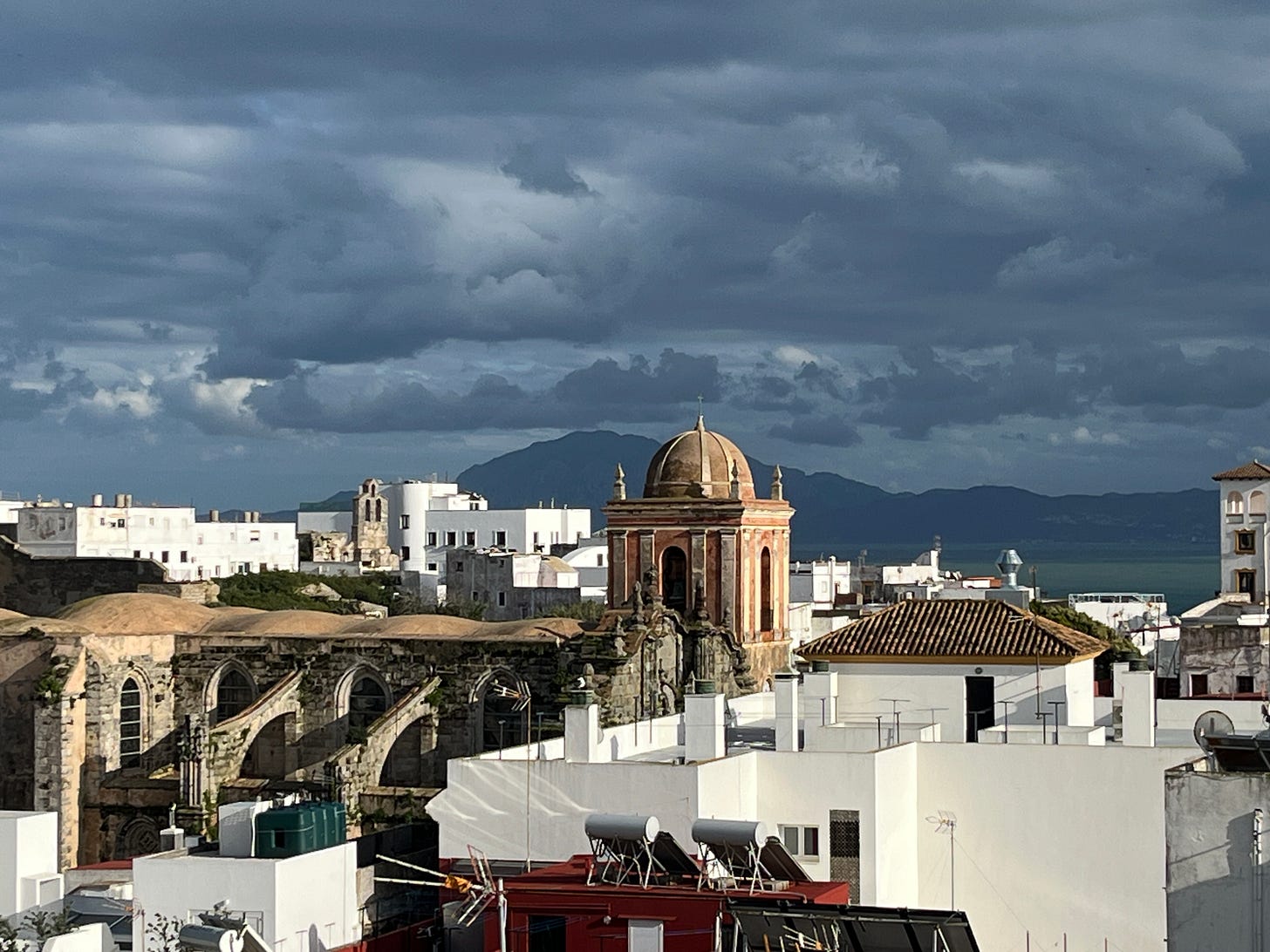
But I could only do so much from Bilbao. I’m spending the second half of my time here reporting, going to see solar and wind farms that are trying to do things better for birds and farmers and towns. Now, I write from Tarifa, the southernmost tip of Spain, a windy passage where Europe meets Africa, the Atlantic Ocean meets the Mediterranean Sea. It is difficult to concentrate on the screen, because I’ve come here to look at the sky, the bird migration just beginning. Wind turbines spin behind me up the hillsides of Spain, as well as across the waters of the Strait of Gibraltar, atop Morocco’s mountains. It’s a slalom course for migrating birds, but I’m here to see the efforts to lessen the impact.
Tarifa, Spain, looking across the Strait of Gibraltar to Morocco. Photo by Meera Subramanian.
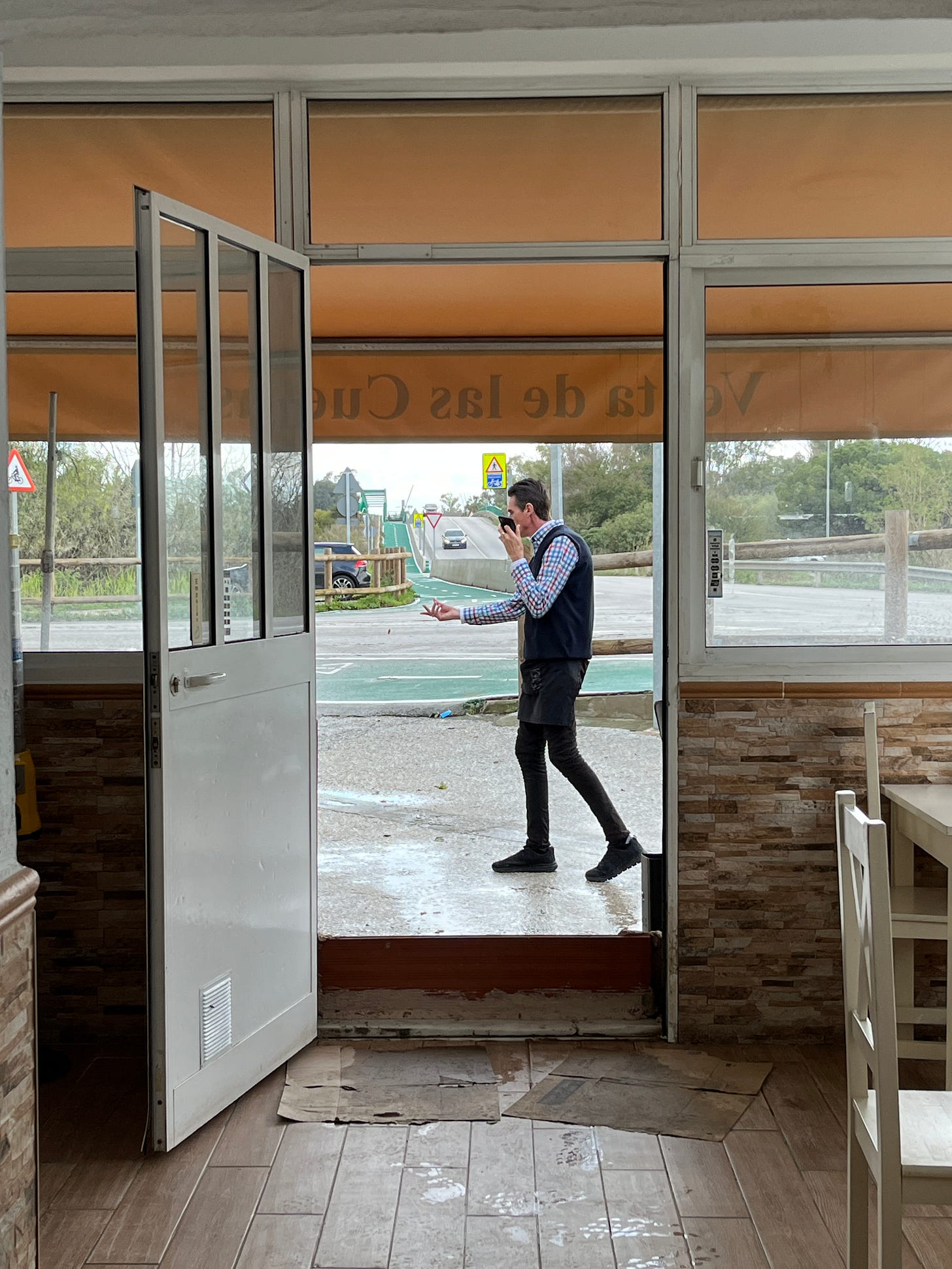
I am thankful for a moment of sun. Andalucia, like most of Spain, has been under a deluge of rain. So much that I couldn’t make it to some of the solar farms on my itinerary, so mired they were in mud. The rain is good, in some ways, needed to alleviate a drought, but it’s also coming too quick, too much, rivers rising. Causing a different type of jitters, with the Valencia floods that killed hundreds last fall still in close memory. I stopped in a cafe for a quick coffee and had to step over the barrier constructed to keep out the rain. It wasn’t enough. The man who passed me a steaming cafe con leche said that, a week and half ago, the place was filled with a half-meter of water. Too early to attribute these weeks of rain to climate change, but it fits the pattern of more extreme weather. More drought, followed by heavier, more intense rains.
Blocked threshold to keep rain out. Photo by Meera Subramanian.
One can only hope that the lush green of this wet spring’s growth is not fuel for wildfires of the future. And that the stories I’m finding offer models that can be implemented—quick! now! yesterday!—to get off fossil fuels and onto clean energy sources in a way that doesn’t cause greater harm or collateral damage. Stay posted for more stories to come.
Journalists & writer friends, take note…
Orion Environmental Writers Workshop Join a community of writers, improve your craft, and reimagine how you think about nature. March 15 (today!) for early bird tuition rate.
Covering Climate Now is offering a free training program aimed at helping newsrooms grow their audiences by telling the climate story better. Check out trainings on offer: Climate Journalism Training Catalog.
Dart Center forJournalism and Trauma, the C.A.R.E.S. (Connecting Audiences, Reporters, Emotions, and Sources) Media Initiative is conducting research to better understand the resources that journalists on the climate/environment beat need to do their work. Take a moment to do this survey.
NYU Stern Climate Economics Journalism Fellowship will bring a group of journalists to NYU Stern’s Greenwich Village campus, September 18–19, 2025, to learn from globally recognized experts in the emerging field of climate economics. Open to new and experienced journalists (staffers and freelancers) covering the interface between climate and the economy. Here are details and application.
And from the Department of Good News…
Illustration by Danica Novgorodoff
A Better World Is Possible, a nonfiction YA graphic novel I’ve been working on with the talented illustrator Danica Novgorodoff is working its way to publication (First Second, 2026). It reveals the pressing danger of the climate crisis through the stories of four youth climate activists who demonstrate the potential of teen power. I’m excited to announce that I received a Grant for Creative Individuals from the Mass Cultural Council that I’ll be putting towards helping this book find its way into the world. THANKS, MCC!
I received the Staige D. Blackford Prize for Nonfiction for my piece about the decision to donate a kidney, published in the Virginia Quarterly Review last fall. This feels deeply full circle; VQR was so generous to honor my piece about India’s vultures with this prize back in 2011. I was only a few years out of grad school, I hadn’t done any truly long-form, and VQR editor Ted Genoways took a chance on me. When that prize happened, it transformed the trajectory of my struggling freelance life. Truly. To receive the prize again, after all these years, for this piece that felt so risky in a completely different way, is the deepest of honors. Thanks to editor Paul Reyes and the whole VQR team.
And I’ll be back in the US soon, for better or worse, in time to give a talk about South Asian vultures—their monumental decline and the efforts to bring them back—for the Brookline Bird Club, April 25, at the Harvard Geological Lecture Hall. In person and on Zoom. More details to come.
I’m reading…
To keep my reading mind in Spain, there’s been Ben Lerner’s Leaving Atocha Station, which exquisitely captured the hungry creative young mind as he makes an infinite number of poor decisions, and I’m midway through Carlos Ruiz Zafón’s Shadow of the Wind.
I listened to The Buried Giant, by Kazuo Ishiguro, at the recommendation of my (former) Orion editor, Sumanth Prabhaker. As our own country tumbles towards civil war (slowly, but quickening, according to Jeff Sharlet), I found this exploration of memory and forgetting—when is it necessary to wipe one’s mind clean in order to live in peace?—haunting. And, in spite of there being dragons and knight errants, it reminded me of similar themes explored in Severance, which I am totally hooked on.
Erica Berry’s book Wolfish was a brilliant exploration of fear and wildness, and her new piece, “The Fault of Time,” in Emergence, is equally captivating. Here’s her Substack.
I found “The End of Children” by Gideon Lewis-Kraus in The New Yorker fascinating and as troubling as it was intended to be. It explored so many facets of the transformation underway, but I also wanted more about the infertility that may be linked to environmental factors, and also the hesitancy I have heard many younger people express about bringing children into a world increasingly ravaged by climate change and other environmental disasters. Still very much worth a read.
And I’ll wait to buy Sewanee School of Letter’s colleague Tiana Clark’s new book of prose poems, Scorched Earth, in person from her this summer, but I had the pleasure of hearing her read some her work in the past. You don’t have to to wait. Available at all the good places (and the bad places, too) where you can buy books.
I leave you with this, pure joy and delight of a song sung in public, crammed in a narrow alley of Old Town, just last night. The rains cancelled Carnaval in Tarifa last week, but they’re happening this weekend. The town is all dressed up. People don themed costumes with their friends and families that are about not about your single individual uniqueness, but about what you can create in concert with your community. I couldn’t catch all the lyrics of this long song, but it seemed a ballad, each stanza ending with a punchline that made the crowd laugh and led to the next round of the story. I’ll have bum-bum-bum-bum-bum running through my head for days, making me smile each time. Hope it’s contagious.
Sentiments can be lost in translation, but also found. I’m out of the US but its mess spreads across the globe like its carbon emissions. The absolute least of it is was sitting in a cafe eating tortilla española and cringing as our new old president declared Spain is a BRICS nation (it isn’t). The most of it is hearing from friends and family about direct impacts: jobs lost, projects frozen, students with questionable immigration status disappeared. Last week, I stood with an Austrian woman and when the subject of our state of affairs came up, both of us speechless about the chaos the 47th has unleashed in a baker’s dozen worth of days, she said, of the country or the man, I’m not sure, that it’s “out of order.”
“Yes, yes! That’s the perfect phrase,” I exclaimed. “I’m going to use that.” And so here we are.
As I walked home afterwards, a woman alone, after midnight, feeling totally safe on the streets of Bilbao even as I walked through a group of a dozen men (oh, the sweet relief of not having cortisol continually coursing through one’s body; consider the whales; consider immigrants now being rounded up), I tumbled the phrase “out of order” around in mind. Out of order can mean broken, nonfunctional. It can indicate an experience of tumult and bedlam. It can also mean when someone steps of out of line, and acts in ways that are socially, ethically, morally improper. With the Austrian woman’s three words, she’d spoken a triple entendre.
To process this moment, I’m alternating between Jeff Sharlet’s Scenes from a Slow Civil War and Katharine Hayhoe’s Talking Climate, somehow finding solace in simultaneously recognizing how bad things are and how good they could be. Be? Maybe? Ayana Elizabeth Johnson reminds us to act locally. My form of protest is to dig deeper into my FRONTIERS fellowship work based at BC3, trying to understand all the dynamics at play in the efforts to shift our energy systems to cleaner forms of wind and solar, something that will continue to happen regardless of the white man in the White House. It’s led me to encouraging conversations about agrivoltaics in France and energy companies that build in community funds voluntarily, but also to a recurring and troubling story of conflict—a chasm between the rural and urban populations of the world—identical to what I’ve experienced in America, especially when I reported on conservative perceptions of climate change for Inside Climate News. I also attended an event, La Agenda Climática en La Nueva Legislatura Europa y su Impacto en Euskadi, The Climate Agenda in the New European Legislature and its impact in Basque Country. And we were right back to the impacts of the global shift to the far right. A sense of nervousness, geopolitics shaky, and the hope that energy independence in the form of renewables can be a part of regional security strategies.
Sweet dreams & flying machines…
There was also, last week, the horror over DC skies. Someone I love deeply and dearly has lost someone they love deeply and dearly in the unspeakable plane crash that ended in the Potomoc. She asked me for hard-won advice, knowing I have lost friends, this one, and this one, and others. Words fail, but I say something about letting the grief come when it will, to not fight it, to let it wash over you when it appears urgent and unexpected, even months, years, down the road of recovery. No, not recovery. Something else. Love and loss burnished into your being. But now the grief is immediate, and the only thing to do is take the unbidden reminder that life is short, precious. Love big. Hold loved ones close. Tell them. This is the other way we can act locally, in our most intimate lives.
Keep notice…
As I’m exploring this new place, I’m searching for slivers of joy amid all this grief and allowing myself moments to recognize them. I found one, as the sun broke through the relentless clouds of Bilbao, of the news, on Friday afternoon, when I finally made it up Etxebarri Parkea. Once a factory site that has been transformed into a park overlooking the city, its tall smokestack is a reminder of what once was. There was a pond created to support birds and critters, and a skate park for humans to play.
When I walked by the skate park, I noticed two men on skateboards, then I noticed that one was much, much older than the other. I was intrigued. Circled around the park and returned to watch him as he made a smooth steady run across the shallow end. Then, as the younger skater was leaving, the older one recruited him to help him summit the last lip of his run. “Come help me,” he said. “Stand here, with one foot here and the other there, and then when I come up, take my hand.” The young man did exactly as told. They tried it 5-6 times, and the older man never quite made it. Except that, well, he’s already made it, right?
I took a picture of them both, then handed my phone to Nico, the 26-year-old German so he can forward it to himself. And Juanjo is telling us he’s famous. “Google me!” he instructed, and indeed there he is on YouTube and TikTok. He is 87 years old, older than ages of the young skater and me, combined. Some lives are unfairly cut short. Others are long, and embraced by the bodies that contain them.
Journalists & writers friends, take note…
For rising juniors and seniors pursuing journalism, consider applying to the Opening Doors, a new initiative aimed at increasing diversity in public media newsrooms. The two-year program will provide skills training, mentorship, and paid internships for ten BIPOC journalism students, with a focus on science, health, and economics reporting. Apply here.
The Uproot Project Fellowshipoffers funding to seven journalists to pursue reporting projects over the course of a year. Fellows will receive up to $2,000 to cover travel and other reporting expenses for their fellowship project. Learn more about the Uproot Project Fellowship and find this year’s application here. Deadline: 11:59pm on March 1, 2025
And to connect with poets who are using their art to face the climate crisis, check out the Hellbender Gathering of Poets, run by my friend and Sewanee colleague Nickole Brown. They’re gearing up for a fall gathering and having inspiring events along the way.
The Matthew Power Literary Reporting Award is a grant of $12,500 to support the work of a promising early-career nonfiction writer on a story that uncovers truths about the human condition. Matt was one of those dear friends we lost way too early. Deadline: Feb. 19
I’ve crossed a border into Spain, and we’re all crossing tipping-point thresholds, too many to count. We’ve passed into 2025, already a quarter into this no-longer-new century of this still-quite-young millennium, and it took mere weeks before wildfires were consuming entire communities in southern California and floods making people flee their homes in Malaysia. Tomorrow, we pass into a new American administration that will make these stories even more frequent as we catapult into a future that feels all too tenuous. Still, still, I repeat like a mantra, it’s not too late, it’s not too late. See Katharine Hayhoe’s great recap of 2024 with lots of good actionable information to carry with you into the new year. She also offered a reminder that although we did indeed pass an entire year having crossed the threshold into a world 1.5 degrees Celsius warmer than pre-industrial times, we’re still not there in terms of the ten-year average that will mark our true failure to reach the goals set at the Paris Climate Accords. If thinking about the future feels daunting, I get it. Britt Wray has changed her Substack’s name from Gen Dread to Unthinkable, also the name of a new climate-mental health platform that has a host of resources for taking care of yourself. Check them out and repeat after me, it’s not too late, it’s not late…
Art has been my solace and fuel since the election. There was the antiquarian book show, where we witnessed the longevity of the written word. And a Georgia O’Keefe – Charles Moore exhibition at the Boston Museum of Fine Arts. O’Keefe, whose work I’ve loved since I was a child, was “most interested in the holes in the bones—what I saw through them—particularly the blue from holding them up against the sky…they were most wonderful against the Blue—that Blue that will always be there as it is now after all man’s destruction is finished.” A perfect thought for this particular moment of beauty and terror.
Not all stories need to be told. I held on to one closely since 2018 and then, last year, something shifted. Maybe it was hitting a five-year mark. Maybe it was being immersed in the writerly world of Sewanee School of Letters, where most summers I teach creative nonfiction atop the verdant Southern Cumberland Plateau in eastern Tennessee, drowned in cicada song. In the classroom, I was asking my students to take risks, to be brave, to put blood on the page. Could I?
And so I began to pull from journals and letters, audio recordings and pictures. All to track the arc of a friendship that began, well, here’s how the piece that emerged begins:
We were two women on either side of thirty throwing punches at one another’s faces in a concrete stairwell abuzz with florescent light. Our instructor showed us how to make a fist (thumbs on the outside), take aim, and put our weight into the shot. I threw punches at her first. She was younger than I was by a handful of years and just as racially ambiguous. Then it was her turn, and I jerked my head to the side to dodge impact, heard the whoosh of fist through air. Fight Club for girls. New York University. Coles Rec Center, 2004. Fourteen years before the surgery.
“A Measure of Gratitude,” just published in the fall issue of the Virginia Quarterly Review, is about the power of female friendships and the burden of gratitude. It’s about sickness and health. The prospect of dying and the act of living. It’s about seeking and hoping and letting go and finding. There is cancer, the swapping of body parts, Peter Singer, the Bhagavad Gita, and bluefish, cooked up with cracker crumbs as new love blooms.
What would you sacrifice for a friendship? This Peregrinations post is public so feel free to share it.
And in some strange way, it’s about how to respond to events like what happened last week at the American ballot box and what will happen in the years to come. How unraveling on the outside can sometimes lead to clarity within. Another snippet from the piece:
Michael waited for my answer. I considered my deepening cynicism, my daily grief. We had a madman scheming in the White House. People were scaling up their assaults—on fellow humans, other species, entire ecosystems, the planet. The world I loved was aflame and the fire spreading. I looked at Michael. “I want to see more good in the world,” I heard myself telling him, “so why not do something…good?” It suddenly seemed achingly simple.
I hope you’ll make a nice cup of tea or pour a glass of wine, put your phone into silent mode, and take the time to read “A Measure of Gratitude.” Maybe afterwards, you’ll decide to dance, or kiss someone, or call up an old friend.
Thanks for reading Peregrinations! Subscribe for free to receive new posts and support my work.
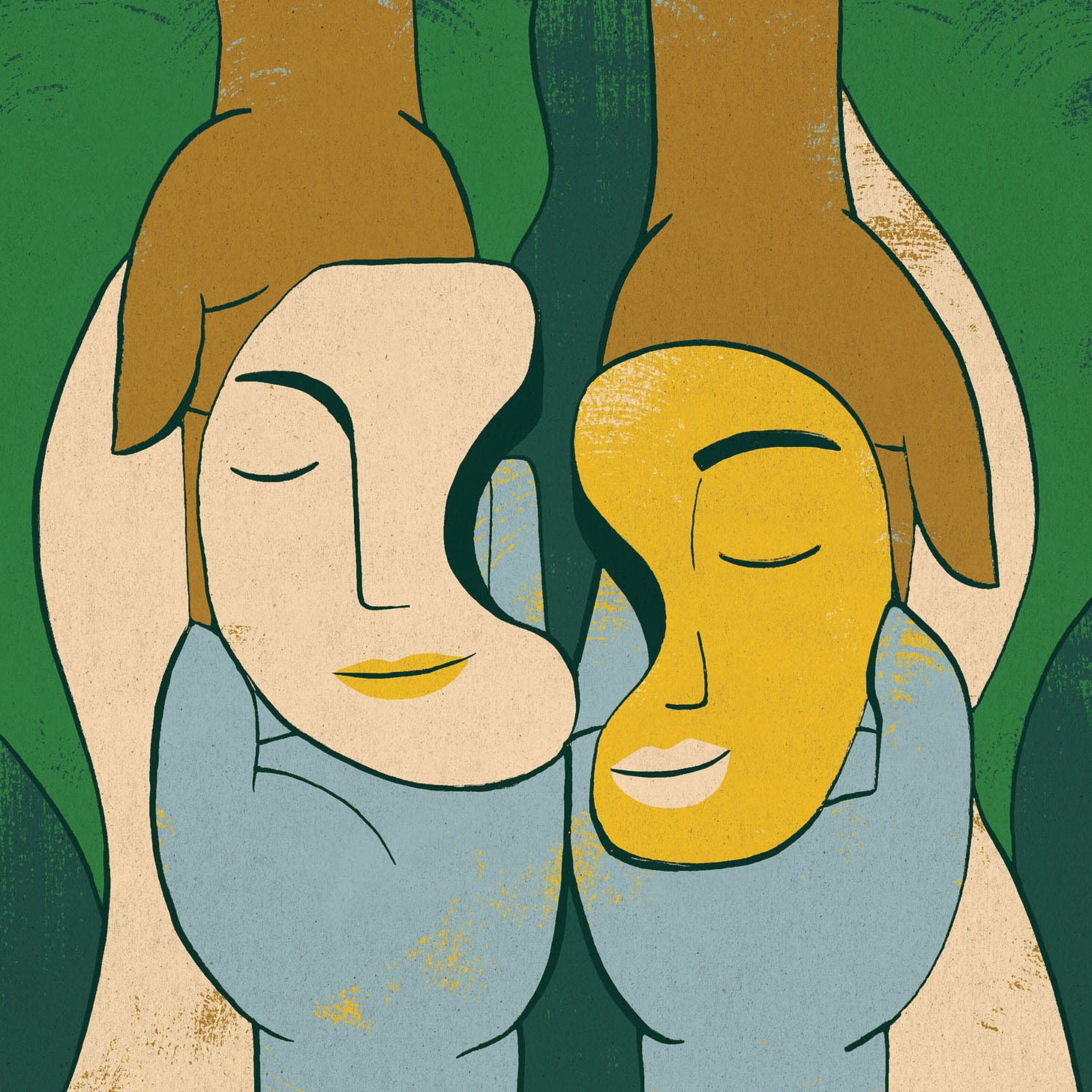
It was a pleasure and honor to once again work with the brilliant editor Paul Reyes at VQR, an ad-free, just-shy-of-a-century-old, award-winning literary magazine that I hope you’ll consider subscribing to so it may exist for another ninety-nine years. And the commissioned illustration by artist Hanna Barczyk is just perfect.
Not all stories need to be told. But, taking a deep breath, I’m glad this one is finally out there.
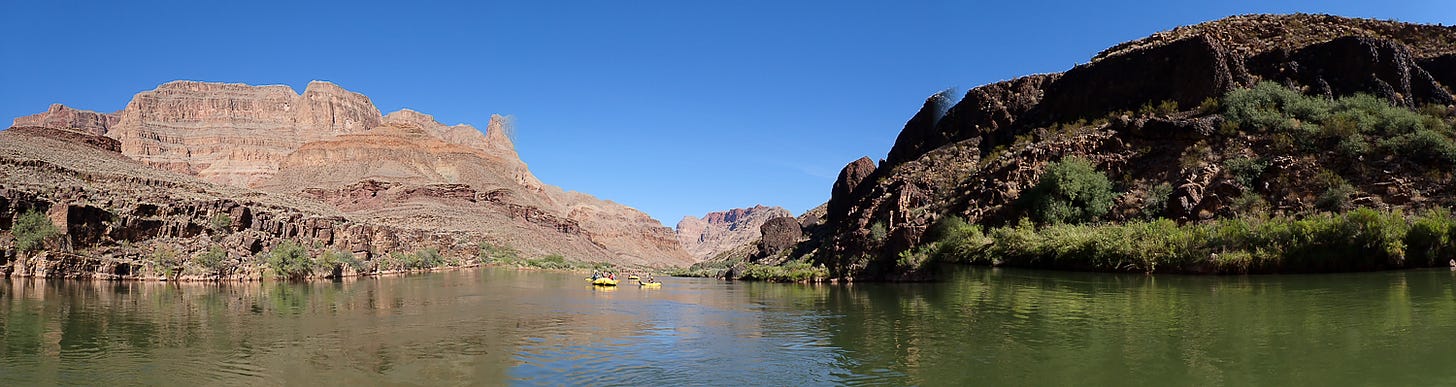
Three rounds in the laundry and there’s still sand in my socks. I like the grit that remains. It’s been over a week since we took out from a bucket list rafting trip down the Colorado River. I adventured there with my husband and his eldest, 226 miles of the river’s reach, from Lee’s Ferry to Diamond Creek, traveling into the depths of what this great earth holds, a truly Grand Canyon.
New layers of rock revealed themselves to us each day as our seven boats moved downstream. Six oar boats and one paddle boat. Some of us slipped into kayaks at times. Us twenty guests in a continual rotation between boats, sometimes paddling, deep strokes into deep green cold water, or relaxing through some stretches, or holding on for dear life as we crashed through the rapids of Granite, Horn, Lava Falls. We pulled onto beaches for hikes into slot canyons, or to go swimming in the Little Colorado River, a tributary with otherworldly pastel blue waters. We passed through sacred lands. All of it felt sacred. I kept feeling like I needed to ask permission. I did, and felt (hope) it was granted. Navajo, Havasupai, Hualapai. And something deeper and more eternal, before even those people arrived, when this place was sea, inhabited by sponges, crinoids, brachiopods, lava flowing and transforming, land masses moving.
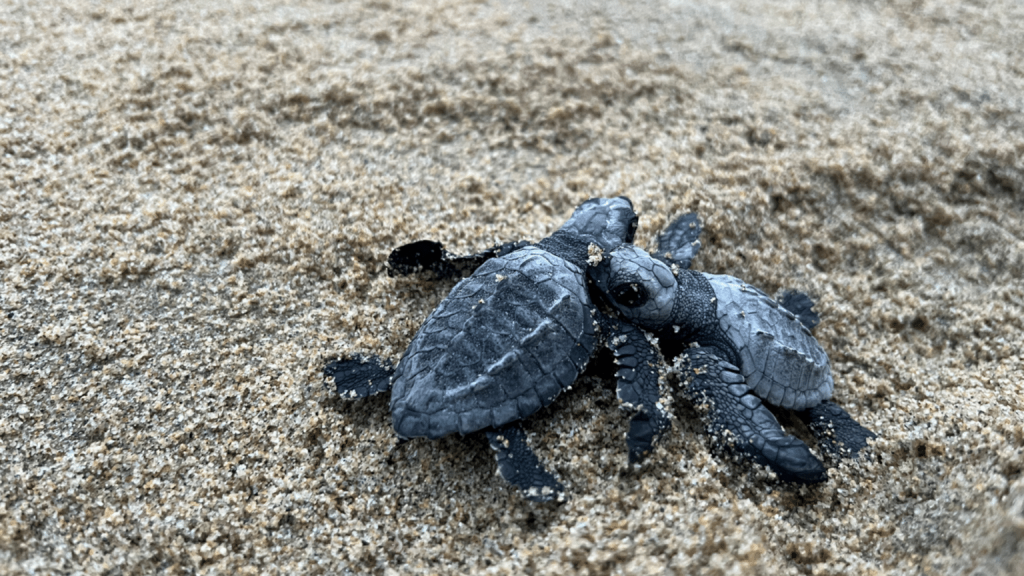
S. AND I SIT ON A LOG on a San Pancho beach of western Mexico’s Nayarit coast, watching. Soon, we’ve been told, there will be a release of sea turtles, but we don’t know quite where, so we observe the movement of humans on the beach—couples in beach chairs; groups of young, tattooed surfers smoking cigarettes and weed; a woman reading a book. An older man races by in a dune buggy with a woman beside him, and then returns a moment later without her, rousing a trio of short-legged mutts to chase after him, barking and chomping at the tires. Where he has left the woman, a coalescing is under way, and we move toward it.
There we find Odette Brunel, a Mexican ecologist with long brown hair and reading glasses looped around her neck, holding a tan plastic bin. A hundred tiny turtles writhe within. They’re only a few inches long, dark flippers and dark shells barely containing an eager energy. Nearby, an eleven-year-old named Ananda holds another bin with more. A growing crowd crane their necks to look in. Children gather. Parents gather. Cell phone cameras, including mine, are at the ready.
Odette goes hoarse explaining anything she can to anyone who will listen, in English and Spanish. Her soft voice stretches over the sound of island music blaring from a nearby hotel that reaches its square body onto the sand of the beach.
“We call this tortuga golfina. It’s the smallest of the sea turtles that come here.”
…
Read the rest of the story, published in Orion, about witnessing the dangerous, crucial volunteer work of protecting and releasing baby olive ridley sea turtles in Mexico, here.
And here’s a rough-cut video I made of the evening: