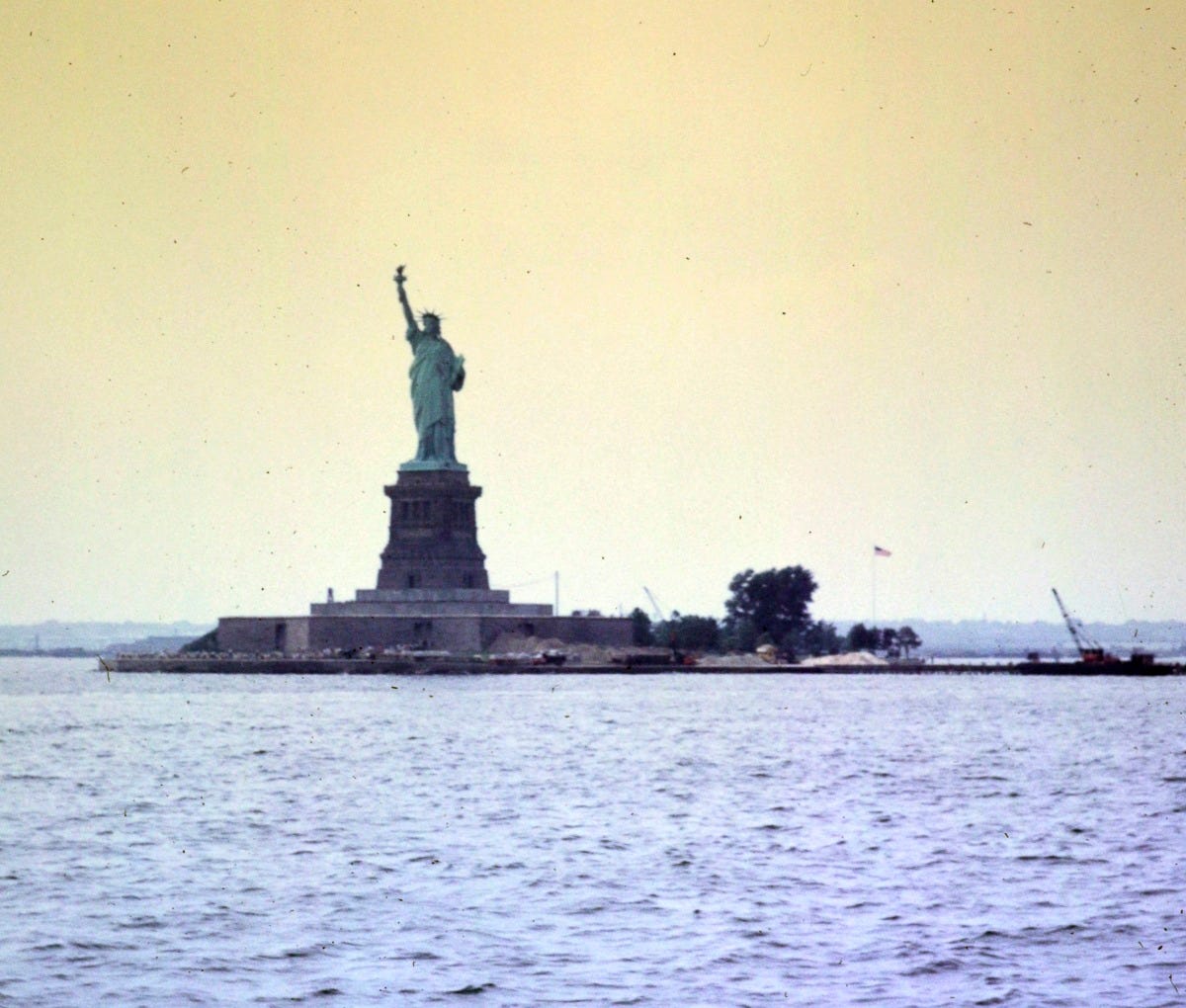
Undated photo my dad took of the Statue of Liberty, sometime in the 1980s.
My dad reaches for words more than he used to. A few years ago, we met regularly on Zoom so I could interview him about his life. I’d given him homework on our third meeting: tell me about places that have been meaningful to you. He arrived to our fourth meeting ready with notes.
“The first places of importance, of significance,” he began, “is the lady at the entrance.”
“Wait, what does that mean?” I asked, not willing to let a single ambiguity linger.
“The freedom… What do you call that?”
Ah, I realized, drawing on the telepathy between father and daughter. The Statue of Liberty. I liked his name better. The lady at the entrance. When he arrived to New York City, with his cardboard suitcase in 1959, three weeks and a day after he left India, he didn’t go through immigration on Ellis Island, closed a handful of years earlier. But he did arrive into New York Harbor. He saw the copper-clad woman with her upheld torch standing on her wee island on the edge of an immense continent that was all possibility.
What do those of us born here see? What did I see, on our visits to the city from nearby New Jersey, where I was born? From a tour boat, with visiting relatives, when I saw the image above, that my Dad snapped? A statue I took for granted. Inert, yet eternal. I believed, as that kid, that the level of the water at her island’s perimeter that would always be static. But my faith that she’d always be standing there, greeting newcomers, was already beginning to fray.
Later generations of my Indian family have come, too. I’ve never talked about the lady at the entrance with a favorite cousin who came in the 1990s. Instead, we’d repeat lines from Eddie Murphy, who plays an African prince in Coming to America:
Good morning, my neighbors! (he cries from his fire escape in Queens)
Hey, fuck you! (shouts back a neighbor)
After the 2016 election, I traveled around America asking those in conservative communities who have faced climate impacts (floods, droughts, failed harvests), about their perceptions of climate change for an Inside Climate News nine-part series (and an Orion piece that feels positively wishful now).
I only touched on it briefly in the pieces but multiple times, die-hard Republicans shared stories about how much they depended on their immigrant employees. They could not—no matter the pay—find local (read White) people both capable and willing to do the work that needed doing. In Georgia, that meant pruning peach trees and stacking up the limbs into massive piles in the mid-summer heat. The locals, I was told, didn’t last ‘til noon. In Texas, that meant getting on a shrimp boat that would be at sea for the next two months. The locals, I was told, showed up for departure drunk. The folks I talked to didn’t want to go on the record. But as business men, they knew who was a good worker. Some were in the country legally. Many, I imagine, were not. It saddened them that that their (White) neighbors didn’t want the work. But the reality was that they didn’t.
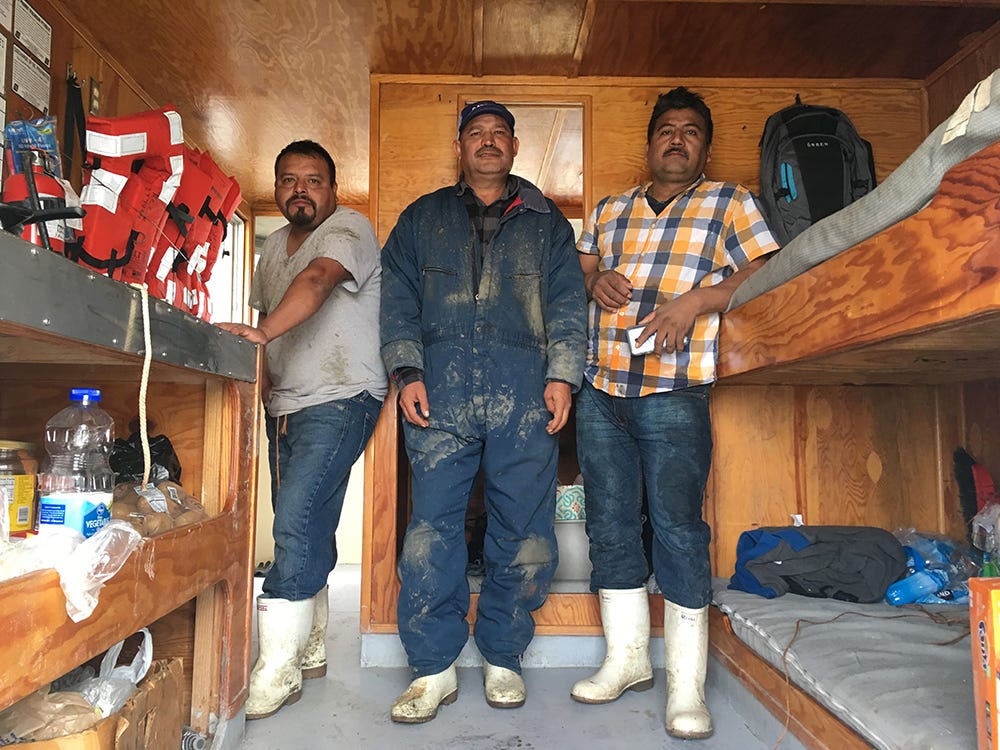
Oystermen in San Leon, Texas. Credit: Meera Subramanian
ICE deportations and detentions are at record levels, sweeps targeting the places people go looking for daywork—7-Elevens and Home Depots. Crackdowns in places that have been established as sanctuary cities. Good morning, my neighbors! Some arrests are made by men in plainclothes, setting the stage where anyone can impersonate an officer, can decide the fate of another, can disappear another human being. Hey! Fuck you!
Where is the lady at the entrance? Where is the recognition of who is actually doing the labor in this country, below the burning sun that beats on the agricultural fields of the Central Valley, behind the restaurant’s swinging kitchen doors and the swinging hammers clutched on rooftops?
I’m still harboring a crush on Spain, meanwhile, which is welcoming immigrants. (I get there are limitations to which immigrants, but still….) El País ran a report in 2022: “A day without immigrants,” recognizing their roles in agriculture, construction, healthcare. Recognizing that “without them, Spain simply would not function.”
No such recognition here from the powers that be. These days, it’s not just my Dad who’s struggling as they reach for words.
Credit: Meera Subramanian
Upcoming…
- On a lighter note…mushroom! Join Orion and the Food & Environment Reporting Network (FERN) on July 17 (2-3pm ET) to celebrate Orion’s Summer 2025 issue, The Future Is Fungi. I’ll be in conversation with FERN editor Theodore Ross and the wonderful writer Erica Berry, talking about our pieces (here & here). Register here.
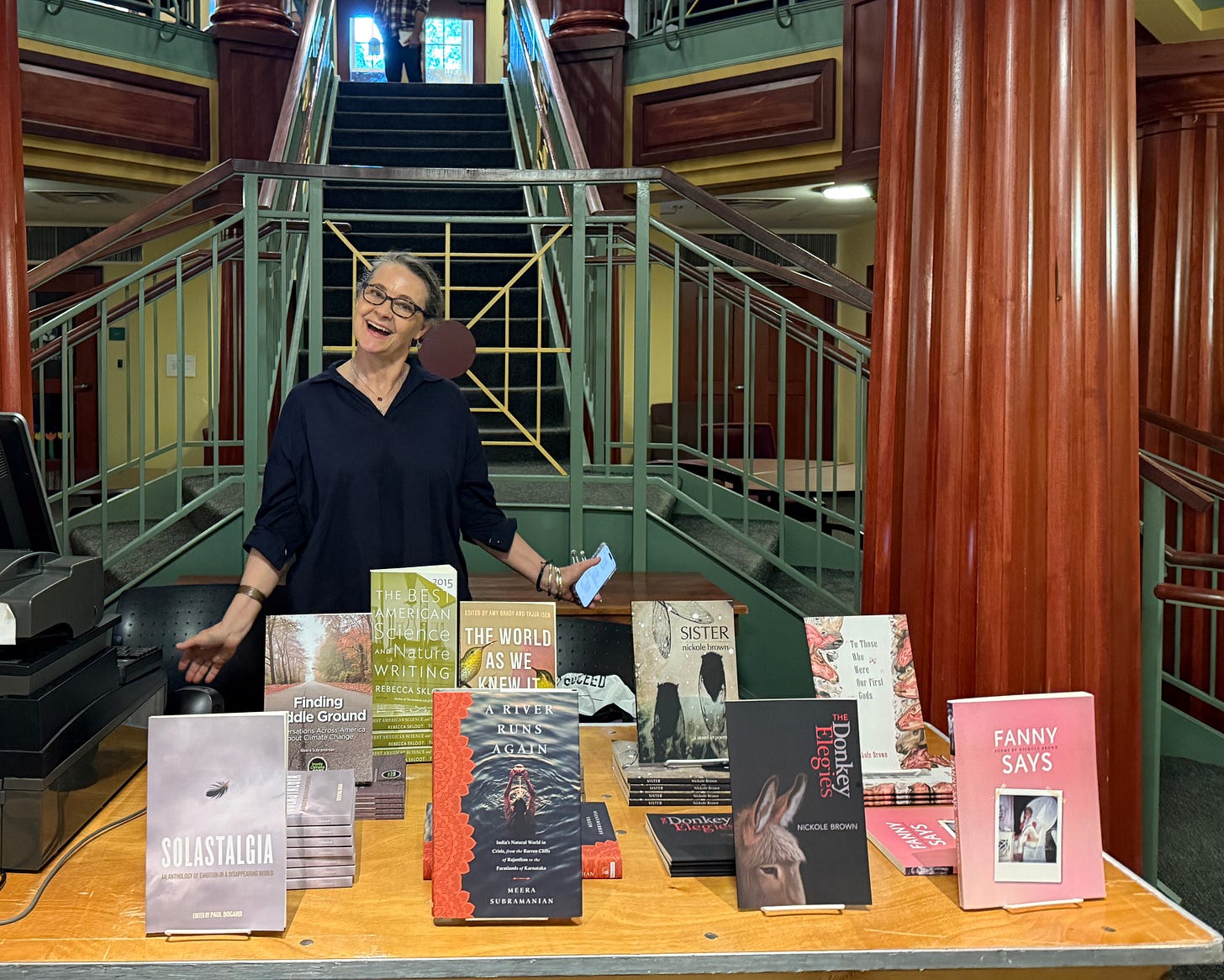
Lucy Murray of the University of the South Bookstore, hamming it up at the book table at the School of Letters faculty reading.
I’m reading/listening…
- My time teaching at the School of Letters in Sewanee, TN is fast coming to a close. The students and fellow faculty are all inspiring, as are those who run the program. Assistant director April Alvarez, with a team that includes one of my former students, Sam Worley, have launched The Suitcase, a podcast that tells a fascinating story of the South in the first half of the last century through the life of Ely Green, a mixed-race man. Have a listen. More episodes coming soon.
- This year I have the delight of teaching with two new faculty, Dan Hornsby and Rebecca Gayle Howell. I deeply enjoyed Dan’s novel Via Negativa. And at the first faculty reading, Rebecca shared work from her new prose poem, Erase Genesis, forthcoming in November 2025. I’ll let Rebecca tell you what it is in her own words: she “made the poems by repeatedly erasing the first three chapters of Genesis (KJV), where the creation myths are told. Each time I came to the chapter again, a new poem emerged. Eventually, this accumulated into a new creation myth, one that seems to begin at climate change and centers the Earth’s vast and divine intelligence for interconnected being.” Oh, yes! This is going to be a gorgeous book, with an aching message. Here’s a peek:
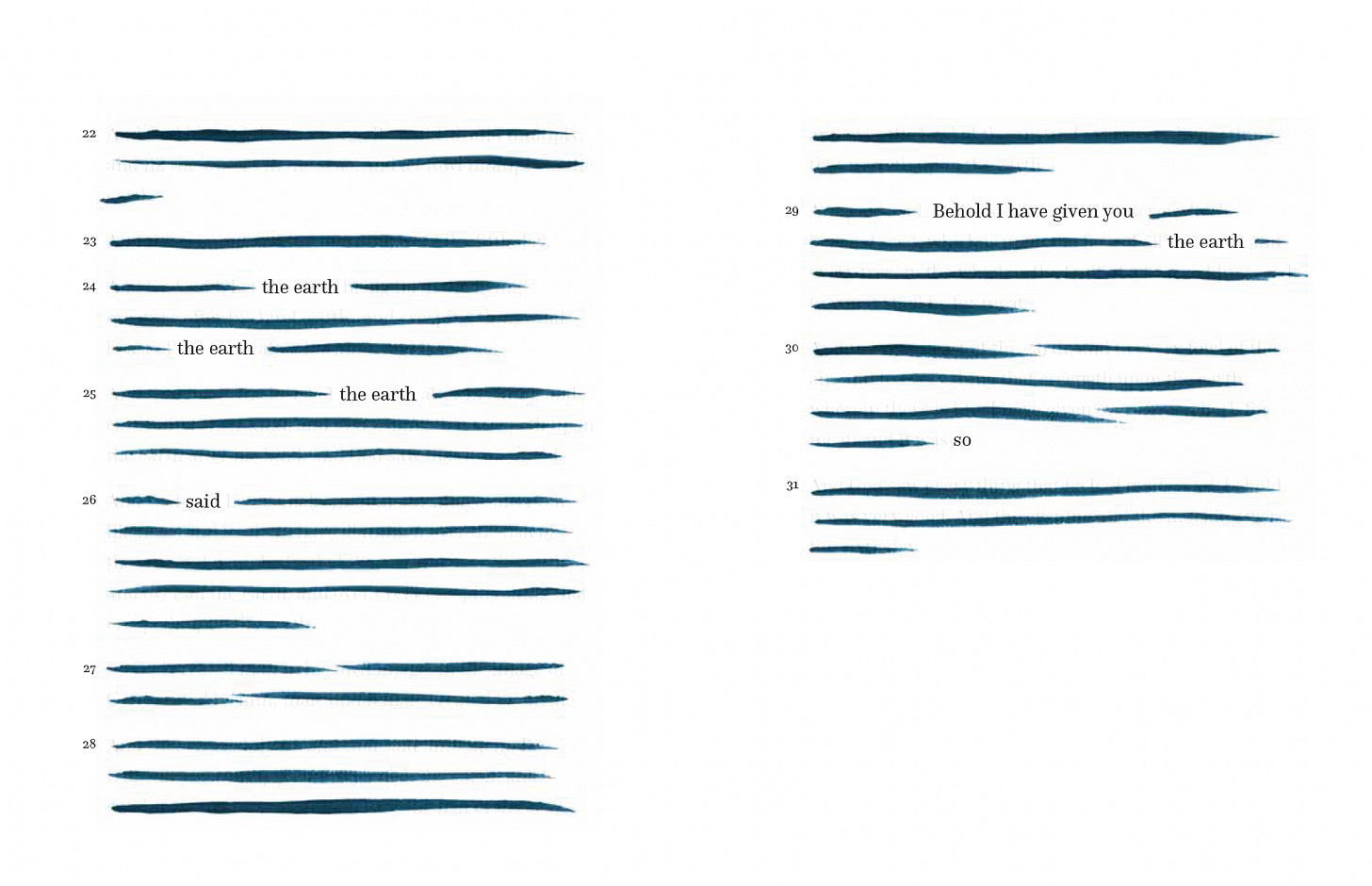
Credit: Rebecca Gayle Howell
- Thanks to Michelle Nijhuis of Conservation Works for tipping me off about Boyce Upholt’s new magazine, Southlands, which aims to capture the unique land and life of Southern habitats. (I reviewed Boyce’s book The Great River for Scientific American a couple years ago.) See what Southlands is up to and pitch in if you want to help make it happen!
- I also had the joy of reading writer and illustrator (and one of our RESP fellows) Martha Park’s debut book, World Without End: Essays on Apocalypse and After, a literary love song to the future, beheld with an expectant hope. Daughter of a mainline Protestant preacher, native of Memphis, Martha writes of the human experience, quite literally, from the deeply personal act of giving birth to the reported inquiry into green burials in the American South, shattering the typical glass wall that separates writing about the climate crisis and writing about faith, and she does it with humility and grace. She absolutely wowed my Creative Nonfiction class when she came to visit last week. We also had a lovely conversation that was just published on Orion.
- I tore through Alison Bechdel’s new comic novel, Spent, and am savoring Feeding Ghosts by Tessa Hull, a graphic memoir about her immigrant mother and grandmother. I taught the start of the it in my class and we keep returning to it again and again.
- “Is nature alive?” The short answer is “Hell, yes!” but the longer answer to the question is explored in Robert Macfarlane’s new book Is a River Alive? Here’s Elizabeth Rush’s review of it: A New Concept for Fighting Climate Change.
Coda…
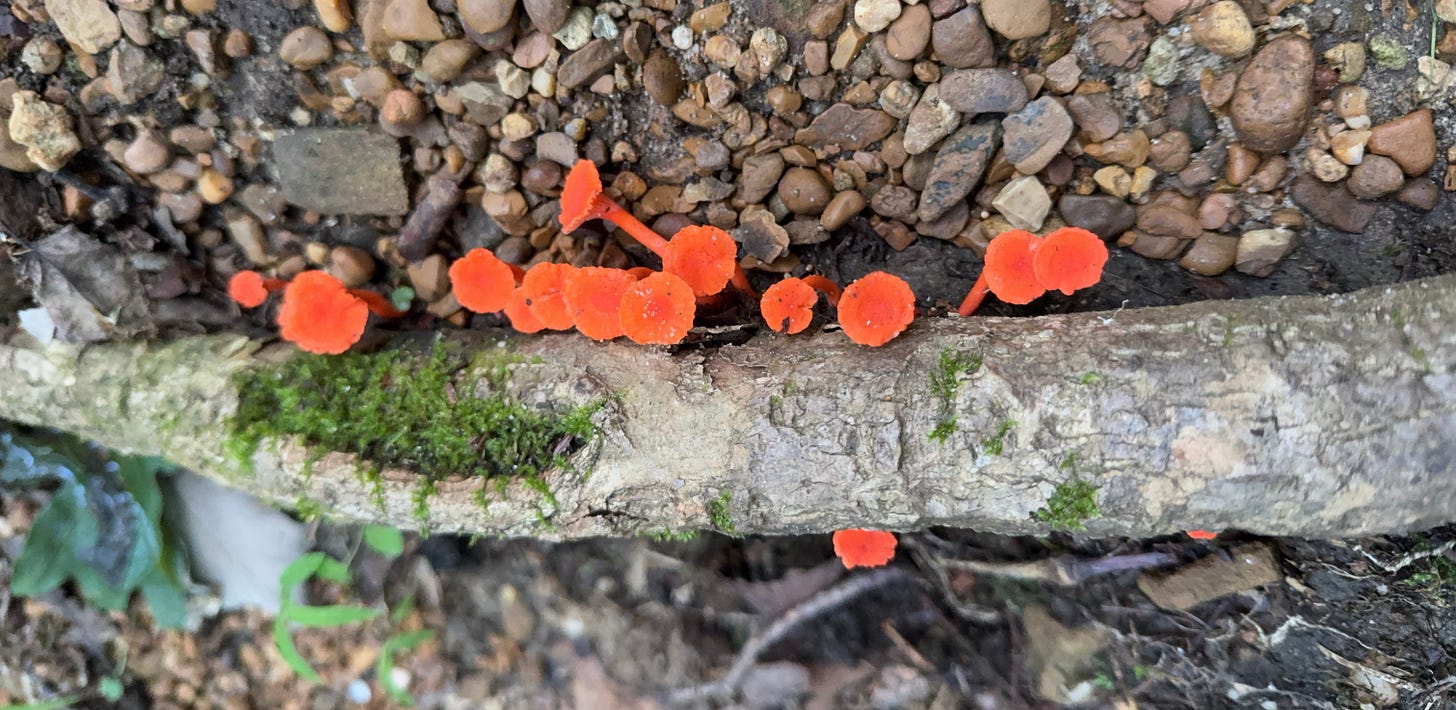
Sewanee environs, in various stages of life, seeding, death.



Leave a Reply