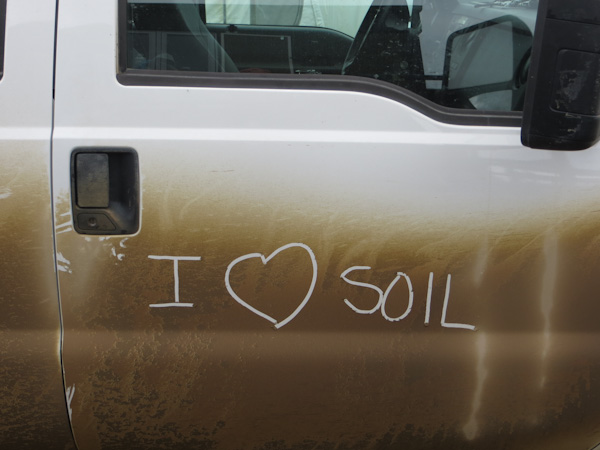
About 35 years ago, when most ecologists were still musing about how we’d deal with the ice age that models then showed was on its way, young scientists Gus Shaver, Terry Chapin and John Hobbie set up camp on an old abandoned airstrip at Toolik Lake on the North Slope of Alaska. Scientists tinker and so when they gazed at this wild and beautiful yet nutrient-poor place, bereft of nitrogen and phosphorous found in the temperate regions of the globe, they wondered what might happen [Read more…]
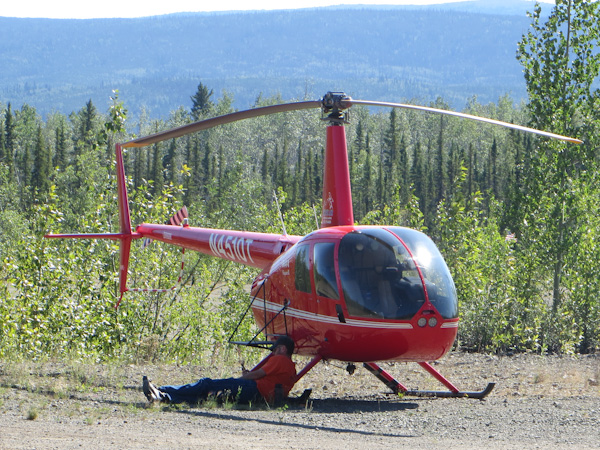
fishscape on the kuparuk river
At the Woods Hole portion of the MBL Logan Science Journalism fellowship, we worked with researcher Linda Deegan. Fishscape, one of her projects, is underway here at Toolik. She’s not here now, but I went out today with her research team as they collect data along the Kuparuk River, studying the impact of climate change on the Arctic grayling, a freshwater fish in the salmon family. The commute, via a Roberston-44 helicopter, was pretty thrilling. And, is it just me, or did the face of Jesus appear in the tundra around :30??
The ride was over much too quickly, and [Read more…]
toolik-bound
Nope, that wasn’t our helicopter. That would have been too quick. Instead, a fine crew cab pick up truck driven by Ben Tucker of University of Alaska Fairbanks carried us safely north to Toolik Field Station yesterday over the course of about ten hours. [Read more…]
getting my bearings straight
Strolling through Fairbanks, Alaska is the Chena River, all glassy and glorious beneath a sky miraculously scrubbed of smoke from the fires that clouded it a day before I arrived. A visit to Alaska has been a wish for quite a long time and it’s great to finally be here on my way to Toolik Field Station as a Logan science journalism Arctic fellow with the Marine Biological Lab (MBL).
The first part of the MBL fellowship took place [Read more…]
A River Runs Again (aka Elemental India)
For years now I’ve been referring to the book I’ve been working on as Elemental India. It still may retain that title when it comes out in India, but here in the United States, now that the manuscript is handed in, the facts checked and checked again, the galleys scanned for typos, and the cover art completed, it is time for a rechristening. Somewhere along the way, it became A River Runs Again: India’s Natural World in Crisis, from the Barren Cliffs of Rajasthan to the Farmlands of Karnataka. The team at PublicAffairs have been amazing to work with and we’re all looking forward to August 25th, when it shall be released. Stay tuned for news on book launch and fall events, and don’t hesitate to be in touch if you have ideas or suggestions.
Kirkus Reviews was the first to respond to the book: [Read more…]
deadly dinners
I spent a good chunk of last winter stepping into women’s kitchens in rural India to see what was cooking. Rice. Rotis. Dal. Curries. But regardless of the meal, most rural homes were cooking over open fires. With the incredible support of a Fulbright-Nehru fellowship, I was working on a book about environmental stories across India, including doing research and reporting about what — if anything — was helping women move away from the polluting form of cooking with biomass. Today, the journal Nature published my piece that tells a little bit about what I found. Deadly Dinners (a heavy-handed but unfortunately devastatingly accurate title) begins:
After returning from her nine-and-a-half-hour shift as a security guard, Savita Satish Dadas begins plucking fenugreek leaves from their stems for dinner. She and her two children, along with three of their cousins, gather in a shed-like structure next to their house in the Satara District of Maharashtra, India. As goats and cows settle in for the night a few metres away, Dadas and the children sit down on a packed dirt floor around the family hearth.
Whisps of smoke rise up from their chulha, the Indian name given to a traditional cooking-stove fuelled by wood and other organic matter often gathered from the countryside. Dadas’s stove, like several of her neighbours’, is sculpted out of clay. But many make a rudimentary three-stone fire — a triangle of elevated points to support a pot — that humans have used for millennia. Dadas feeds roughly chopped logs into the stove and her hands shape moistened flour into bhakri bread, the rhythmic movement illuminated by the flickering flames.
With this simple daily act, Dadas shares a connection with more than one-third of the world’s population, the three billion people who depend on solid biomass fuels — such as wood, animal dung, agricultural waste and charcoal — or coal for their cooking needs.
this is how it happens
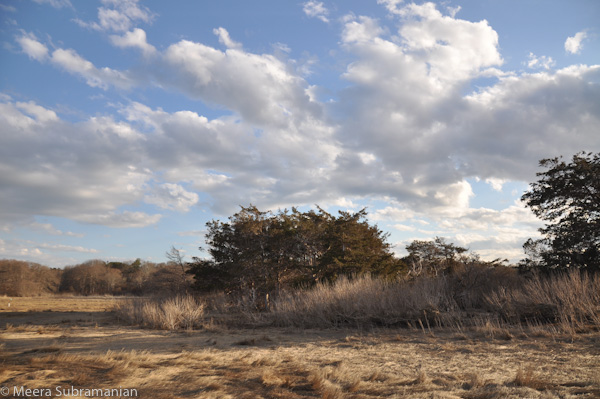
Lean back til you feel like you’ll tip. Take in the sky. Wasn’t it a steely grey just a minute ago, and now, now, blue like the eggs already in the nest, cluttered with clouds that have broken apart. Soon the marsh grass will erupt. An emerald carpet reaching up, breaking through the brackish phragmites, pounded flat in the last storm, but for now, a wash of pale shades.
This is how it happens, falling in love with a place. [Read more…]
the city & the sea
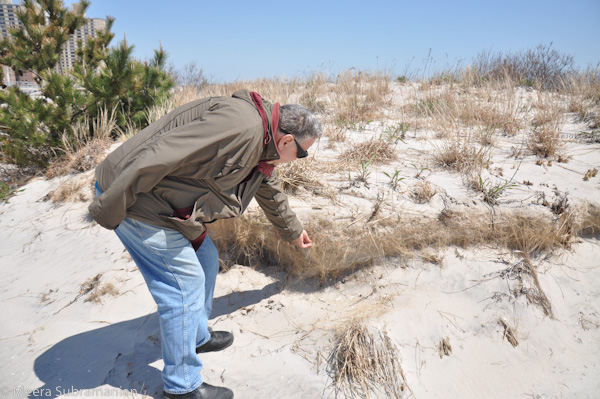
Last year I went to NYC six months after Hurricane Sandy had struck to look at recovery (and retreat) efforts and to explore the issue of coastal infrastructure in a time of changing climate. Here’s an excerpt from the start of the piece, published in the March/April issue of Orion magazine:
ONCE UPON A TIME, about 2 million years ago, the Pleistocene era locked up the world’s water in glaciers miles thick. Then, it warmed. It was about ten thousand years ago when the water of the melting glaciers was released to reshape the world into the coastlines we now associate with modern-day maps.
By all indications, though, the shape of those coastlines is about to change.
The archipelago of New York City’s five boroughs has almost six hundred miles of littoral zone between solid ground and watery sea, a place of straits and river mouths, bays and beachy backshores. It’s also a place whose contours have been radically transformed by its citizens. A large percentage of the city’s edges were created artificially, filled in and built upon with the false confidence that land taken from the sea is permanently allocated for terrestrial use. But on October 29, 2012, the record-breaking storm surge that swept over New York City flooded fifty-one square miles of that falsely allocated land—and like a finger from a watery grave, the high-water mark traced the coastline that once was and may soon be again. The mayor’s office says that, by the 2050s, 800,000 New Yorkers will live in hundred-year flood plains, double the current number. [Read more…]
parting notes
Five months of a Fulbright-Nehru fellowship is coming to a close. Given that the fellowship involves both the US and Indian governments, there was just a wee bit of paperwork. At. Every. Step. [Has anyone else ever known where I’ve slept each and every night?] As it all wraps up, there was a final report. Actually, two. A couple questions seemed worth sharing. [Read more…]
crowing about the ordinary
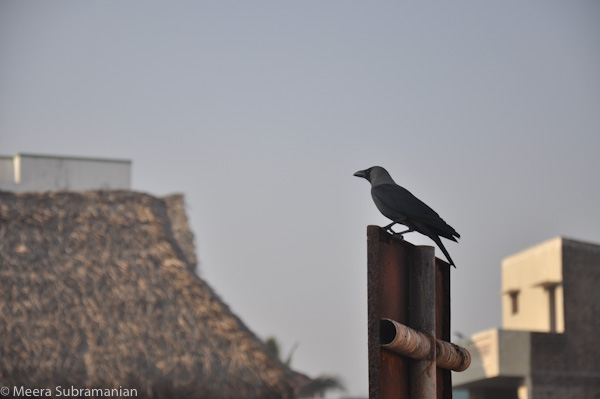
I have missed chasing birds on this trip to India. Mostly it’s been about people, in all their human glory, although the partial focus on vultures meant that the reporting about birds actually involved very few live creatures, but rather discussions and strategies for how to make a world where, once again, the skies becomes full. But one thing that a vulture conservationist said has stuck with me. He said that the South Asian vulture crisis has made him not take any bird for granted. (This, of course, could be extended to: take nothing for granted.) I’ve been trying to take his words to heart, directing my camera at the ebony and grey scavengers that remain, the Indian crow, Corvus splendens. [Read more…]
- « Previous Page
- 1
- …
- 11
- 12
- 13
- 14
- 15
- …
- 27
- Next Page »