Meera Subramanian
  • Home
  • Books
  • Writing
  • Bio
  • Blog
  • Photos
  • Events
  • Speaking
  • Contact

every day is turkey day

April 21, 2025 By meerasub Leave a Comment

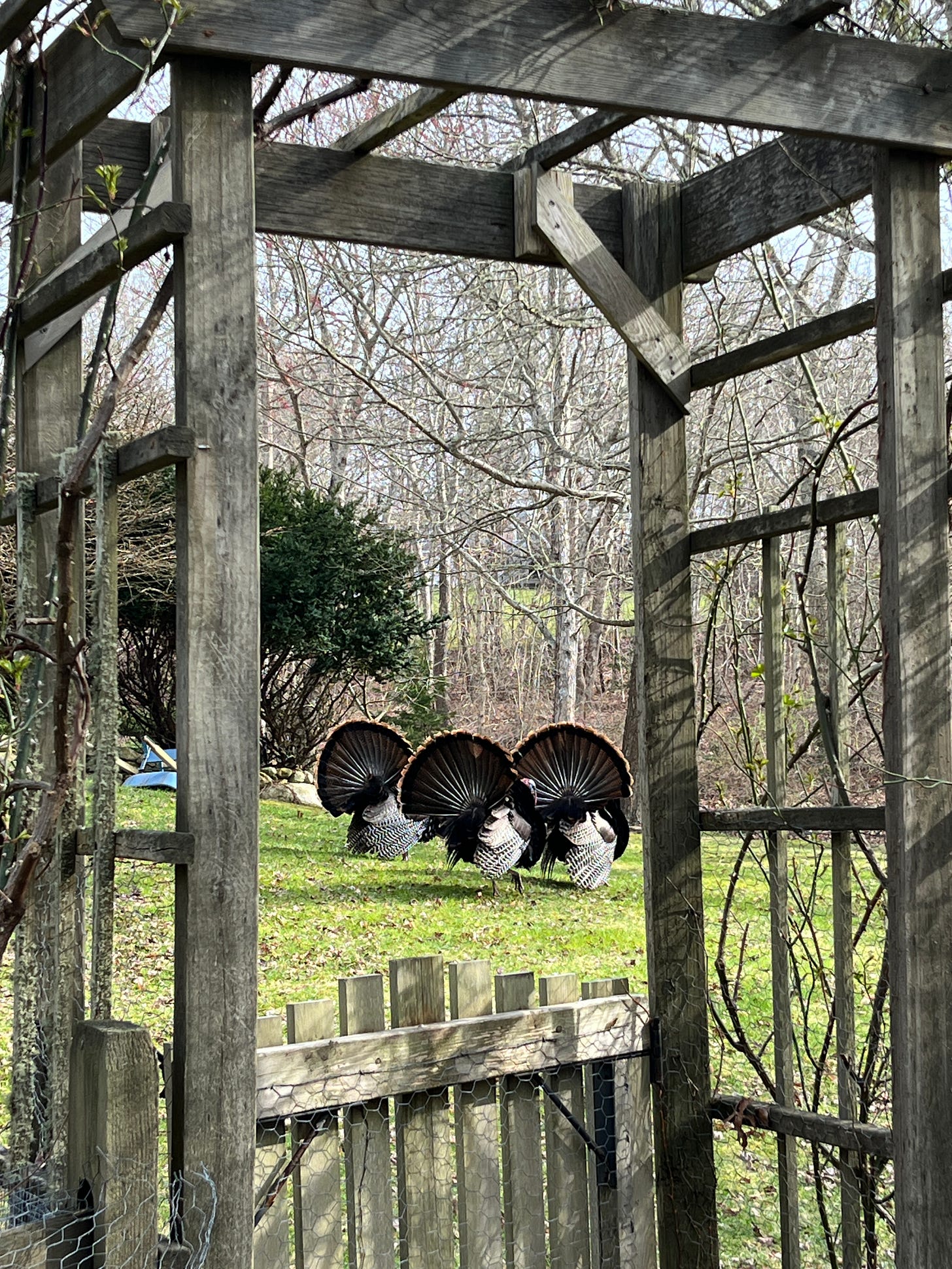
Three turkeys with tails fanned out, viewed through a garden gate

The view from my garden. Credit: Meera Subramanian

I have reluctantly returned to the country of my birth, the place that has always inspired the greatest culture shock after long travels. How quickly I’ve stopped dreaming in Spanish, as the raucous sounds of English fill my mind. Foot travel and cheap trains are replaced by big trucks riding the ass of my Prius as I drive too far to get a dozen eggs that cost six times what they did in Spain. But there are good friends, and my beloved bookshelf, and the yard is teeming with turkeys and other signs of springtime life. Together, it is the antidote to the unraveling.

Between the work of catching up—pitching stories about renewable energy in Spain, preparing for a talk (more below), handling personal crises minor and major—I watch wild turkeys loitering about Cape Cod. Or, I guess, we’re the loiterers. They bear our presence. I could watch them all day. And do.
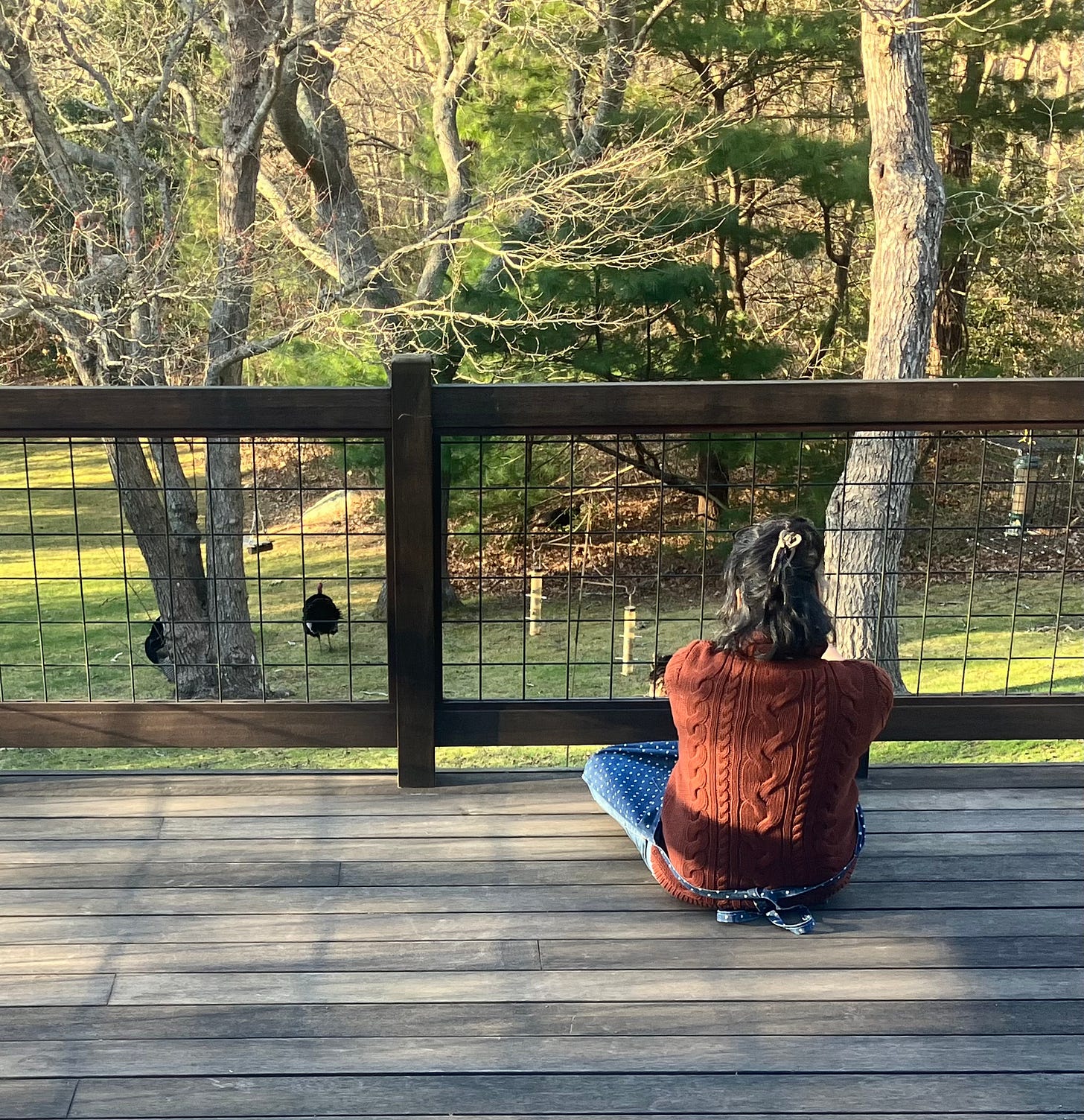
Woman sitting on deck watching turkeys in yard

Take the time to notice the wild things around us. Credit: Stephen Prothero

Tomorrow is Earth Day, something I find myself resisting—every day is earth day, damn it!—and it comes as years of scientific gains and movement towards climate goals are being bludgeoned, as human rights from clean air to due process are eroded. I gather with my fellow citizens on the rotary who hold signs mentioning kings and oligarchs tight lest they blow away in the fierce wind. My friend and I talk with Andrew, a supporter of 47, a proud participant of January 6th, his language and message perfectly honed in response to any question. “Anything you want to ask us?” I offer, but he shakes his head and responds with a sentence that drifts away in the wind, “No, I have trouble getting my thoughts together…” We’ve all learned how to talk in this age of pontification. Listening is another skill.

I gain more understanding by returning to Jeff’ Sharlet’s book The Undertow:

We say we are in crisis. The crisis of democracy—the gun—the crisis of climate—the fire, the water, the rain—the crises of our own little lives—debt and Twitter and rage, and most of all the ordinary losses of love and loved ones that feel too vast. But that word, crisis, supposes we can act. It supposes the outcome is yet to be determined. The binary yet to be toggled, a happy ending or a sad one, victory or defeat. As it we have not already entered the aftermath.

Will we save democracy or lose it? Will the earth boil, or will we all drive electric cars? Are the dead gone, or do they live in our hearts forever?

Such imaginations we have.

My imagination wanders, as I watch eight tom turkeys back home, spectacular tail feathers fanned in full display, wings hanging low as they shimmy, faces an explosion of blue and bright red, all glorious and grotesque. The dangling wattle known as a snood draping down over their beaks in the most impractical of ways.
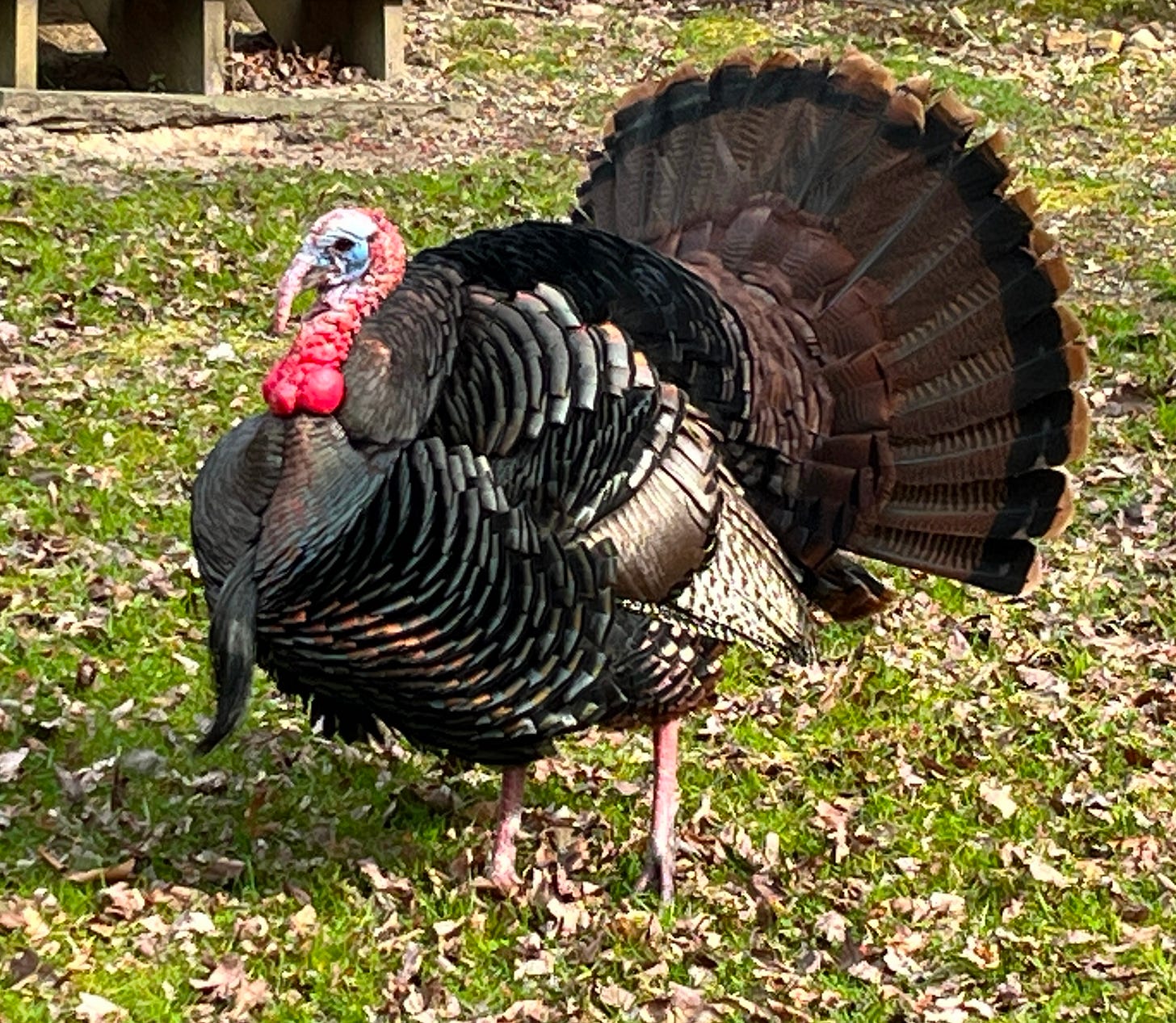
Tom turkey in full display

Tom turkey in full display. Credit: Meera Subramanian

You may have heard the ole story, about Benjamin Franklin and his disappointment that the aggressive eagle had been chosen as our nation’s symbol. In 1784, he wrote in a letter to his daughter:

For my own part I wish the bald eagle had not been chosen as the representative of our country. He is a bird of bad moral character. He does not get his living honestly. You may have seen him perched on some dead tree, where, too lazy to fish for himself, he watches the labour of the fishing hawk; and when that diligent bird has at length taken a fish, and is bearing it to his nest for the support of his mate and young ones, the bald eagle pursues him, and takes it from him. . . . the turkey is in comparison a much more respectable bird, and withal a true original native of America.

I agree, even though my love of raptors is deep and slightly irrational. But even the morally bankrupt eagle only takes what she needs. Acknowledges the limits of necessity even as he steals from the osprey. But the turkeys do earn my respect as they did Benjamin’s, as they make their own way through the world. Mostly peaceful.

There’s been some fighting, too.

One male jammed his beak down the other’s throat and held it there for so long in a suffocating stalemate that I was thinking there might be a roast turkey for dinner. But one relented, and the other chased the loser away. It always seems to be the boys. The hens just want to eat in peace, and carry on with their task. I thank them for ridding our yard of ticks more than their sparring, strutting cohorts. But all play their part.

How quickly I’ve become accustomed to them. When a fox ran through the yard, they scattered, one even taking a lumbering flight to the treetops where they roost at night, (enormous black silhouettes against the skeletons of still bare oak branches and a gloaming sky draining of color). The daytime yard was empty for hours and a keening loneliness set in that only abated when I once again detected movement out of the corner of my eye.

When I went down to work in the garden to gather my thoughts, they scattered again, only to drift back up and surround me as I turned over the winter cover crop, preparing for what is to come, for another season to unfold. The work of a garden is endless. So is the work of democracy. Or for a habitable climate. I will be the first to admit it is exhausting.

Yet.

The turkeys carry on. And so do I. And so do you. Find our ways to fight and also know that we need to make time to ensure our own sustenance as well. Step away from the socials. Pick up the binoculars. Watch the natural world doing the work of living. The toms, the hens, together. They are all spectacular. These magnificently large creatures, living in our midst. Doing the work of replenishment. Eating. Courting. Creating more.

It wasn’t always like this. Native to North America, Meleagris gallopavo was domesticated by the Aztecs, who introduced them to invading Spaniards, who took them to Europe and then brought them back, while other conquerers nearly annihilated the wild ones. In the early 1800s, only about 30,000 remained, down from many millions. Today, there’s an estimated seven million in North America, in part because of the work of hunters and governments. Disappearance is one possibility. So is abundance.

No wonder I want to turn my attention to them. Especially as I prepare to share stories of disappearance and hopes of resurrection from South Asia about some other very large birds….

Talking vultures

For those in the Cambridge, Massachusetts area or who have access to a computer, I invite you to join me for a talk I’m giving this Friday evening for the Brookline Bird Club, taking place at Harvard’s Geological Lecture Hall. It’s titled South Asian Vultures: Crisis & Conservation. Here’s all the info and here’s a description:

Not too long ago, millions of vultures flew over South Asia, so abundant that no one had bothered to count them. Until the 1990s, when populations of three Gyps vultures collapsed by more than 97 per cent in a decade. It was the fastest avian decline ever recorded. Conservationists scrambled to find the cause and start captive breeding programs. What happens when South Asia’s essential clean-up crew vanishes? Cape Cod-based journalist and National Geographic Explorer Meera Subramanian has spent nearly twenty years searching for the answer to that question and discovered a story of conservation in a time of mass extinctions, a chronicle of biologists strategizing and cautiously celebrating. Join her as she shares photos and stories from covering the crisis in both India and Nepal, where the birds’ absence has had ecological, cultural and even religious implications.

Journalists & writer friends, take note…

  • The Council for the Advancement of Science Writing (CASW) is accepting entries for the fourth Sharon Begley Science Reporting Award, a career prize for a mid-career science journalist of “unflinching dedication, skill, moral clarity, and commitment to mentoring”. Prize includes a $20,000 grant. Deadline: April 30, 2025.
  • Orion Environmental Writers’ Workshop (June 15-20, 2025, The Omega Institute in Rhinebeck, New York) Join a community of writers, improve your craft, and reimagine how you think about nature. Guided by award-winning instructors, the Orion Environmental Writers’ Workshop provides an intimate space to connect with writers, artists, and editors, spark creativity, and renew, illuminate, and deepen your relationship with place. This week-long workshop is cosponsored by the Omega Center for Sustainable Living. Deadline: May 1, 2025.
  • FRONTIERS open call for application for early-career journalists Round three! This is the same fellowship I just finished up in Spain, but targeted for early-career journos. Deadline: May 6, 2025.
  • Covering Climate Now announced an updated training program, aimed at helping newsrooms grow their audiences by telling the climate story better. The program is available exclusively to journalists working for CCNow partners. For a list of the specific trainings they’re offering, free of charge and starting this spring, check out the Climate Journalism Training Catalog.

I’m reading/watching…

  • After the Deluge by Gary Greenberg in Harper’s, in which he explores some of the same possibilities I did in this piece I wrote for Orion a while ago, but from the close vantage of a small Connecticut town’s selectman responsible for trying to unite a divided populace in the aftermath of a tornado…and a flood. What climate change?
  • This consideration of life and death on a Washington farm, from my friend Christopher Solomon, in Orion.
  • I’ll keep reading Brendan Boyle’s Substack, La Comunidad, on life in Spain. On his post, What does Spain think of Donald Trump?, he captured what I experienced during my travels and conversations across the Iberian Peninsula.
  • I finished Carlos Ruiz Zafón’s Shadow of the Wind, which descended into darkness that feels like it’s getting closer to today’s America. But I’m holding onto this line, as I turn to new writing projects that still elude me: “Julián had once told me that a story is a letter the author writes to himself, to tell himself things that he would be unable to discover otherwise.”
  • I love this visual portrayal of land use made by National Geographic Explorer Dan Raven-Ellison, who traveled the length of Great Britain and captured drone footage of suburbia and bogs, fields and forests, seaside and soccer field, with each second representing a percentage of land use.
  • This morning’s post by Bill McKibben, on the death of Pope Francis, a religious leader who recognized that the real roots of the climate crisis reside in the power imbalance created by a “technocratic paradigm” and viewing the world through a reductionist lens.

Coda…

Years ago, I attended an event in Chennai, India, with Jane Goodall as part of her ceaseless work with Roots & Shoots. I went with my mom and dad, my mom’s hair long and grey and pulled back in a long ponytail that made her look like Jane. Last week, my musician friend Casey Neill saw Jane in Oregon, still ceaseless at 91 years old, and there she was as musician Dana Lyons sang this song for her. Dana’s new record is ‘Cracks in the Heartland,’ which Casey produced. Enjoy, friends.

Don’t stop, ever.

Filed Under: A River Runs Again, elemental india, events, just another day, photography, readings, Substack, travels

Consider the Vulture

January 31, 2024 By meerasub Leave a Comment

Line of vultures on curving branch

Vultures stay close to the feeding grounds of the Jatayu Vulture Restaurant, Nepal. Photo by Alisha Vasudev ©


For close to twenty years, I’ve covered the catastrophic decline, and tentative recovery, of South Asia’s vultures. In my book A River Runs Again, I took a deep dive into the situation in India. Last year, I went to Nepal to cover a new chapter in the story, as the country’s captive-breeding program came to a close, and the last birds were released back into the wild. The story was published today at The New Yorker. Here’s a bit:

We were in a microcosm of abundance in a landscape of loss: most of the nine vulture species found in South Asia were there in front of us. We watched white-rumped vultures, whose neck ruffles look like seventeenth-century formal wear, and Himalayan griffons, which are larger and paler. We also saw an immense cinereous vulture; a red-headed vulture with fuschia wattles; and a small Egyptian vulture. Nepali pointed out a slender-billed vulture. According to the I.U.C.N. Red List of Threatened Species, there are less than one thousand mature individuals left in the world.

One bird tugged at the cow’s head, which was now detached. The vultures were so gross that they were gorgeous. It’s easy to shun vultures as dirty and disgusting, or as harbingers of death, but they are more like undertakers, performing an essential job and receiving little thanks for their work. As obligate scavengers, vultures survive almost exclusively on what is already dead.

[Read more…]

Filed Under: A River Runs Again, elemental india, journalism, National Geographic Explorer, News Tagged With: A River Runs Again, Alisha Vasudev, Asia, birds, birds of prey, captive breeding, conservation, diclofenac, Elemental India, extinction, india, Nepal, pollution environment, The New Yorker, Tulsi Rauniyar, vultures

more on Chennai’s water crisis

August 2, 2019 By meerasub Leave a Comment

The summer Southwest monsoon has brought some rain and momentary relief to Chennai, but the question of how to mitigate water shortages (and excesses) are not gone. After my New York Times op-ed last month, I’ve had a chance to speak about water with others interested in the story. These issues are not disappearing anytime soon. From the World Resources Institute:

New data from WRI’s Aqueduct tools reveal that 17 countries – home to one-quarter of the world’s population—face “extremely high” levels of baseline water stress, where irrigated agriculture, industries and municipalities withdraw more than 80% of their available supply on average every year.

I spoke to Mark Goldberg on the Global Dispatches Podcast. In essence, do all the small stuff first: restore wetlands, enforce rainwater catchment mandates, educate on conservation, fix leaky pipes, capture water across the landscape with small-scale systems that work with nature, and not against it. Can India develop a new 21st-century model of sustainable development? The opportunity is still there, though hard to see evidence of embracing such possibility. Listen to the podcast here:

On the BBC’s podcast Beyond Today, I spoke with host Matthew Price about the crisis. BBC’s Rajini Vaidyanathan also reported from Chennai directly. Have a listen here.

I also make a cameo appearance in this Al Jazeera The Stream news piece, featuring Veena Srinivasan, a senior fellow with Ashoka Trust, Raj Bhagat Palanichamy, a data manager with World Resources Institute India, and T.M. Krishna, a musician, artist, and activist. Watch the episode here:

And then sit back and watch/listen to T.M. Krishna’s haunting song Poromboke:

Filed Under: A River Runs Again, audio, climate change, drought, elemental india, journalism Tagged With: Chennai, climate change, india, interview, podcast, water

Chennai’s Water Crisis

July 15, 2019 By meerasub Leave a Comment

Rebecca Conway for The New York Times


While researching and reporting A River Runs Again (aka Elemental India), I explored small-scale, across-the-landscape solutions for water crises in India. Even just a few years later, the world is warmer and there are more people in need of water. When the major South Indian city of Chennai, where my father is from and where many in my extended family live, ran out of piped water during its current drought, I wrote an op-ed for The New York Times about how India might consider a new approach to development that might embrace the methods I wrote about in the book. Here’s how it begins:

India’s water crisis offers a striking reminder of how climate change is rapidly morphing into a climate emergency. Piped water has run dry in Chennai, the capital of the southern state of Tamil Nadu, and 21 other Indian cities are also facing the specter of “Day Zero,” when municipal water sources are unable to meet demand.

Chennai, a city of eight million on the Bay of Bengal, depends on the fall monsoon to provide half of the city’s annual rainfall. Last year, the city had 55 percent less rainfall than normal. When the monsoon ended early, in December, the skies dried up and stayed that way. Chennai went without rain for 200 days. As winter passed into spring and the temperature rose to 108 degrees Fahrenheit, its four water reservoirs turned into puddles of cracked mud.

Some parts of the city have been without piped water for five months now. Weary women with brightly colored plastic jugs now await water tankers, sometimes in the middle of the night. On June 20, the delayed summer monsoon arrived as a disappointing light shower.

These water crises are now global and perennial….

Read the rest of “India’s Terrifying Water Crisis” here at The New York Times.

Filed Under: A River Runs Again, climate change, drought, elemental india, journalism, News Tagged With: Chennai, climate change, dams, development, drought, india

Women’s Health & The Environment: Going Up In Smoke

April 11, 2017 By meerasub Leave a Comment

Tomorrow I’ll be heading to the heartland for University of Iowa’s Global Forum to talk cookstoves. With people from a variety of backgrounds — anthropology, engineering, economics, gender studies, journalism, non-profits and more — we’ll discuss the troubling persistence of harm from biomass cookstoves used by three billion people around the world. This multidisciplinary approach seems like a good step away from thinking about this as a purely an engineering problem, or an economic problem, or a development problem. It’s all those things and a whole lot of other messy humanness. It’s what I explored in my book, A River Runs Again and this piece for Nature. The event is free and open to the public.

Filed Under: A River Runs Again, News, readings, travels Tagged With: cookstove, events, fire, health, Iowa, women

upcoming talks: MIT, BU & Harvard

February 2, 2017 By meerasub Leave a Comment


Eco Swaraj: Can India’s Model of the Micro Transform Development for the 21st Century?

It’s been a year and half since A River Runs Again was published and my answer to the above question continues to morph. If you’re in the Cambridge, Massachusetts area in the next couple of months, you’ll have a chance to join me as I think out loud about what I found while researching the book over three years and what recent world events make me think now. (You can read a little more on that at the KSJ blog post, here.)

e4Dev student group of the MIT Energy Initiative (MITei)
Tuesday, February 7, 2017
5:30 pm – 6:30 pm
MIT, Building E18, Room 304
50 Ames Street, Cambridge MA
You can find more information and RSVP here. 

Harvard STS Circle
Monday, March 27, 2017
12:15 pm – 2:00 pm
Harvard University, K262, Bowie-Vernon Room, CGIS
1737 Cambridge Street, Cambridge, MA
You can find more info and RSVP here. 
(To get a free sandwich, be sure to RSVP by Wednesday at 5:00 pm the week before!)

I’ll be showing lots of photographs and here’s a description of the talk:

In this exploration of life, loss and survival in modern-day India, Subramanian shares findings and photographs from her book, A River Runs Again: India’s Natural World in Crisis from the Barren Cliffs of Rajasthan to the Farmlands of Karnataka. Using the five elements (earth, water, fire, air, and ether) as a framework, she traveled across India to seek out the ordinary people and micro-enterprises determined to guide India into a more sustainable future. Could India be the perfect place to shift from an outdated model of the macro — big dams, industrial agriculture, nuclear power, all developed in the West — to a new model of the micro? Should it choose this path, India could create a sustainable model of development that could be implemented elsewhere, from industrializing China to electrifying sub-Saharan Africa, to drought-stricken America, with its crumbling infrastructure.

Spread the word!

AND….

…I’ll also be joining a great panel hosted by Boston University Institute for Sustainable Energy & Union of Concerned Scientists:

Science & Environment: A Journalist’s Perspective
Thursday, February 16, 2017
4:00 pm – 5: 30 pm
The Westin Copley Place Hotel
10 Huntington Avenue, Boston, MA 02116
Panel Discussion followed by cocktail reception and hors d’oeuvres.
This event is free & open-to-all.

Science and policy issues in energy and the environment have become a rich source of material for authors and journalists across the media spectrum.  In particular, both the science of climate change and the reportage on that science have both become heavily politicized, posing unique challenges for journalism.

This panel discussion explores the evolving role of authors and journalists who work in the energy and environment fields.  Each panelist will discuss the evolution of their professional experience and the challenges of writing and reporting in this field, especially in the wake of the 2016 presidential election.

Panelists

  • Joe Romm, acclaimed author, Center for American Progress Senior Fellow, and science advisor to the National Geographic series “Years of Living Dangerously” and named by Rolling Stone as one of “The 100 People Who Are Changing America”
  • Naomi Oreskes,  award-winning and widely-cited science historian and Harvard University professor, co-author of Merchants of Doubt  (2010, Bloomsberry Press) 
  • Seth Borenstein, award-winning national and international science writer for the Associated Press
  • Meera Subramanian, award-winning journalist and MIT Knight Science Journalism Fellow whose work has been published around the world and author of A River Runs Again: India’s Natural World in Crisis from the Barren Cliffs of Rajasthan to the Farmlands of Karnataka(2015, PublicAffairs)

Moderator

  • John Rogers, Senior Energy Analyst at the Union of Concerned Scientists, and co-author, Cooler Smarter: Practical Steps for Low-Carbon Living (2012, Island Press)

More info here.

Filed Under: A River Runs Again, readings Tagged With: A River Runs Again, book tour, Boston, Cambridge, energy, events, india, Knight Science Journalism, pollution environment, readings

A River Runs Again Orion Book Award finalist

October 14, 2016 By meerasub Leave a Comment

screen-shot-2016-10-14-at-8-18-17-am

Orion Magazine just announced its annual Book Award finalists and A River Runs Again was on the list! Could I be in better company? I think not. Sy Montgomery’s Soul of an Octopus, Summer Brennan’s The Oyster War, and Helen Macdonald’s wildly acclaimed H is for Hawk.

Thank you, Orion. When I lived in NYC, I used to go to the annual Orion Book Award events at the Cynthia Reeves Gallery way over on the West Side in Chelsea and would fawn over the authors, the chance to meet them and get books signed, but more importantly, to get inspired. Seems that it worked. Just to have made the list is the greatest of honors.

The winner will be announced Monday.

UPDATE: Huge congrats to Sy Montgomery for winning the award!

Filed Under: A River Runs Again, awards, News Tagged With: A River Runs Again, awards, New York City

Santa Monica Green Prize

September 7, 2016 By meerasub Leave a Comment

I’m delighted to announce that A River Runs Again: India’s Natural World in Crisis, from the Barren Cliffs of Rajasthan to the Farmlands of Karnataka was awarded the Green Prize for Sustainable Literature from the Santa Monica Public Library. Here’s how the library describes the award and a complete list of winners, including Pope Francis:

Screen Shot 2016-09-07 at 8.44.10 AM“The Library established the Green Prize to encourage and commend authors, illustrators, and publishers who produce quality books for adults and young people that make significant contributions to, support the ideas of, and broaden public awareness of sustainability. The City of Santa Monica’s Sustainable City Plan defines sustainability as “meeting current needs – environmental, economic, and social – without compromising the ability of future generations to do the same.” The Green Prize is sponsored by the Santa Monica Public Library and the City of Santa Monica’s Office of Sustainability and the environment.” [Read more…]

Filed Under: A River Runs Again, awards, News Tagged With: Green Prize, Santa Monica Public Library

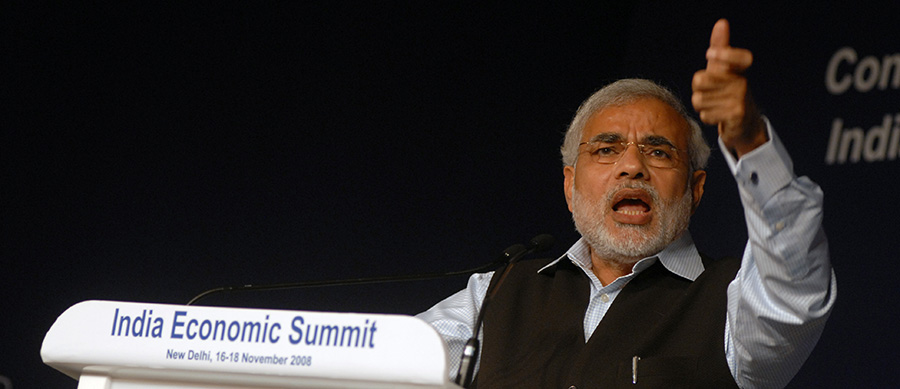
Will Modi Colonize his Country or Enact EcoSwaraj?

March 20, 2016 By meerasub Leave a Comment

NEW DELHI/INDIA, 16NOV08 -Narendra Modi, Chief Minister of Gujarat, India, speaks during the welcome lunch at the World Economic Forum's India Economic Summit 2008 in New Delhi, 16-18 November 2008. Copyright World Economic Forum (www.weforum.org)/Photo by Norbert Schiller

Photo by Norbert Schiller via Wikimedia Commons

I am a half-daughter of India. I have watched the South Asian nation develop since I first visited Madras as a young girl, my Indian father bringing his fair-skinned American wife and my brother and me from America on multiple trips to visit dozens of relatives along the shores of the Bay of Bengal.

In the forty years since that first visit, the country has undergone a whole-scale transformation. Never have there been so many humans with so much elemental need for healthy food, clean water, and dependable energy systems. How will India bring these basics to her citizenry?

In recent years, I have visited as an environmental journalist and Fulbright scholar to seek out the answer to this question, investigating the state of India’s natural world and exploring how the elements – earth, water, fire, air and ether – are faring. I found a subcontinent in crisis, but I also found individuals and organisations reinventing their landscapes and lives.

Whether they will receive support from the government remains to be seen.

Read the rest at TheDailyO.

Filed Under: A River Runs Again, elemental india, journalism Tagged With: A River Runs Again, Elemental India, india, journalism, opinion

Elemental India tour continuing south…

February 9, 2016 By meerasub Leave a Comment


2016.01.31-27

More events coming up for Elemental India. Specific details here. Hope to see you and do share the word with others you know in the following cities:

Pune:
• 11 Feb: Fergusson College
Chennai:
• 15 Feb: MIDS
• 16 Feb: IIT-M Research Park
Bengaluru:
• 19 Feb: Azim Premji University
• 19 Feb: IISc Centre for Ecological Sciences
Hyderabad:
• 26 Feb: University of Hyderabad

Filed Under: A River Runs Again, elemental india Tagged With: A River Runs Again, book tour, Elemental India, events, india, pollution environment

  • 1
  • 2
  • 3
  • 4
  • Next Page »

Follow Meera on Substack

for the very occasional bit of news.

Categories

Tags

Alaska anthology A River Runs Again Art awards birds birds of prey books book tour Cambridge cape cod climate change conservation death dissent Elemental India energy events Fulbright india InsideClimate News journalism kenya Knight Science Journalism Nature New York City organic farming Orion peregrine falcon pesticides photography politics pollution environment Princeton University radio readings religion reviews science Society of Environmental Journalists teaching travel USA vulture water

Archives by Month

Connect

  • Bluesky
  • Facebook
  • Instagram
  • LinkedIn

© 2026 Meera Subramanian. | All Rights Reserved. | Mastodon | Website design by Sumy Designs, LLC

Green_14