
One of my absolute favorite photojournalists is Ami Vitale. Here she is talking about her work around the world for a short film by MediaStorm, featuring her photography and videoography, as she talks about the power of the lens, the power of the natural world, and the power of people to make change in their lives.
in praise of geysers

It’s simple. Ten minutes before you plan to bathe, you flip a switch. The light comes on and the water heats up. You wash. You turn the switch off. Geysers, as these small almost-instantaneous-but-not-quite hot water heaters are called in India, are so smart. I don’t keep a kettle simmering all day so that when the urge for a cup of tea strikes, I can have it instantly. (btw, for my tea at home, I use this, one of the best Christmas presents I ever received.) Same idea. Yet this is how we heat water in American homes. It’s the second largest energy expense in the average home, typically accounting for about 18% of the utility bill.
This one in the guest house where I’m staying is particularly cheerful.
into the clouds

This is how my friend described Mussoorie, a hill town in the foothills of the Himalayas, in the state of Uttarakhand: “It’s as though someone has been up all night, scrubbing the sky!” Normally, that is what’s to be expected. Radiant blue skies of autumn. But the monsoon came early, and with a vengeance, causing flooding that wiped out villages in July. And it’s staying late. The scrubbers still scrubbing, nothing to see from down here on the ground but mist and clouds. Normal, these days, is no longer normal. [Read more…]
it’s a PublicAffair (and HarperCollins India, too)

Days before I got on a plane to head to India to continue researching and reporting my book, it was sold in the USA. (HarperCollins India will be publishing it in South Asia.) Here’s the official announcement:
Meera Subramanian’s ELEMENTAL INDIA, a bittersweet tapestry of five stories dealing with life, loss, and survival set against the lush backdrop of India’s natural world that renders the storm of opinions around natural resources into an intimate drama, to Clive Priddle at Public Affairs, by Elise Capron at Sandra Dijkstra Literary Agency (NA).
Now, to work…
Dilli, for a start
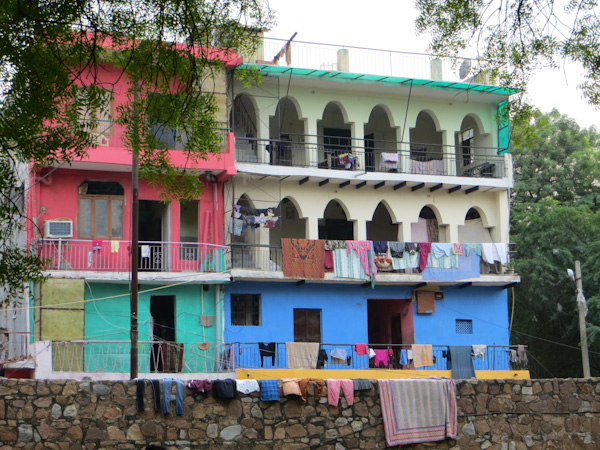
I arrived to Delhi to begin five months of research and reporting on Elemental India, with the support of USIEF’s Fulbright–Nehru fellowship. They set me up at the lovely Vandana B&B in Safdarjung Enclave, where I sit on a balcony as the sun goes down, the sky clearing after a day sprinkled with rains that brought the temp down. The birds are raucous, parrots having a cocktail party overhead and the kites catching the last of the day’s thermals. Crows find their stations on bare branches in the tree among a park’s trees across the street, plucking and grooming and stretching into the sunset. A chipmunk war breaks out in the treetops. Delhi is lush from a long summer and heavy monsoon rains. It is a jungle with a dead river flowing through it, inhabited by 22 million people. [Read more…]
school poisoning a window into a world of pesticides

The death of 23 schoolchildren last month in Bihar after they ate a free school lunch that was tainted with an abundantly used pesticide is just a reminder of the extensive presence of these chemicals in all facets of life in India. Last week, I spoke with radio host Carol Hills of PRI’s The World about the issue. Thanks to Peter Thomson for producing it.
farming into the future – presentation at sturgis library, cape cod

photo by Meera Subramanian
Join award-winning environmental journalist, Fulbright scholar and West Barnstable resident Meera Subramanian for an evening in Punjab, the breadbasket of India, exploring pressing questions about the future of food in South Asia and the world. Can India and other countries move away from the agribusiness model of farming that has been shown to deplete and contaminate water supplies, cause human health problems, and decimate wildlife habitat, yet still feed the growing number of people on the planet? Meet Gora Singh and other organic farmers in this northwestern corner of India, who insist the answer is yes. Punjab is where the Green Revolution began in India, and where a hint of what might come next is emerging. Also: bonus photographs from all over India! This talk is free, but registration is requested. [Read more…]
bihar’s school deaths highlight india’s struggle with pesticides

photo by Amit Dave/Reuters
India is still reeling from the deaths of 23 schoolchildren in the village of Dharmasati Gandawa in Bihar on July 17 after they ate a free school lunch that was made with cooking oil tainted with the pesticide monocrotophos. The police say that the cooking oil might have been kept in a container that once held the pesticide.
The devastating event in Bihar reveals a larger problem in India that stems from the wide use of biocides in myriad forms, in cities and villages, in homes and fields.
mucking about

It begins something like this…
I was expecting more dead bodies in Varanasi – really, burning bodies everywhere – for this is the place Hindus come to die, hoping for instant liberation from the cycle of birth and rebirth. But instead I discover that only two of the dozens of ghats are “burning ghats,” stacked with wood and smoldering funeral pyres. Most everywhere else, people are just very busy living. Some do cremate their loved ones here, but most engage in more quotidian tasks.
They wash dishes, wash clothes, wash their bodies. Mothers cook, feeding twigs into compact wood cook stoves and food into hungry mouths. People sell things; they buy things. They pray and dunk themselves in the water vigorously, jumping up and down as they fulfill a lifelong Hindu requirement to bathe in the waters of the Ganges. Others light candles and incense and circumambulate the grand broad-leafed pipul trees where I’m sure all these deliciously pagan-disguised-as-Hindu rituals originated, the idea of God and greater things tumbling from the branches like dappled sunlight.
Read the rest of Mucking About: Stepping into the Unknown on the Banks of Ganges here at Gadling.
And, even better, find a bookseller near you next month when The Best Women’s Travel Writing, volume 9 comes out and you can find Mucking About and a profusion of other great tales from travelers of the female persuasion. Or don’t delay and pre-order now.
no-compromise chocolatier mott green is gone

On June 1, 2013, Mott Green — old friend, compatriot, co-founder of the Grenada Chocolate Company — died from an electrocution accident in Grenada.
Yesterday, my sweetheart Stephen and I headed down to New York City from the Cape to go to Mott’s memorial service at the Riverside Memorial Chapel at 76th and Amsterdam on the Upper West Side. The day was gorgeous and traffic light, if my heart was heavy. I was worried I would know no one – my association with Mott through Oregon and Grenada, only connecting with him a few times over my time in NYC, meeting his mother at her home, and joining him and Pastrami that day we hunted down Jacques Torres and later slept on the roof of the 6th Street squat in the summer heat.
But the heaviness I carried for the last week lifted as soon as I walked in and saw Edmund Brown. Edmund! The third chocolatier! The last chocolatier from the theobroma trinity of Mott, Edmund and Doug Browne. Together they created a solar-powered, organic, radically egalitarian chocolate company that made damn fine dark chocolate. [Read more…]
- « Previous Page
- 1
- …
- 13
- 14
- 15
- 16
- 17
- …
- 27
- Next Page »
