Meera Subramanian
  • Home
  • Books
  • Writing
  • Bio
  • Blog
  • Photos
  • Events
  • Speaking
  • Contact

Consider the Vulture

January 31, 2024 By meerasub Leave a Comment

Line of vultures on curving branch

Vultures stay close to the feeding grounds of the Jatayu Vulture Restaurant, Nepal. Photo by Alisha Vasudev ©


For close to twenty years, I’ve covered the catastrophic decline, and tentative recovery, of South Asia’s vultures. In my book A River Runs Again, I took a deep dive into the situation in India. Last year, I went to Nepal to cover a new chapter in the story, as the country’s captive-breeding program came to a close, and the last birds were released back into the wild. The story was published today at The New Yorker. Here’s a bit:

We were in a microcosm of abundance in a landscape of loss: most of the nine vulture species found in South Asia were there in front of us. We watched white-rumped vultures, whose neck ruffles look like seventeenth-century formal wear, and Himalayan griffons, which are larger and paler. We also saw an immense cinereous vulture; a red-headed vulture with fuschia wattles; and a small Egyptian vulture. Nepali pointed out a slender-billed vulture. According to the I.U.C.N. Red List of Threatened Species, there are less than one thousand mature individuals left in the world.

One bird tugged at the cow’s head, which was now detached. The vultures were so gross that they were gorgeous. It’s easy to shun vultures as dirty and disgusting, or as harbingers of death, but they are more like undertakers, performing an essential job and receiving little thanks for their work. As obligate scavengers, vultures survive almost exclusively on what is already dead.

[Read more…]

Filed Under: A River Runs Again, elemental india, journalism, National Geographic Explorer, News Tagged With: A River Runs Again, Alisha Vasudev, Asia, birds, birds of prey, captive breeding, conservation, diclofenac, Elemental India, extinction, india, Nepal, pollution environment, The New Yorker, Tulsi Rauniyar, vultures

apologia

September 27, 2022 By meerasub Leave a Comment


Mourning Dove by Meera Subramanian

In homage to Barry Lopez and Amanda Stronza. And the flying creatures.

The familiar thud on the kitchen glass, but louder, heavier. When I look up, I still see small gray feathers suspended in the air. The stickers that help birds see the glass we like to look through, which I found through the American Bird Conservatory, have helped. The thuds have diminished this season, even as we’re in the thick of migration. I suspect that one of the raptors I’m so enamored of was in pursuit of this dove, frantic, flying fast, until the air became glass and she was downed. Other strikes this year were just stuns. Five minutes later, and the feathers lifted the life back into the sky, airborne again. Not this time.

In the summer of 2021, I had great plans to attend the The Art of Mending show at the Brick House Museum in Kennebunk, Maine. Covid thwarted the plans again and again. I watched the video of exhibition, glad for it, at least. The show was curated by Scott and Nancy Nash of the Illustration Institute / @illustration_institute. They’re friends. (Scott designed the gorgeous logo of RESP for us.) They’re the kind of friends you see once or twice a year and hours pass in an instant, so enlivened and wide-ranging is the conversation. They told us about the show when it was still in the planning stages. In these times when it can feel like too much is broken or breaking, they sought out those who were focused on repair.

woodcut of hands holding a dead bird

From Apologia by Barry Lopez, with woodcuts by Robin Eschner

One of the people they found was Dr. Amanda Stronza / @amandastronza, an anthropologist, conservationist and photographer in Austin, Texas whom they’d come across on Instagram when she started honoring the dead animals she discovered in her meanderings. She created memorials with the flowers, cones, seeds, leaves and whatever natural bits she found around the lifeless body. I took it today as inspiration. It seemed the right thing to do, when I lifted the dove from below the window and carried her to the edge of the yard.

Amanda, in turn, was inspired by Barry Lopez, who wrote about his tendency to stop when he sees roadkill and remove the body. “I carry each one away from the tarmac into a cover of grass or brush out of decency,” he writes in his short book Apologia. “Who are these animals, their lights gone out? What journeys have fallen apart here?”

A journey fell apart here today. More than one. It’s likely there’s a mate nearby, a mourning dove in mourning, their broods fledged but their bond still strong. The hawks won’t come back for their quarry, but perhaps she’ll be sustenance for someone else, a scavenger furry or six-legged, the cycle continuing.


Filed Under: just another day Tagged With: Amanda Stronza, Barry Lopez, birds, death, Illustration Institute, mending, mourning

found on Haul Rd

August 1, 2015 By meerasub Leave a Comment

2015.07.27Pluck-68

Still, always, I am enraptured. The sense memory of a peregrine falcon remains in my hands though it has been years now since I held one. But this gyrfalcon is new to my skin, new to my eyes. I think she’s a she, larger than a female peregrine, and she is dead and frozen on the table in the trailer of Lab 1 at Toolik Field Station on the North Slope of Alaska. Dalton Highway, better known as Haul Road for the semis that carry supplies back and forth between inland Fairbanks and Deadhorse on the Arctic Ocean, parallels the spine of the pipeline through this part of Alaska. On that road, the gyrfalcon most likely made contact with some vehicle passing through. Toolik people found her on the side of the road, intact, limp, just a dollop of blood at the edge of her beak. I found her in the -80 freezer, clouds of coolness pooling at my feet when Seth, the Toolik naturalist, opened the double door and found the plastic bag with her remains. He sets her out on the table. Switches on the light. He lets me hold her, the weight hefty for the hollow-boned fighter. Ice crystals glaze her beak, sweep over her eyes, cinched shut. Her tail is long, barred with bands of smoky grey and and smudged tan, the striations of feathers running on the diagonal. Her head tucks in toward one rounded shoulder, a demure pose, cozy and shy and frozen in place like the permafrost that lies below this northern land. On a piece of paper in the bag are the details: “Found on Haul Road btwn Slope Mtn & OKs culverts 7.17.2015″

Life forms larger than a mosquito are few and far between here on the halo of the earth. Ground squirrels scrambling along the tundra underfoot and the arora borealis, a different type of life force, invisible but existent overhead, masked by the eternal daylight this time of year. There is a buzz with each wolf or grizzly sighting, a coveted moment of witnessing great bigness. The ground is alive with microorganisms, and bees hover around the purple glow of fireweed blooms that are hopeful that a seed might form before the killing freeze arrives. But today there is one less gyrfalcon flying through these wide open skies. Seth slips her back into the bag and returns her to the raptor morgue.

@toolik @Mblscience #eulogy #gyrfalcon #raptor #Alaska #truestoryshort

Filed Under: travels Tagged With: Alaska, birds, birds of prey, raptors, Toolik

crowing about the ordinary

February 13, 2014 By meerasub

2014.02.08Pudu-182

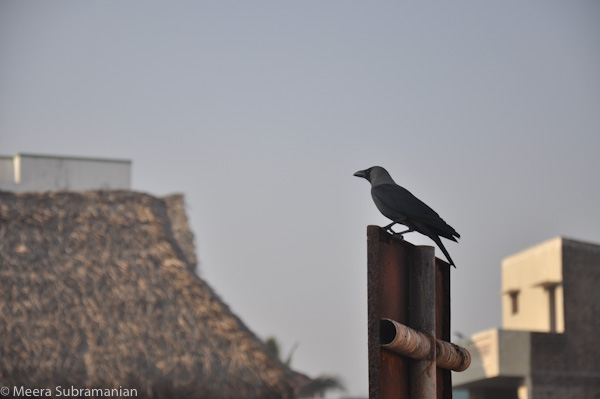
I have missed chasing birds on this trip to India. Mostly it’s been about people, in all their human glory, although the partial focus on vultures meant that the reporting about birds actually involved very few live creatures, but rather discussions and strategies for how to make a world where, once again, the skies becomes full. But one thing that a vulture conservationist said has stuck with me. He said that the South Asian vulture crisis has made him not take any bird for granted. (This, of course, could be extended to: take nothing for granted.) I’ve been trying to take his words to heart, directing my camera at the ebony and grey scavengers that remain, the Indian crow, Corvus splendens. [Read more…]

Filed Under: travels Tagged With: birds, crows, india

Follow Meera on Substack

for the very occasional bit of news.

Categories

Tags

Alaska anthology A River Runs Again Art awards birds birds of prey books book tour Cambridge cape cod climate change conservation dissent Elemental India energy events Fulbright india InsideClimate News journalism kenya Knight Science Journalism Nature New York City organic farming Orion peregrine falcon pesticides photography plastics politics pollution environment Princeton University radio readings religion science Society of Environmental Journalists teaching Texas travel USA vulture water

Archives by Month

Connect

  • Bluesky
  • Facebook
  • Instagram
  • LinkedIn

© 2026 Meera Subramanian. | All Rights Reserved. | Mastodon | Website design by Sumy Designs, LLC

Green_14