Meera Subramanian
  • Home
  • Books
  • Writing
  • Bio
  • Blog
  • Photos
  • Events
  • Speaking
  • Contact

The Future is Fungi

June 2, 2025 By meerasub Leave a Comment

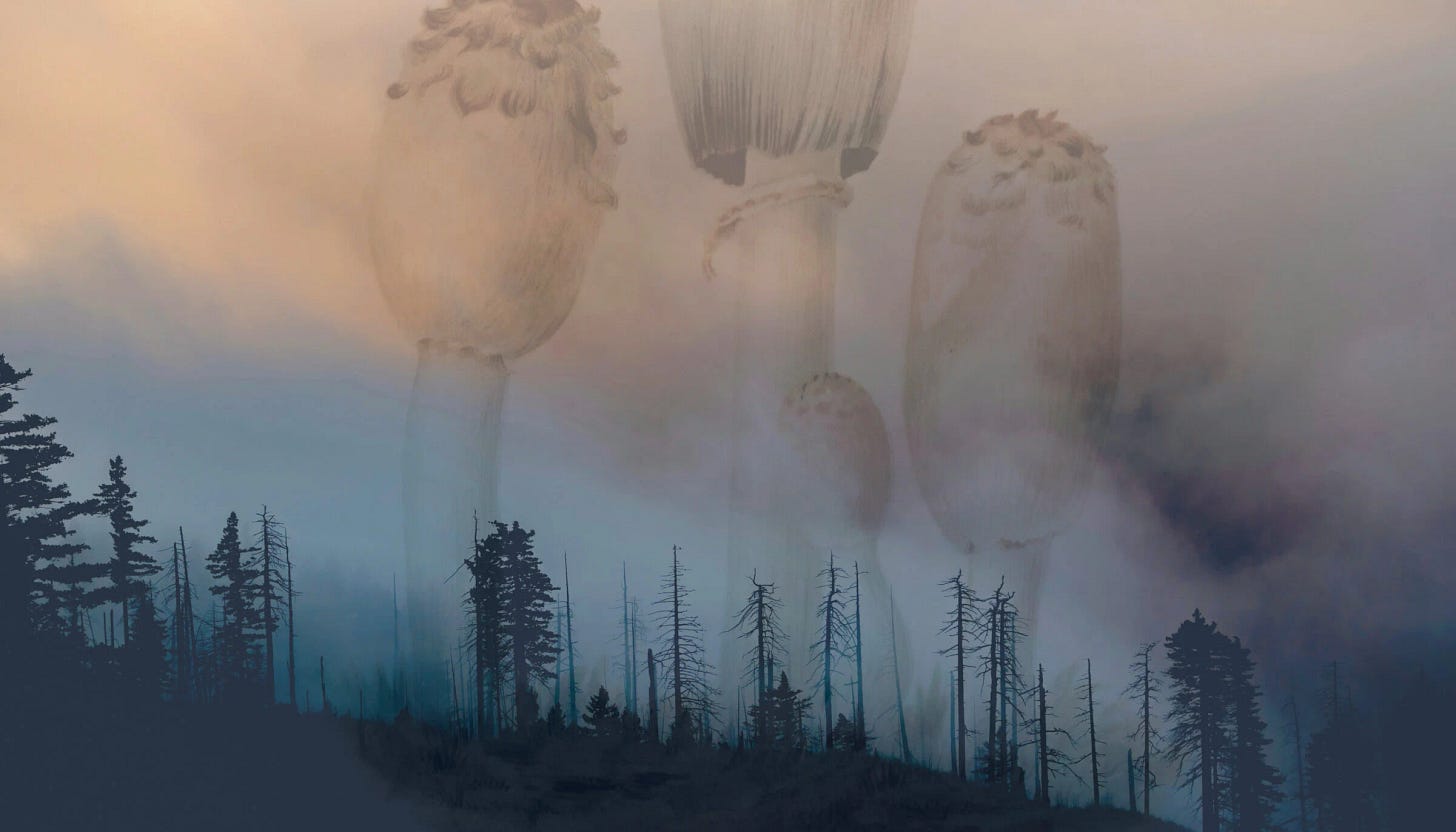
dreamy dual image of mushrooms and forest after fire
Art by iStock and Orion designer Ella Frances Sanders.

“Let’s talk about mushrooms. That’s a really good story. I love the mushroom story.”

That was Margaret Atwood’s response to Ezra Klein when he asked her about what what is not being discussed, but should be. Something fundamental. (Go to 1:03:30 here to listen.) I suspect he was expecting a response a little more on-the-nose about authoritarianism, but Margaret’s right. Mushrooms utterly break down hierarchies, and categorization, along with biomass. Spend any time considering the mushroom and you will have your mind blown, no ingestion necessary.

The latest issue of Orion magazine is all about fungi. It includes pieces from some of my favorite writers: Maria Popova, Erica Berry, Eula Biss, and Lia Purpura. There’s a conversation between Merlin Sheldrake, Jeff VanderMeer, Kaitlin Smith and Corey Pressman. And so much more! I encourage you to subscribe to Orion if you don’t already. It’s a beautiful, nonprofit, ad-free magazine about nature and culture that, in print, is an absolute pleasure to hold.

I had the honor of writing a piece, too. The Food & Environment Reporting Network helped fund the story “Out of the Ashes,” (thank you!), which considers the future of fungi (and us) in a warming world. I was drawn to the stories of Christian Schwarz and Ron Hamill, of their encounters with fungi and fire, of discovering newly named “exuberant cindercaps” but also watching mushroom flushes that felt like last hurrahs. Their stories make up the piece. But, honestly, one of the hardest parts about reporting is that so much never makes it into the story, but still informs me in so many ways. People are so generous with their time, with their experiences, their knowledge. Pages of notebooks filled. Tape running. And then it sits in my files forevermore. Please go read the final story, but I thought I’d use this space to share some of the outtakes:


hand holding mushroom
Photo by Meera Subramanian.

Return to Oregon

I was able to get back out to my old stomping grounds in Oregon at peak mushroom season to do reporting. Or, rather, what should have been peak mushroom season. It’s late October but it’s dry. Too dry. I took a mushroom identification class back in 1996 or so with Joe Spivack, and he proved a generous guide for this story. I stay with him and his wife, who are both good friends of mine. They have a weather station perched on their deck, the monitor affixed to their kitchen cabinets. The rain what was supposed to come that week registered a pathetic tenth of an inch.

We slip in a mushroom hunt on our way to the coast for the Yachats Mushroom Festival on the coast, bumping two miles up a logging road into the Cummins Creek Wilderness. The air of the forest is intoxicating. Cathy points out European buttercup, an invasive, that covers the ground, but also elderberry, sorrel, nettle. Names of plants I once knew come back to me. Western hemlock. Spruce. A few Douglas firs. Many of these species have close associations with mushrooms. We find a boletus, a false chanterelle, a short-stemmed russula, clavilina corral mushroom, Inocybe, a pile of Suilus, and Agaricus subrutilescens, which is good eating, the first find worth saving after twenty minutes of mushroom hunting. But Joe sees what’s not there. The mushrooms that are missing.

Finally we work our way up a steep hill to get off the trail and deeper into the forest, and almost immediately, Cathy finds chanterelles buried beneath sword ferns so immense they wrap our waists and disappear our legs. We lean down. We look. We ready our knives. Joe explains they’re slow-growing, and probably came up with the rains that were “normal and good” in September. We eventually get a few pounds among us, cleaning them off as we put them in our baskets and bags. “We should find like 60 species up here. We’ve found—what?—maybe nine, ten?” he yells to the trees as much as to me and Cathy. “This place is fungally devoid!” which makes me smile, even though there’s a pit in my stomach when you see these indicators of a changing ecosystem.

We leave with our small haul, winding the rest of the way on 101 into Yachats, crossing the Yachats River where bald eagles soar and seals frolic in the waves that pound the beach.

people climbing up steep sand dune
Climbing steep dunes as the day heats up. Photo by Meera Subramanian.

We never stop moving

It’s 9:15 in the morning and there’s still a chill in the air when Joe and I pull up into a parking lot at the Oregon Dunes Natural Resource Area. We’re met by Frankie, a black dachshund-pit bull mix whose human is forager and chef Joseph Crawford. I’m tagging along with him, Trent and Kristen Blizzard of Modern Forager, and their friend Jeem, everyone loaded up with gathering baskets, bags, knives, paintbrushes, and walkie-talkies. Water and sandwiches are already stashed in backpacks and the Gaia app set into motion. We walk across the parking lot, into the sand towards the edge of the shore pines—about 90 seconds of movement—before Trent cries out, “Matsi!”

For the next six hours straight we move, sometimes together, sometimes spread out, always within a holler of each other, or a two-note whoop that Kristen has for her husband, or resorting to the walkie-talkies when the distance gets too far. When it’s time to eat, Joseph pulls a sandwich out and takes a bite…and continues to move. There are logs to sit on. We do not sit on them. Instead it’s burritos al camino and sips of water sucked from Camelbaks.

We pass through a forest, spy bear prints that look quite fresh, cross a highway of sand dodging ATVs that appear suddenly. The dunes curve, the forest changes, from shore pines to pokey spruce forests that look like a fairyland of green amid a desert. Each ecosystem a world unto itself. There we—meaning the pros—find King boletes, Boletus edulis. We duck under the boughs of spruce, step through salal and kinickkinnick with bright red berries. The ground is spongy underfoot. We want to lie on it, sleep on it. I want to lie on it, sleep on it. But no, we keep moving! Trent is off ahead, nearly out of range, and Kristen checks in on him on channel 2 every once in a while. He sees a what we learn later is a ruffed grouse that seems to be following him. I think it’s my spirit animal, he says over the walkie talkie. The bird comes to me and Kristen. Keeps following our group, in spite of Frankie chasing it, causing it to fly into the low branches of spruce. Joseph is in awe. Tells me later, if I was alone, I would have stayed for an hour with it, meditated with it. He is wonderstruck. We all are.

Kristen Blizzard of Modern Forager finding Boletus edulis. Photo by Meera Subramanian.

In one rare moment, our group of six stops moving, Joseph and I grazing on an evergreen huckleberry bush festooned with dark purple berries that pop in our mouths. We talk about what is known about fungi. Frankie is grazing on the lower branches, lapping off the berries with his tongue.

“The black trumpets that grow here in Willamette Valley show up in random-ass places,” Joseph says. He is less interested in what we know and wants to revel in the mystery. “I’m trying to say we have no fucking idea why something grows there… There’s something super complicated and super confusing about fungi.” And that’s the beauty.

Joseph Crawford holding massive matsutake mushroom
Joseph Crawford holding massive Boletus edulis. Photo by Meera Subramanian.

Hours into our journey, I learn to see. It brings me to my knees, which sink into the sand. I reach for my knife. I cannot see the matsutake mushroom, but I know it is there. The dark asparagus-like stalk of a late-stage candystick/candy cane/sugarstick, Allotropa virgata, is a giveaway, since the parasite cannot live unless it thieves carbon from the green plants, those sun drinkers, around it, using the hidden underground threads of matsutake mycelium as the energy conduit.

A foot away from the candy cane is a hump pushing up the duff of the forest floor an earthly eruption. This is puhpowee, visible. I dig the point of the knife down around the stem as far as I can, as I’ve watched the experienced mushroom hunters I’ve been with for hours do repeatedly. I unearth a perfect 8” mushroom. My companions, whose bags are already laden with matsutakes and boletes, share the joy. I have found my fungi lens in these coastal Oregon dune forests.

Jeem hands me the cheap paintbrush we’re using to brush the sand off the bulbous base of the stalk, revealing creamy white. Before tucking it into my sack, I bring it to my nose to breathe its singular smell, piquant and woody, and that evening, I breathe in the scent again when I slice the firm flesh into thin slices and drop them into ramen broth. I take it into my body. The satisfaction of finding one’s food, plucking it alive from the earth. When I ask Kristen, “Why mushrooms?” she tells me it’s all about the community. She can open a bottle of preserved mushrooms and memories flood back of the day they were picked, the friends she was with. “So much of the terroir, that you recall with that smell.”

“I mean ‘looking’ not just in the sense of ‘seeing’ but also ‘looking for,’ to seek without the certainty of finding,” wrote Maria Pinto. “It is a kind of humble attention to the world, using all your senses to open yourself to life and the land.”

pine cone with mushroom being passed to a child
Photo by Meera Subramanian.

Mycologists, next gen.

Susie Holmes has been teaching biology at Lane Community College for 16 years, including mycology. Every year, she takes her students out to the forest that cradles the campus in south Eugene. “It’s a wonderful stand of oak and conifer,” she told me as we sat on strawbales at the Mt. Pisgah Arboretum the day before its mushroom festival. “So a nice set of ectomycorrhizal hosts.” She sends the student out to specific areas to document every single species of mushroom they can find. What is the species richness? Observe everything. Count how many individuals there are, the species abundance. Pay close attention. (This is why I love scientists. And poets. They spend their lives mastering the art of paying attention.) What happens when the adjacent stand is clearcut? The next year, the mushrooms were silent. She showed me a spreadsheet “We identified 397 distinct taxa over 15 years. 334 species.” Abundance. Richness. She teaches at college, but also volunteered at both mushroom festivals I attended. Sparking the next generation, and the one after that, with knowledge.

Susie Holmes handing mushroom to children
Susie Holmes at Yachats Mushroom Festival walk. Photo by Meera Subramanian.

“We’ll find out.”

By the end of my reporting, I realize I am thinking more about how fungi are changing in a time of climate crisis, which is the direction the story eventually went. Also at the Mt. Pisgah mushroom festival, I sat down with Noah Siegel, who just published a field guide, Mushrooms of Cascadia, with Christian Schwarz, who leads my story. Noah calls himself @mycohobo on Insta, spends months on the road following fungi. He can identify just about anything, and he’s seeing changes. Go into the southern Sierra Nevadas in California, he tells me, and you’ll see it. A third of the trees, dead from the last drought. Over the last handful of years, he’s seen the treeline literally going up in elevation.

“On the north coast of California, southern coast of Oregon, you can really notice the stress in the Sitka spruce,” he says. Summers have 35% less fog than they used to. And the trees need cold, wet summers. Without it, needles tumble off. Trees die back. “It wouldn’t surprise me if that tree disappears from California in the next 50 or 75 years.”

As for mushrooms in those conditions, “You just don’t find anything,” he says, too dry and then, all too quickly, too cold. “I mean, that’s happened a lot lately.”

“How long can that happen before the system…?” my question drifts off.

“…Collapses?” Noah fills the space. “We’ll find out.”

But, he’s not too dire. “You know, all these things have survived far worse droughts than what we’ve experienced lately. And they’ve also survived through ice ages. I mean, they’re resilient. It just may be different from what we’re used to.”

You need a wild forest

I meet Molly Widmer a week before she is to retire from her life of work as a BLM botanist. Her fair skin is brushed with freckles and her body can barely contain the energy of someone, it seems to me, who should be entering the work force, not leaving it. She tells me she likes to remind obsessive mushroomers of the ecosystems that are needed to provide for the delights they gather.

“Do you like chanterelles, boletes, matsutake, russulas?” she asks them. “You cannot have them without a wild forest.”

Yes, you can cultivate some mushrooms, but the vast majority need conditions we can barely understand. A certain plant, this much rain, that much cold.

“Mushrooming,” she says, “lends humility. There they are! There they aren’t! When will they be back? We have no idea.” No fucking idea.

Here’s to humility, and all the wild forests and rank places that bring us the bounty we need to survive and delight in the world.

Check out the full issue of Orion about fungi here: https://orionmagazine.org/issue/summer-2025/. Get a subscription! Follow me here.

Journalists & writer friends, take note…

  • The Institute for Journalism & Natural Resources, in partnership with the Uproot Project, is offering Reporting on the Urban Environment, an expenses-paid workshop for journalists of color. Deadline: June 6
  • Grants of $5,000 to $10,000 available to support significant reporting efforts that lead to the publication of content connected to the Colorado River Basin from the Water Desk, based at the University of Colorado Boulder. Open to journalists (freelance and staff) and media outlets. Deadline: June 16

And from the Department of Good News…

  • Scientists at the Alhambra, the thirteenth century Moorish palace, in southern Spain, are ensuring that the grounds preserve biodiversity along with human history, reintroducing lost species and managing to create habitat. Newt sex!

I’m reading/listening…

  • …to so much goodness!
  • Martha Park, who was one of our Religion & Environment Story Project fellows, has published her first book, World Without End: Essays on Apocalypse and After. A beautiful inquiry into motherhood, faith, and how to live in the world, written through memoir and reported essays. We had a lovely conversation about it that will be published soon.
  • Listen (or read) Annabel Howard’s piece Thirty Years in Emergence. I enjoyed listening to her read it in her lush voice.
  • Spy on Devon Frederickson’s life in Norway via Instagram as she works on her new book about the community of people who coexist with common eider ducks.
  • Corey Farrenkopf was the librarian at my local library until he shifted farther out on the Cape. He’s been a dogged writer, and and his new collection of short stories, Haunted Ecologies, brings together eco themes and horror, a genre I haven’t read since I binged on Stephen King as a teen. Really, these days, they’re not so far apart. He also has a novel. Go, Corey!
  • Just finished Via Negativa by Daniel Hornsby, whom I’ll have the pleasure of teaching with in Sewanee School of Letters this summer. It’s about a priest on the run, moving both away from and towards something as he tries to find some sort of peace, an injured coyote as companion. Full of thoughtful luminous lines like, “I felt that a blanket of darkness had been pulled over things. Or a blanket of false light had been stripped away….”
  • I’m calibrating my consumption of news, and appreciating Trump’s environmental policies quantified by Jeff Tollefson in Nature.
  • Climate Note, a new report from the great researchers at the Yale Program on Climate Change Communication shows that “ a majority of registered voters want federal agencies to increase their efforts to protect people from the health harms of global warming.”
  • And then check out the women making their dream maps in India, showing how they envision restoration of once communal lands.

Coda…

I am still highly distracted by the turkeys that are in the yard continuously. More pulling down books on birds from my bookshelves. More realizations. We live in a lek! An exploded lek! (Not so different than the sage grouse ones that draw tourists from far-flung places out west.) Most of the females have disappeared, presumably to sit on nests, and it’s primarily down to three males vying for the affection of a single female. One fellow is in the lead. There’s been some more fighting among two of the boys (the third hovered longingly, “Doesn’t any one wanna fight me?”), but mostly strutting. So. Much. Strutting. If I were a filmmaker, I’d direct a scene where a woman is quietly eating her dinner with focus while three men flex their muscles and pump their chests behind her. And she pays them no attention at all. But she’ll make her choice, eventually. She seemed close yesterday, letting the lead circle around her like a planet around a sun. And this morning the yard is quiet. Except for the brood of hairy woodpeckers chittering and chirping from the hole in the tree visible from my desk. Heading to Sewanee, Tennessee to teach in a few days. Hoping for woodpecker fledging to witness before I depart, and that the turkeys don’t move in with S. in my absence. They’re getting very very comfortable…


two turkeys perched on a deck railing

Filed Under: climate change, journalism, Orion, photography, Substack, travels, Uncategorized Tagged With: climate change, climate crisis, fungi, matsutake, mushrooms, Oregon, Orion

every day is turkey day

April 21, 2025 By meerasub Leave a Comment

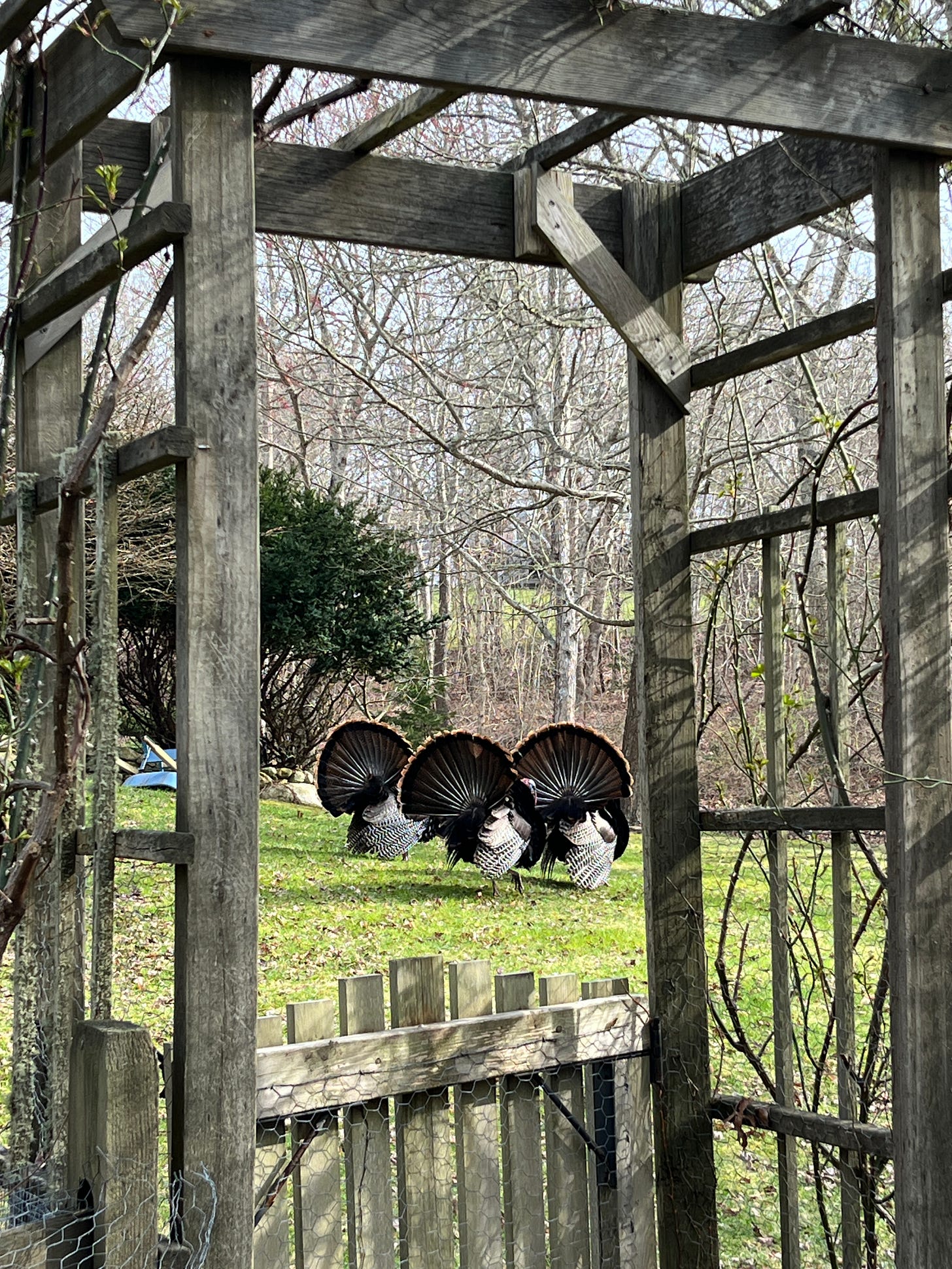
Three turkeys with tails fanned out, viewed through a garden gate

The view from my garden. Credit: Meera Subramanian

I have reluctantly returned to the country of my birth, the place that has always inspired the greatest culture shock after long travels. How quickly I’ve stopped dreaming in Spanish, as the raucous sounds of English fill my mind. Foot travel and cheap trains are replaced by big trucks riding the ass of my Prius as I drive too far to get a dozen eggs that cost six times what they did in Spain. But there are good friends, and my beloved bookshelf, and the yard is teeming with turkeys and other signs of springtime life. Together, it is the antidote to the unraveling.

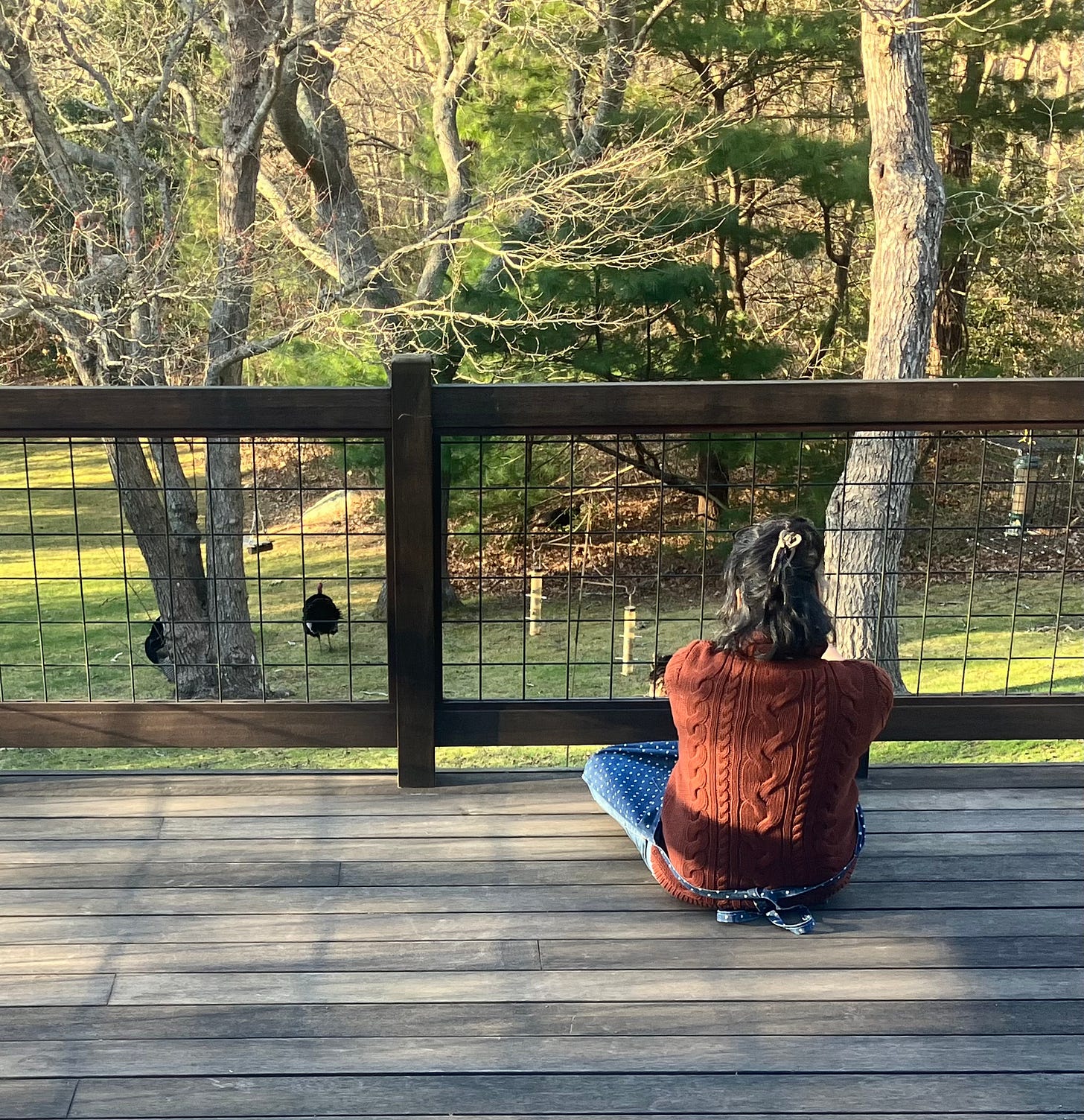
Between the work of catching up—pitching stories about renewable energy in Spain, preparing for a talk (more below), handling personal crises minor and major—I watch wild turkeys loitering about Cape Cod. Or, I guess, we’re the loiterers. They bear our presence. I could watch them all day. And do.

Woman sitting on deck watching turkeys in yard

Take the time to notice the wild things around us. Credit: Stephen Prothero

Tomorrow is Earth Day, something I find myself resisting—every day is earth day, damn it!—and it comes as years of scientific gains and movement towards climate goals are being bludgeoned, as human rights from clean air to due process are eroded. I gather with my fellow citizens on the rotary who hold signs mentioning kings and oligarchs tight lest they blow away in the fierce wind. My friend and I talk with Andrew, a supporter of 47, a proud participant of January 6th, his language and message perfectly honed in response to any question. “Anything you want to ask us?” I offer, but he shakes his head and responds with a sentence that drifts away in the wind, “No, I have trouble getting my thoughts together…” We’ve all learned how to talk in this age of pontification. Listening is another skill.

I gain more understanding by returning to Jeff’ Sharlet’s book The Undertow:

We say we are in crisis. The crisis of democracy—the gun—the crisis of climate—the fire, the water, the rain—the crises of our own little lives—debt and Twitter and rage, and most of all the ordinary losses of love and loved ones that feel too vast. But that word, crisis, supposes we can act. It supposes the outcome is yet to be determined. The binary yet to be toggled, a happy ending or a sad one, victory or defeat. As it we have not already entered the aftermath.

Will we save democracy or lose it? Will the earth boil, or will we all drive electric cars? Are the dead gone, or do they live in our hearts forever?

Such imaginations we have.

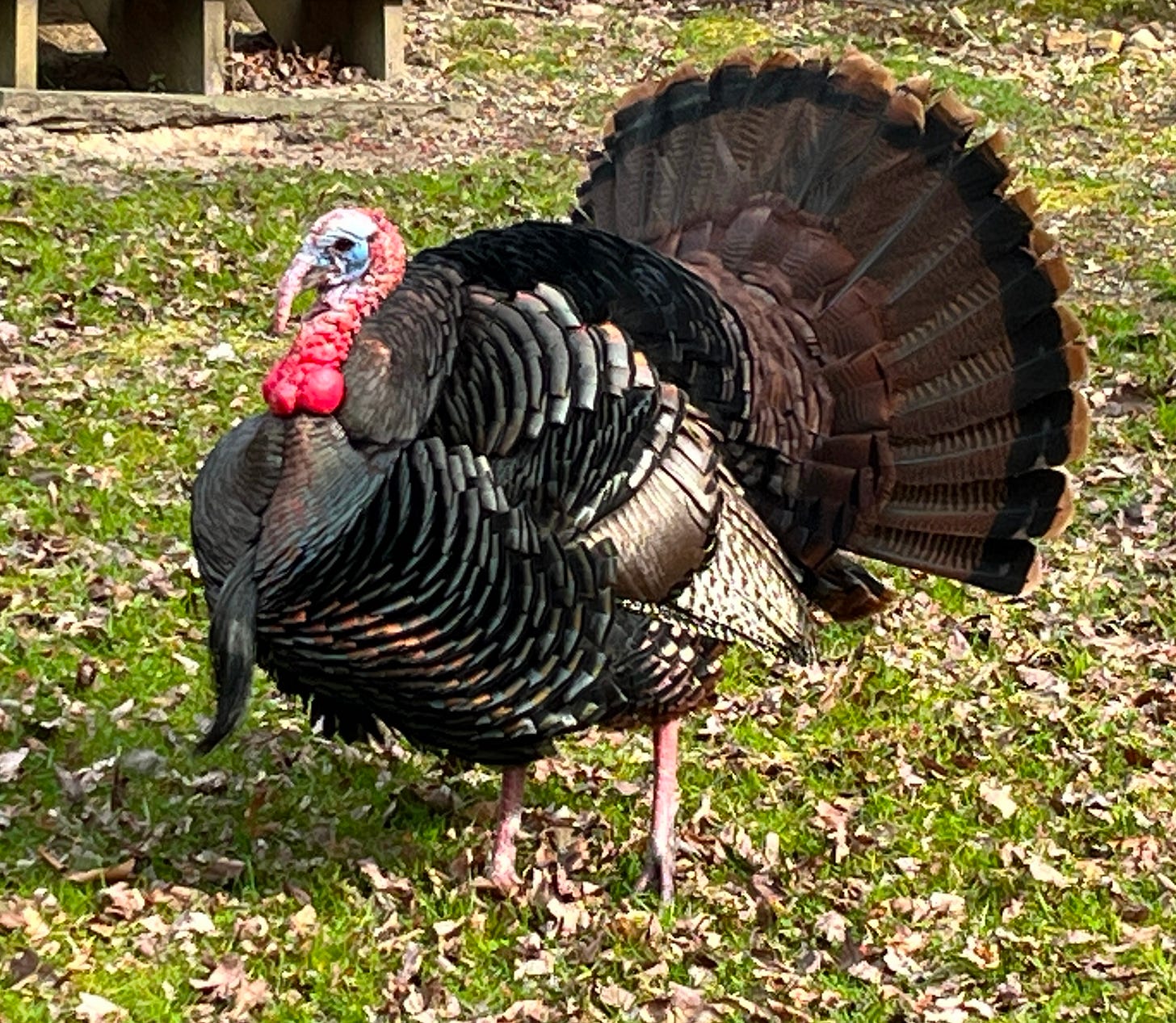
My imagination wanders, as I watch eight tom turkeys back home, spectacular tail feathers fanned in full display, wings hanging low as they shimmy, faces an explosion of blue and bright red, all glorious and grotesque. The dangling wattle known as a snood draping down over their beaks in the most impractical of ways.

Tom turkey in full display

Tom turkey in full display. Credit: Meera Subramanian

You may have heard the ole story, about Benjamin Franklin and his disappointment that the aggressive eagle had been chosen as our nation’s symbol. In 1784, he wrote in a letter to his daughter:

For my own part I wish the bald eagle had not been chosen as the representative of our country. He is a bird of bad moral character. He does not get his living honestly. You may have seen him perched on some dead tree, where, too lazy to fish for himself, he watches the labour of the fishing hawk; and when that diligent bird has at length taken a fish, and is bearing it to his nest for the support of his mate and young ones, the bald eagle pursues him, and takes it from him. . . . the turkey is in comparison a much more respectable bird, and withal a true original native of America.

I agree, even though my love of raptors is deep and slightly irrational. But even the morally bankrupt eagle only takes what she needs. Acknowledges the limits of necessity even as he steals from the osprey. But the turkeys do earn my respect as they did Benjamin’s, as they make their own way through the world. Mostly peaceful.

There’s been some fighting, too.

One male jammed his beak down the other’s throat and held it there for so long in a suffocating stalemate that I was thinking there might be a roast turkey for dinner. But one relented, and the other chased the loser away. It always seems to be the boys. The hens just want to eat in peace, and carry on with their task. I thank them for ridding our yard of ticks more than their sparring, strutting cohorts. But all play their part.

How quickly I’ve become accustomed to them. When a fox ran through the yard, they scattered, one even taking a lumbering flight to the treetops where they roost at night, (enormous black silhouettes against the skeletons of still bare oak branches and a gloaming sky draining of color). The daytime yard was empty for hours and a keening loneliness set in that only abated when I once again detected movement out of the corner of my eye.

When I went down to work in the garden to gather my thoughts, they scattered again, only to drift back up and surround me as I turned over the winter cover crop, preparing for what is to come, for another season to unfold. The work of a garden is endless. So is the work of democracy. Or for a habitable climate. I will be the first to admit it is exhausting.

Yet.

The turkeys carry on. And so do I. And so do you. Find our ways to fight and also know that we need to make time to ensure our own sustenance as well. Step away from the socials. Pick up the binoculars. Watch the natural world doing the work of living. The toms, the hens, together. They are all spectacular. These magnificently large creatures, living in our midst. Doing the work of replenishment. Eating. Courting. Creating more.

It wasn’t always like this. Native to North America, Meleagris gallopavo was domesticated by the Aztecs, who introduced them to invading Spaniards, who took them to Europe and then brought them back, while other conquerers nearly annihilated the wild ones. In the early 1800s, only about 30,000 remained, down from many millions. Today, there’s an estimated seven million in North America, in part because of the work of hunters and governments. Disappearance is one possibility. So is abundance.

No wonder I want to turn my attention to them. Especially as I prepare to share stories of disappearance and hopes of resurrection from South Asia about some other very large birds….

Talking vultures

For those in the Cambridge, Massachusetts area or who have access to a computer, I invite you to join me for a talk I’m giving this Friday evening for the Brookline Bird Club, taking place at Harvard’s Geological Lecture Hall. It’s titled South Asian Vultures: Crisis & Conservation. Here’s all the info and here’s a description:

Not too long ago, millions of vultures flew over South Asia, so abundant that no one had bothered to count them. Until the 1990s, when populations of three Gyps vultures collapsed by more than 97 per cent in a decade. It was the fastest avian decline ever recorded. Conservationists scrambled to find the cause and start captive breeding programs. What happens when South Asia’s essential clean-up crew vanishes? Cape Cod-based journalist and National Geographic Explorer Meera Subramanian has spent nearly twenty years searching for the answer to that question and discovered a story of conservation in a time of mass extinctions, a chronicle of biologists strategizing and cautiously celebrating. Join her as she shares photos and stories from covering the crisis in both India and Nepal, where the birds’ absence has had ecological, cultural and even religious implications.

Journalists & writer friends, take note…

  • The Council for the Advancement of Science Writing (CASW) is accepting entries for the fourth Sharon Begley Science Reporting Award, a career prize for a mid-career science journalist of “unflinching dedication, skill, moral clarity, and commitment to mentoring”. Prize includes a $20,000 grant. Deadline: April 30, 2025.
  • Orion Environmental Writers’ Workshop (June 15-20, 2025, The Omega Institute in Rhinebeck, New York) Join a community of writers, improve your craft, and reimagine how you think about nature. Guided by award-winning instructors, the Orion Environmental Writers’ Workshop provides an intimate space to connect with writers, artists, and editors, spark creativity, and renew, illuminate, and deepen your relationship with place. This week-long workshop is cosponsored by the Omega Center for Sustainable Living. Deadline: May 1, 2025.
  • FRONTIERS open call for application for early-career journalists Round three! This is the same fellowship I just finished up in Spain, but targeted for early-career journos. Deadline: May 6, 2025.
  • Covering Climate Now announced an updated training program, aimed at helping newsrooms grow their audiences by telling the climate story better. The program is available exclusively to journalists working for CCNow partners. For a list of the specific trainings they’re offering, free of charge and starting this spring, check out the Climate Journalism Training Catalog.

I’m reading/watching…

  • After the Deluge by Gary Greenberg in Harper’s, in which he explores some of the same possibilities I did in this piece I wrote for Orion a while ago, but from the close vantage of a small Connecticut town’s selectman responsible for trying to unite a divided populace in the aftermath of a tornado…and a flood. What climate change?
  • This consideration of life and death on a Washington farm, from my friend Christopher Solomon, in Orion.
  • I’ll keep reading Brendan Boyle’s Substack, La Comunidad, on life in Spain. On his post, What does Spain think of Donald Trump?, he captured what I experienced during my travels and conversations across the Iberian Peninsula.
  • I finished Carlos Ruiz Zafón’s Shadow of the Wind, which descended into darkness that feels like it’s getting closer to today’s America. But I’m holding onto this line, as I turn to new writing projects that still elude me: “Julián had once told me that a story is a letter the author writes to himself, to tell himself things that he would be unable to discover otherwise.”
  • I love this visual portrayal of land use made by National Geographic Explorer Dan Raven-Ellison, who traveled the length of Great Britain and captured drone footage of suburbia and bogs, fields and forests, seaside and soccer field, with each second representing a percentage of land use.
  • This morning’s post by Bill McKibben, on the death of Pope Francis, a religious leader who recognized that the real roots of the climate crisis reside in the power imbalance created by a “technocratic paradigm” and viewing the world through a reductionist lens.

Coda…

Years ago, I attended an event in Chennai, India, with Jane Goodall as part of her ceaseless work with Roots & Shoots. I went with my mom and dad, my mom’s hair long and grey and pulled back in a long ponytail that made her look like Jane. Last week, my musician friend Casey Neill saw Jane in Oregon, still ceaseless at 91 years old, and there she was as musician Dana Lyons sang this song for her. Dana’s new record is ‘Cracks in the Heartland,’ which Casey produced. Enjoy, friends.

Don’t stop, ever.

Filed Under: A River Runs Again, elemental india, events, just another day, photography, readings, Substack, travels

On the Move: Bilbao to Tarifa, in pursuit of good energy

March 15, 2025 By meerasub Leave a Comment

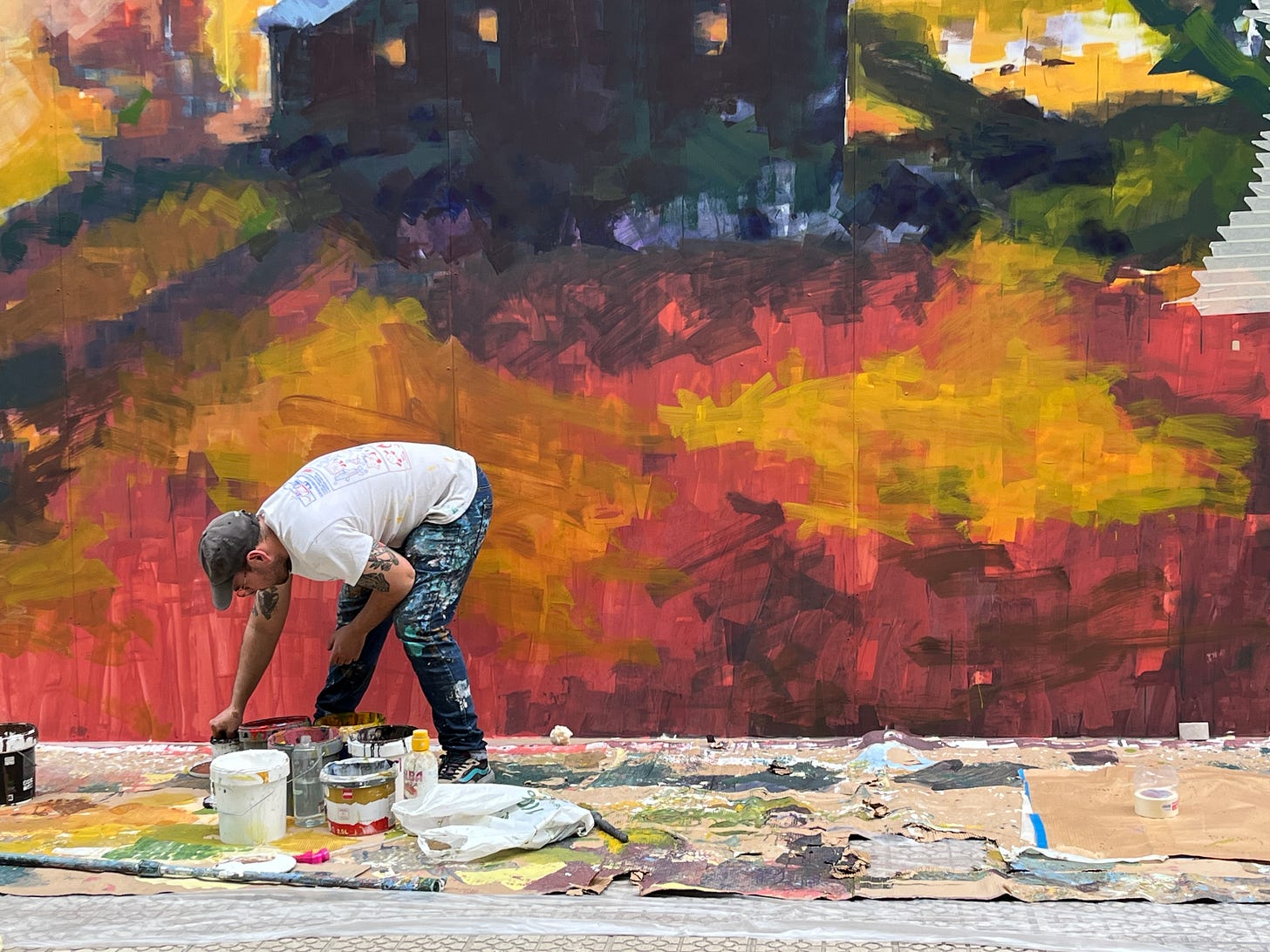
man bent over paints with a wash of color on wall behind him.

Muralist at work, Bilbao. Photo by Meera Subramanian.

{Latest Substack}

Peregrinations are underway. I’m more than two months into my FRONTIERS fellowship, the first half of which was spent in Bilbao at the Basque Center or Climate (BC3) Change. I came here with the question: can renewable energy projects be built in a way that’s better for biodiversity, people, and place?

It’s complicated.

But like the muralist I caught mid-stream as he transformed a construction blind into a work of art, it takes layers of paint, layers of understanding. I’m thankful for the FRONTIERS grant to have the time to keep digging. The researchers at BC3 helped give me a crash course in understanding the renewable energy landscape, and I’ve been busy conducting dozens of interviews, in Spanish and English, with BC3 staff as well as people all over Spain and in France. They’ve included researchers in agrivoltaics, ornithology and environmental conflict; organizations such as Greenpeace, Eudemon and Renewable Energy Foundation; political representatives such as mayors of small towns with renewable energy projects; reps from renewable energy companies; and many others.

When I arrived in Spain, Biden was still president. A week later, he wasn’t. Nowhere is far enough away from the new president’s wrath. BC3 researchers lost US partners when funding was frozen. A cousin lost his job in Bangkok related to USAID. A friend lost a year’s worth of climate work on New Jersey organic farms. A niece’s new position at NOAA as a fledging applied ecologist feels tenuous. But also, my stepdaughter, who is an environmental lawyer for Earthjustice, was part of the team that just sued Trump and the USDA to release IRA funds that were contractually promised and are now frozen. The lawsuits against the administration are piling up.

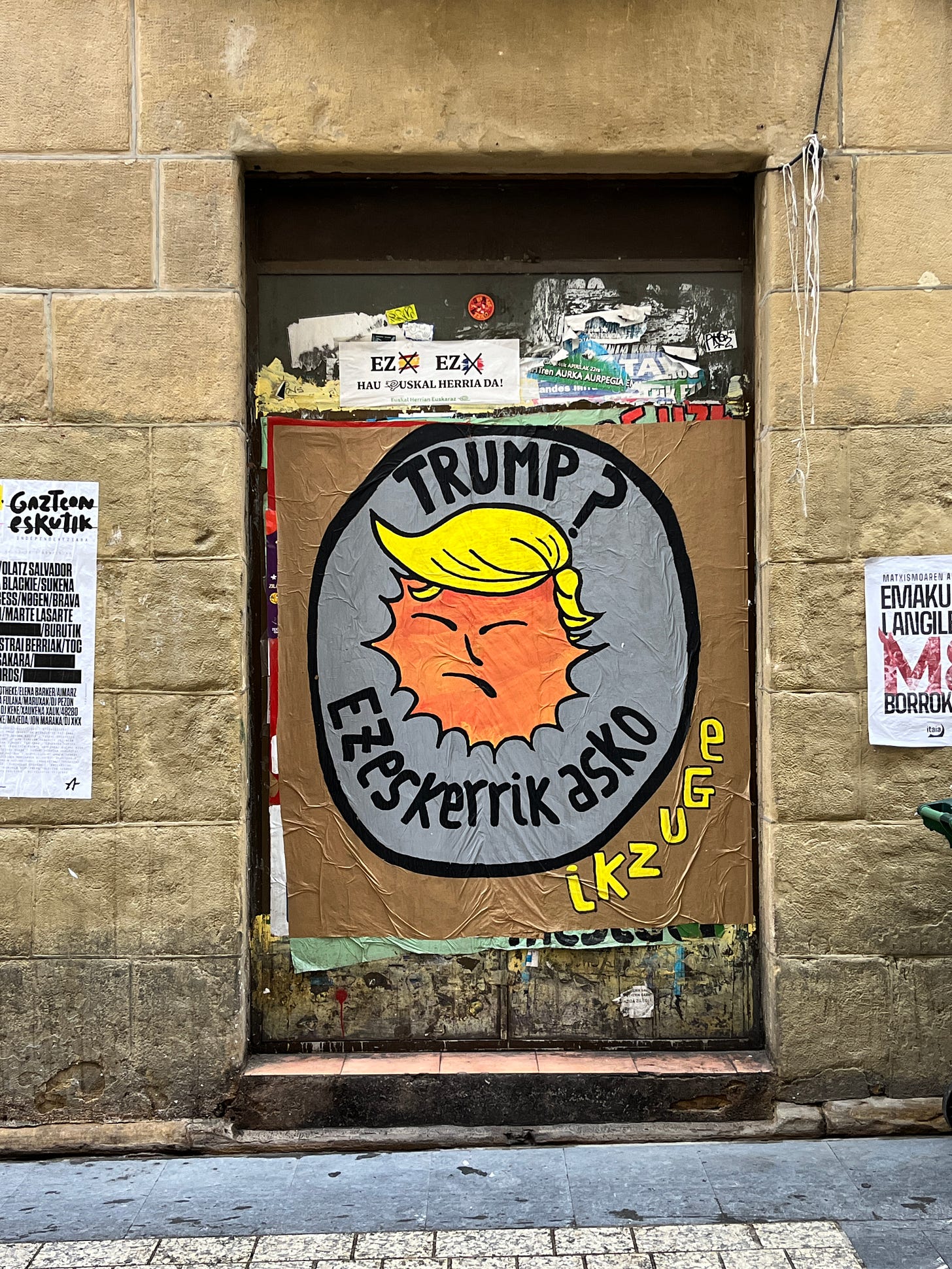
Here in Europe, the mood is jittery. (Also, I am fielding the repeated baffled question/accusation: how could you Americans have voted him in … again?!) I attended The Climate Agenda in the New European Legislature and Its Impact in the Basque Country, an event in Bilbao on January 31, when the wrecking ball was taking its first wild swings. Panelists included local politicians and journalists from other parts of Europe, offering a lens into the dynamics and tensions around renewable energy, especially in the wake of the inauguration of Donald Trump. Europe is readying itself for … well, just about anything. There is the tension between the desperate need to ramp up the clean energy transition to achieve energy independence butting against the need to divert resources to build war chests. Bolstering nuclear power keeps coming up. So does resistance:

graffiti in Basque Country, Spain

Spotted on a wall in San Sebastian, a play on an anti-nukes image, “Nuclear power? No thanks,” in Basque. Photo by Meera Subramanian.

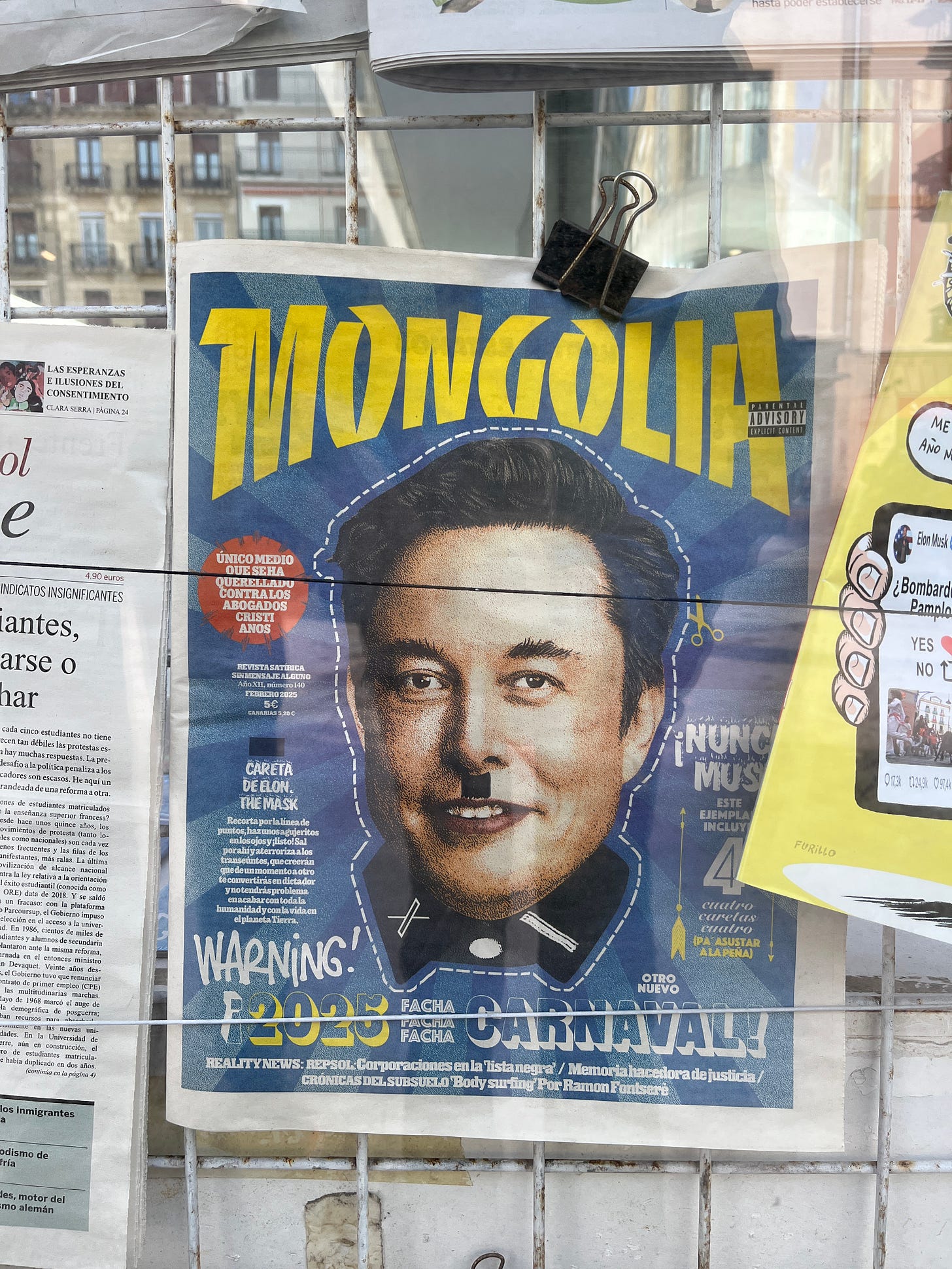
Also spotted at a news stand:

Photos by Meera Subramanian.

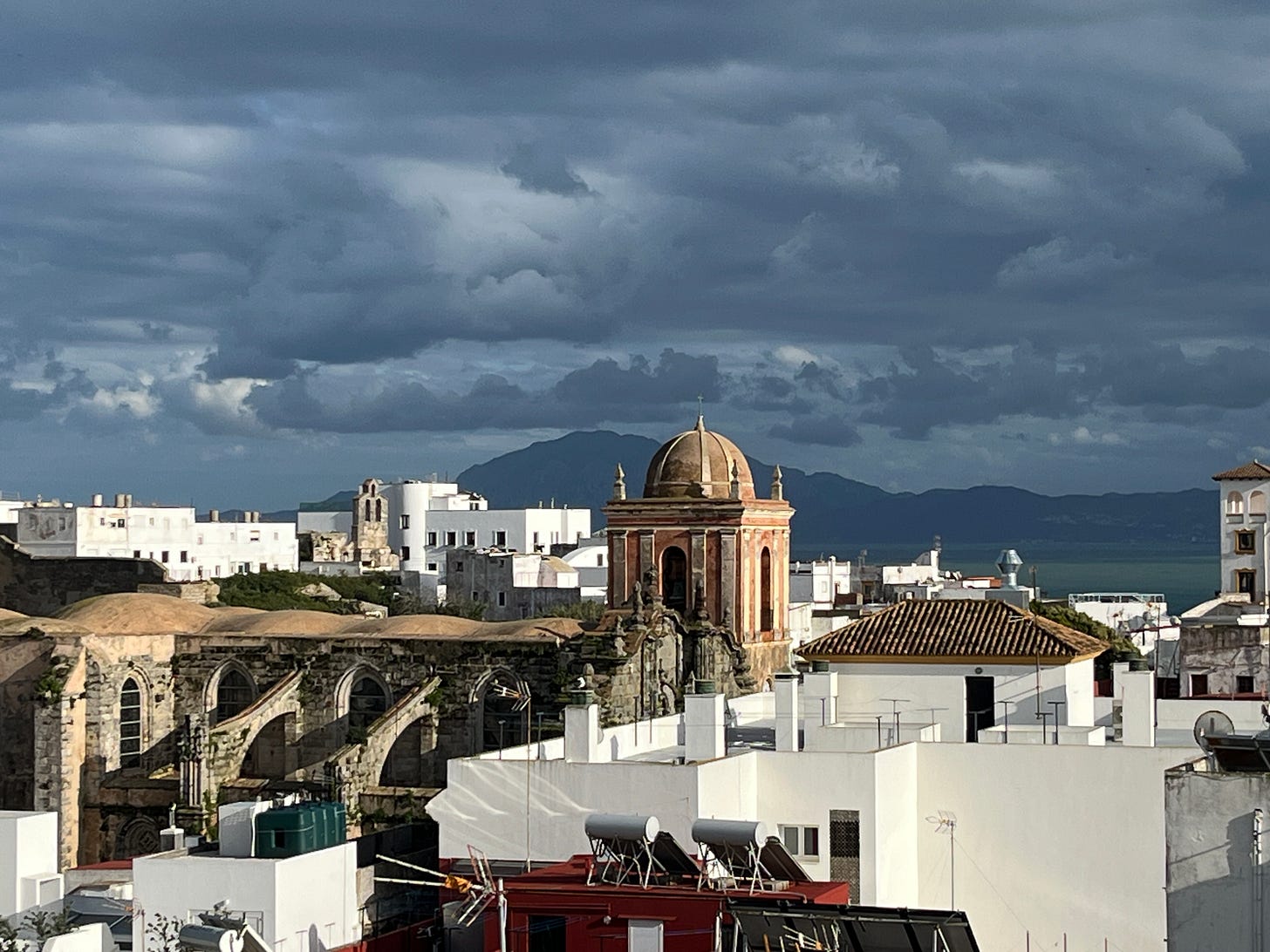
But I could only do so much from Bilbao. I’m spending the second half of my time here reporting, going to see solar and wind farms that are trying to do things better for birds and farmers and towns. Now, I write from Tarifa, the southernmost tip of Spain, a windy passage where Europe meets Africa, the Atlantic Ocean meets the Mediterranean Sea. It is difficult to concentrate on the screen, because I’ve come here to look at the sky, the bird migration just beginning. Wind turbines spin behind me up the hillsides of Spain, as well as across the waters of the Strait of Gibraltar, atop Morocco’s mountains. It’s a slalom course for migrating birds, but I’m here to see the efforts to lessen the impact.

Tarifa, Spain, looking across the Strait of Gibraltar to Morocco

Tarifa, Spain, looking across the Strait of Gibraltar to Morocco. Photo by Meera Subramanian.

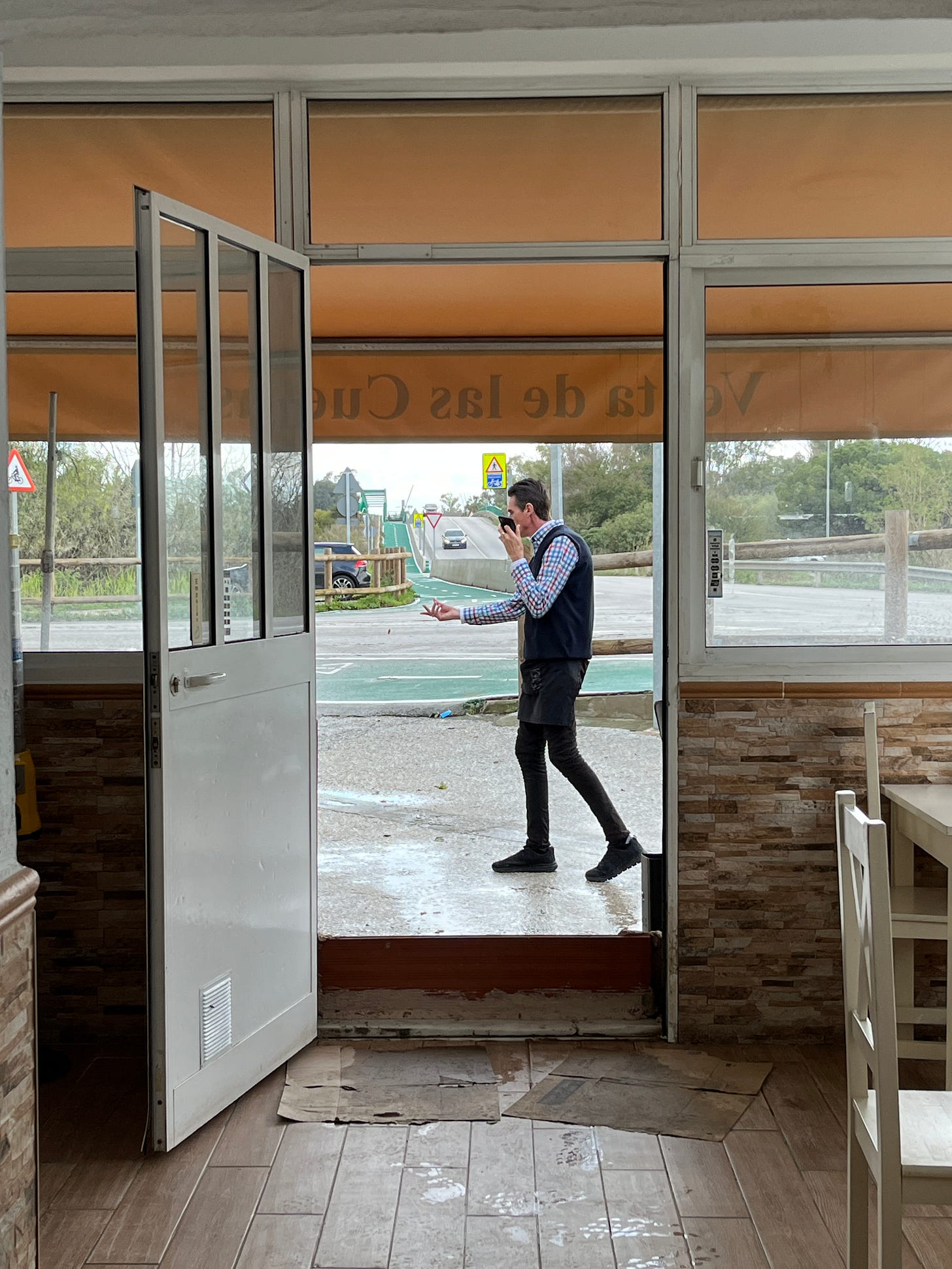
I am thankful for a moment of sun. Andalucia, like most of Spain, has been under a deluge of rain. So much that I couldn’t make it to some of the solar farms on my itinerary, so mired they were in mud. The rain is good, in some ways, needed to alleviate a drought, but it’s also coming too quick, too much, rivers rising. Causing a different type of jitters, with the Valencia floods that killed hundreds last fall still in close memory. I stopped in a cafe for a quick coffee and had to step over the barrier constructed to keep out the rain. It wasn’t enough. The man who passed me a steaming cafe con leche said that, a week and half ago, the place was filled with a half-meter of water. Too early to attribute these weeks of rain to climate change, but it fits the pattern of more extreme weather. More drought, followed by heavier, more intense rains.

man outside, and lower part of doorway blocked.

Blocked threshold to keep rain out. Photo by Meera Subramanian.

One can only hope that the lush green of this wet spring’s growth is not fuel for wildfires of the future. And that the stories I’m finding offer models that can be implemented—quick! now! yesterday!—to get off fossil fuels and onto clean energy sources in a way that doesn’t cause greater harm or collateral damage. Stay posted for more stories to come. 

Journalists & writer friends, take note…

  • Orion Environmental Writers Workshop Join a community of writers, improve your craft, and reimagine how you think about nature. March 15 (today!) for early bird tuition rate.
  • Covering Climate Now is offering a free training program aimed at helping newsrooms grow their audiences by telling the climate story better. Check out trainings on offer: Climate Journalism Training Catalog.
  • The Sharon Begley Science Reporting Award is open for entries. Deadline: April 30.
  • FRONTIERS open call for round three, specifically for early-career journalists Deadline: May 6, 17:00 (CEST).
  • Dart Center forJournalism and Trauma, the C.A.R.E.S. (Connecting Audiences, Reporters, Emotions, and Sources) Media Initiative is conducting research to better understand the resources that journalists on the climate/environment beat need to do their work. Take a moment to do this survey.
  • Trying to keep track of the Trump administration’s dismantling of climate regulations? Options include: “A Running Tally of Trump’s Climate Impacts” from Drilled, and the Climate Backtracker from the Sabin Center for Climate Change Law at the Columbia Law School.
  • NYU Stern Climate Economics Journalism Fellowship will bring a group of journalists to NYU Stern’s Greenwich Village campus, September 18–19, 2025, to learn from globally recognized experts in the emerging field of climate economics. Open to new and experienced journalists (staffers and freelancers) covering the interface between climate and the economy. Here are details and application.

And from the Department of Good News…

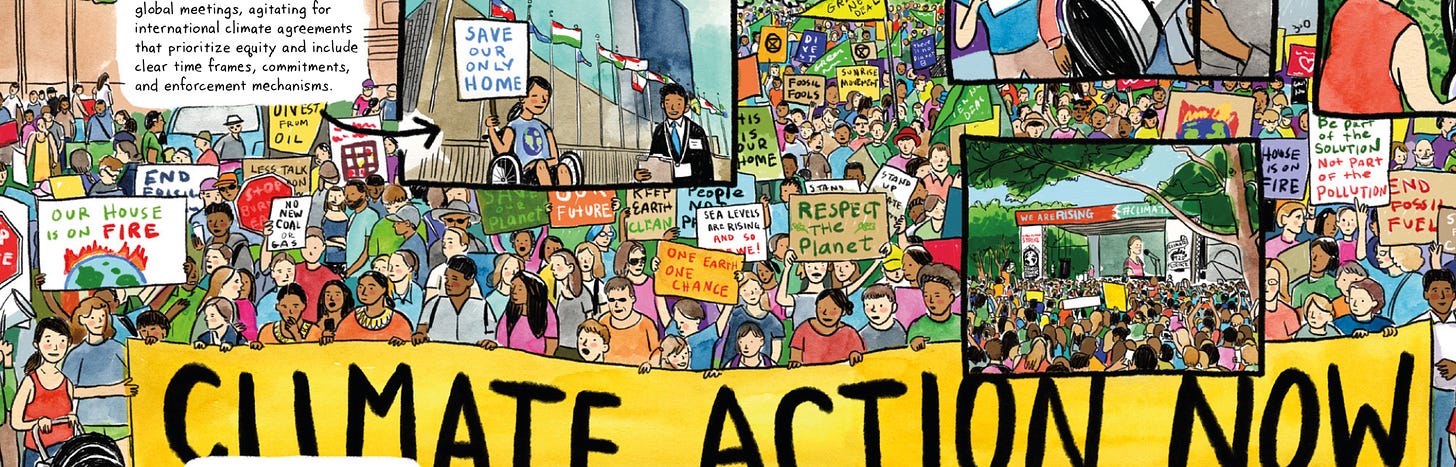
illustration of climate march

Illustration by Danica Novgorodoff

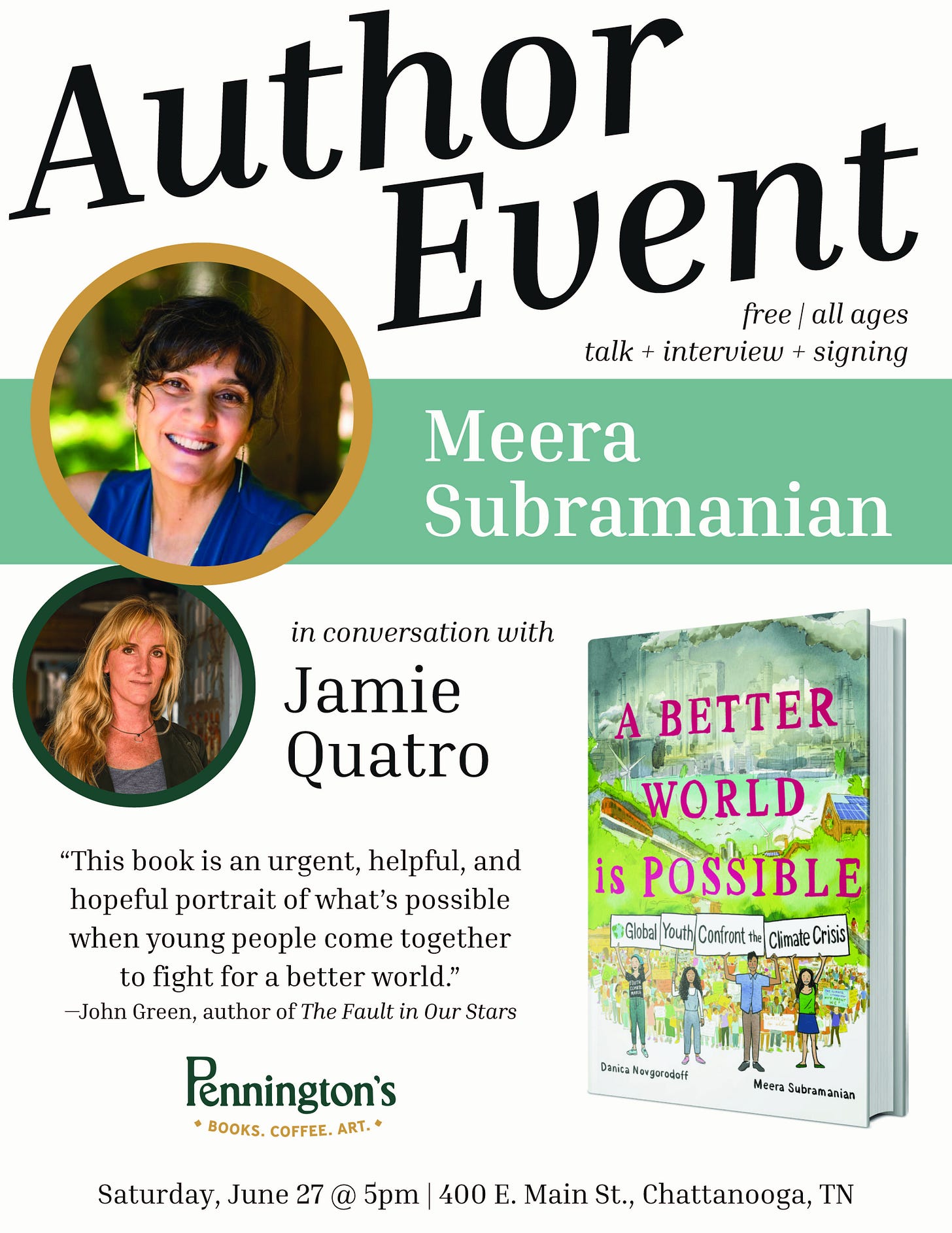
  • A Better World Is Possible, a nonfiction YA graphic novel I’ve been working on with the talented illustrator Danica Novgorodoff is working its way to publication (First Second, 2026). It reveals the pressing danger of the climate crisis through the stories of four youth climate activists who demonstrate the potential of teen power. I’m excited to announce that I received a Grant for Creative Individuals from the Mass Cultural Council that I’ll be putting towards helping this book find its way into the world. THANKS, MCC!
  • I received the Staige D. Blackford Prize for Nonfiction for my piece about the decision to donate a kidney, published in the Virginia Quarterly Review last fall. This feels deeply full circle; VQR was so generous to honor my piece about India’s vultures with this prize back in 2011. I was only a few years out of grad school, I hadn’t done any truly long-form, and VQR editor Ted Genoways took a chance on me. When that prize happened, it transformed the trajectory of my struggling freelance life. Truly. To receive the prize again, after all these years, for this piece that felt so risky in a completely different way, is the deepest of honors. Thanks to editor Paul Reyes and the whole VQR team.
  • I’m also am a True Story Award finalist, for my New Yorker piece, Consider the Vulture.
  • And I’ll be back in the US soon, for better or worse, in time to give a talk about South Asian vultures—their monumental decline and the efforts to bring them back—for the Brookline Bird Club, April 25, at the Harvard Geological Lecture Hall. In person and on Zoom. More details to come.

I’m reading…

  • To keep my reading mind in Spain, there’s been Ben Lerner’s Leaving Atocha Station, which exquisitely captured the hungry creative young mind as he makes an infinite number of poor decisions, and I’m midway through Carlos Ruiz Zafón’s Shadow of the Wind.
  • I listened to The Buried Giant, by Kazuo Ishiguro, at the recommendation of my (former) Orion editor, Sumanth Prabhaker. As our own country tumbles towards civil war (slowly, but quickening, according to Jeff Sharlet), I found this exploration of memory and forgetting—when is it necessary to wipe one’s mind clean in order to live in peace?—haunting. And, in spite of there being dragons and knight errants, it reminded me of similar themes explored in Severance, which I am totally hooked on.
  • I got an early look at Sadie Babits’ forthcoming Hot Takes: Every Journalist’s Guide to Covering Climate Change (Island Press). I had the pleasure of serving with Sadie on the SEJ Board, and she followed me as president. Now, she’s the lead climate editor at NPR. Get this book on your radar!
  • Erica Berry’s book Wolfish was a brilliant exploration of fear and wildness, and her new piece, “The Fault of Time,” in Emergence, is equally captivating. Here’s her Substack.
  • I found “The End of Children” by Gideon Lewis-Kraus in The New Yorker fascinating and as troubling as it was intended to be. It explored so many facets of the transformation underway, but I also wanted more about the infertility that may be linked to environmental factors, and also the hesitancy I have heard many younger people express about bringing children into a world increasingly ravaged by climate change and other environmental disasters. Still very much worth a read.
  • And I’ll wait to buy Sewanee School of Letter’s colleague Tiana Clark’s new book of prose poems, Scorched Earth, in person from her this summer, but I had the pleasure of hearing her read some her work in the past. You don’t have to to wait. Available at all the good places (and the bad places, too) where you can buy books.

I leave you with this, pure joy and delight of a song sung in public, crammed in a narrow alley of Old Town, just last night. The rains cancelled Carnaval in Tarifa last week, but they’re happening this weekend. The town is all dressed up. People don themed costumes with their friends and families that are about not about your single individual uniqueness, but about what you can create in concert with your community. I couldn’t catch all the lyrics of this long song, but it seemed a ballad, each stanza ending with a punchline that made the crowd laugh and led to the next round of the story. I’ll have bum-bum-bum-bum-bum running through my head for days, making me smile each time. Hope it’s contagious.

{For video go to Substack}

Be well, friends. Be fierce. Be ready.

[Read more…]

Filed Under: awards, climate change, drought, journalism, News, peregrinations, Substack, travels

Out of Order

February 4, 2025 By meerasub Leave a Comment

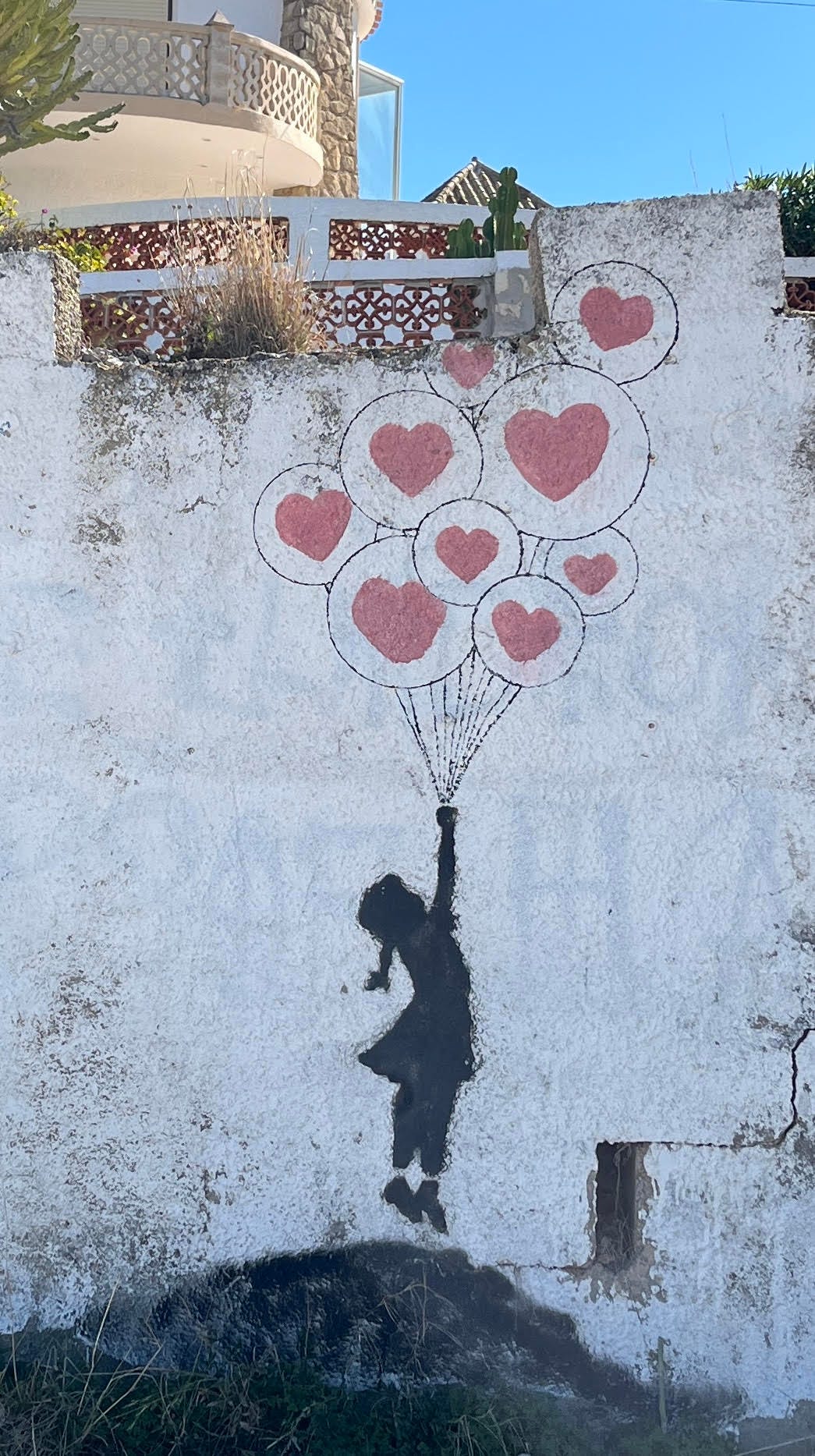
graffiti of girl being lifted by heart balloons

{latest Substack…}

Sentiments can be lost in translation, but also found. I’m out of the US but its mess spreads across the globe like its carbon emissions. The absolute least of it is was sitting in a cafe eating tortilla española and cringing as our new old president declared Spain is a BRICS nation (it isn’t). The most of it is hearing from friends and family about direct impacts: jobs lost, projects frozen, students with questionable immigration status disappeared. Last week, I stood with an Austrian woman and when the subject of our state of affairs came up, both of us speechless about the chaos the 47th has unleashed in a baker’s dozen worth of days, she said, of the country or the man, I’m not sure, that it’s “out of order.”

“Yes, yes! That’s the perfect phrase,” I exclaimed. “I’m going to use that.” And so here we are.

As I walked home afterwards, a woman alone, after midnight, feeling totally safe on the streets of Bilbao even as I walked through a group of a dozen men (oh, the sweet relief of not having cortisol continually coursing through one’s body; consider the whales; consider immigrants now being rounded up), I tumbled the phrase “out of order” around in mind. Out of order can mean broken, nonfunctional. It can indicate an experience of tumult and bedlam. It can also mean when someone steps of out of line, and acts in ways that are socially, ethically, morally improper. With the Austrian woman’s three words, she’d spoken a triple entendre.

To process this moment, I’m alternating between Jeff Sharlet’s Scenes from a Slow Civil War and Katharine Hayhoe’s Talking Climate, somehow finding solace in simultaneously recognizing how bad things are and how good they could be. Be? Maybe? Ayana Elizabeth Johnson reminds us to act locally. My form of protest is to dig deeper into my FRONTIERS fellowship work based at BC3, trying to understand all the dynamics at play in the efforts to shift our energy systems to cleaner forms of wind and solar, something that will continue to happen regardless of the white man in the White House. It’s led me to encouraging conversations about agrivoltaics in France and energy companies that build in community funds voluntarily, but also to a recurring and troubling story of conflict—a chasm between the rural and urban populations of the world—identical to what I’ve experienced in America, especially when I reported on conservative perceptions of climate change for Inside Climate News. I also attended an event, La Agenda Climática en La Nueva Legislatura Europa y su Impacto en Euskadi, The Climate Agenda in the New European Legislature and its impact in Basque Country. And we were right back to the impacts of the global shift to the far right. A sense of nervousness, geopolitics shaky, and the hope that energy independence in the form of renewables can be a part of regional security strategies.

panel discussion on climate and politics

Sweet dreams & flying machines…

There was also, last week, the horror over DC skies. Someone I love deeply and dearly has lost someone they love deeply and dearly in the unspeakable plane crash that ended in the Potomoc. She asked me for hard-won advice, knowing I have lost friends, this one, and this one, and others. Words fail, but I say something about letting the grief come when it will, to not fight it, to let it wash over you when it appears urgent and unexpected, even months, years, down the road of recovery. No, not recovery. Something else. Love and loss burnished into your being. But now the grief is immediate, and the only thing to do is take the unbidden reminder that life is short, precious. Love big. Hold loved ones close. Tell them. This is the other way we can act locally, in our most intimate lives.

Keep notice…

As I’m exploring this new place, I’m searching for slivers of joy amid all this grief and allowing myself moments to recognize them. I found one, as the sun broke through the relentless clouds of Bilbao, of the news, on Friday afternoon, when I finally made it up Etxebarri Parkea. Once a factory site that has been transformed into a park overlooking the city, its tall smokestack is a reminder of what once was. There was a pond created to support birds and critters, and a skate park for humans to play.

When I walked by the skate park, I noticed two men on skateboards, then I noticed that one was much, much older than the other. I was intrigued. Circled around the park and returned to watch him as he made a smooth steady run across the shallow end. Then, as the younger skater was leaving, the older one recruited him to help him summit the last lip of his run. “Come help me,” he said. “Stand here, with one foot here and the other there, and then when I come up, take my hand.” The young man did exactly as told. They tried it 5-6 times, and the older man never quite made it. Except that, well, he’s already made it, right?

I took a picture of them both, then handed my phone to Nico, the 26-year-old German so he can forward it to himself. And Juanjo is telling us he’s famous. “Google me!” he instructed, and indeed there he is on YouTube and TikTok. He is 87 years old, older than ages of the young skater and me, combined. Some lives are unfairly cut short. Others are long, and embraced by the bodies that contain them.

Journalists & writers friends, take note…

  • For rising juniors and seniors pursuing journalism, consider applying to the Opening Doors, a new initiative aimed at increasing diversity in public media newsrooms. The two-year program will provide skills training, mentorship, and paid internships for ten BIPOC journalism students, with a focus on science, health, and economics reporting. Apply here.
  • The Uproot Project Fellowship offers funding to seven journalists to pursue reporting projects over the course of a year. Fellows will receive up to $2,000 to cover travel and other reporting expenses for their fellowship project. Learn more about the Uproot Project Fellowship and find this year’s application here. Deadline: 11:59pm on March 1, 2025
  • And to connect with poets who are using their art to face the climate crisis, check out the Hellbender Gathering of Poets, run by my friend and Sewanee colleague Nickole Brown. They’re gearing up for a fall gathering and having inspiring events along the way.
  • The Matthew Power Literary Reporting Award is a grant of $12,500 to support the work of a promising early-career nonfiction writer on a story that uncovers truths about the human condition. Matt was one of those dear friends we lost way too early. Deadline: Feb. 19

Take care, friends. Take care of each other.

[Read more…]

Filed Under: climate change, peregrinations, photography, Substack, travels Tagged With: BC3, Bilbao, death, FRONTIERS, grief, politics, skateboarding, Spain

the art of being present

November 13, 2024 By meerasub Leave a Comment

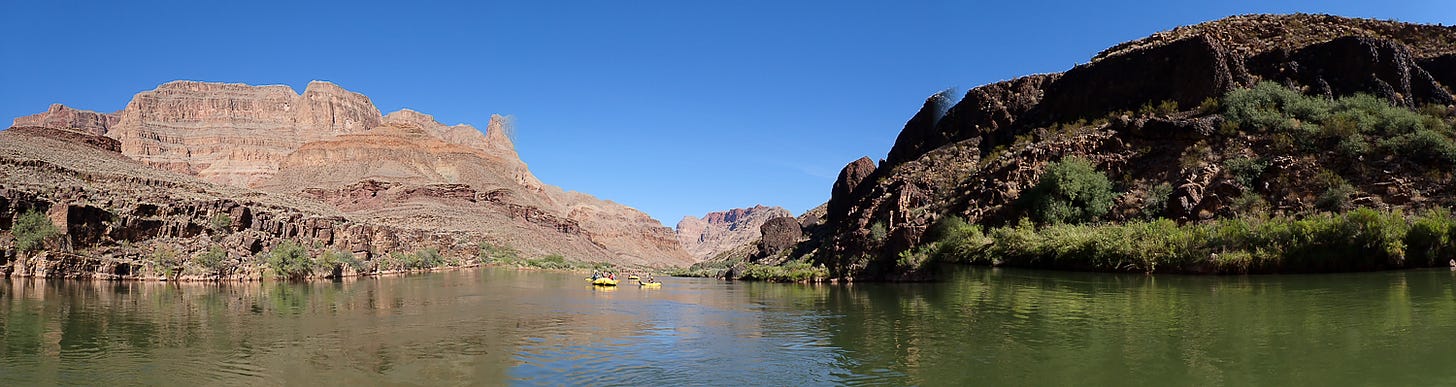
panorama of Colorado River with two rafts in view

by Meera Subramanian

Three rounds in the laundry and there’s still sand in my socks. I like the grit that remains. It’s been over a week since we took out from a bucket list rafting trip down the Colorado River. I adventured there with my husband and his eldest, 226 miles of the river’s reach, from Lee’s Ferry to Diamond Creek, traveling into the depths of what this great earth holds, a truly Grand Canyon.

New layers of rock revealed themselves to us each day as our seven boats moved downstream. Six oar boats and one paddle boat. Some of us slipped into kayaks at times. Us twenty guests in a continual rotation between boats, sometimes paddling, deep strokes into deep green cold water, or relaxing through some stretches, or holding on for dear life as we crashed through the rapids of Granite, Horn, Lava Falls. We pulled onto beaches for hikes into slot canyons, or to go swimming in the Little Colorado River, a tributary with otherworldly pastel blue waters. We passed through sacred lands. All of it felt sacred. I kept feeling like I needed to ask permission. I did, and felt (hope) it was granted. Navajo, Havasupai, Hualapai. And something deeper and more eternal, before even those people arrived, when this place was sea, inhabited by sponges, crinoids, brachiopods, lava flowing and transforming, land masses moving.

[Read more…]

Filed Under: drought, peregrinations, Substack, travels Tagged With: geology, Grand Canyon, river rafting, rivers, silence, tech

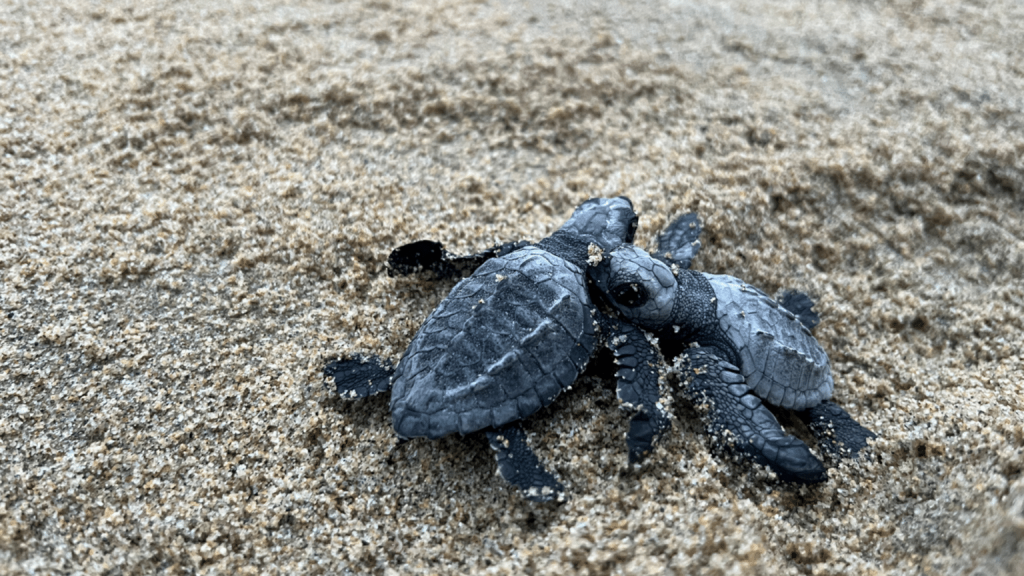
baby sea turtle release!

January 17, 2024 By meerasub Leave a Comment

two baby sea turtles on the sand

by Meera Subramanian

S. AND I SIT ON A LOG on a San Pancho beach of western Mexico’s Nayarit coast, watching. Soon, we’ve been told, there will be a release of sea turtles, but we don’t know quite where, so we observe the movement of humans on the beach—couples in beach chairs; groups of young, tattooed surfers smoking cigarettes and weed; a woman reading a book. An older man races by in a dune buggy with a woman beside him, and then returns a moment later without her, rousing a trio of short-legged mutts to chase after him, barking and chomping at the tires. Where he has left the woman, a coalescing is under way, and we move toward it.

There we find Odette Brunel, a Mexican ecologist with long brown hair and reading glasses looped around her neck, holding a tan plastic bin. A hundred tiny turtles writhe within. They’re only a few inches long, dark flippers and dark shells barely containing an eager energy. Nearby, an eleven-year-old named Ananda holds another bin with more. A growing crowd crane their necks to look in. Children gather. Parents gather. Cell phone cameras, including mine, are at the ready.

Odette goes hoarse explaining anything she can to anyone who will listen, in English and Spanish. Her soft voice stretches over the sound of island music blaring from a nearby hotel that reaches its square body onto the sand of the beach.

“We call this tortuga golfina. It’s the smallest of the sea turtles that come here.”

…

Read the rest of the story, published in Orion, about witnessing the dangerous, crucial volunteer work of protecting and releasing baby olive ridley sea turtles in Mexico, here. 

And here’s a rough-cut video I made of the evening:

Filed Under: climate change, journalism, peregrinations, photography, plastics, travels, video Tagged With: Mexico, Orion, Project Tortuga, sea turtle, turtle

United in Change

December 16, 2019 By meerasub Leave a Comment

Photo by Meera Subramanian

As a reader I find there are stories that just stick with me; I can’t shake them. But as a journalist, I experience this a thousand-fold. What appears in print can feel like a haiku, with too many interviews and notebook jottings ending up on the cutting room floor. The histories of place I unearthed through research. The letters to the editor in the thin pages of the local newspaper. The anecdotes shared by those who didn’t make it into the piece. The deep story revealed behind and between their words, too big for the bounds of the word-count. 

As I finished up each of the nine pieces that were part of the series Finding Middle Ground series for InsideClimate News that I worked on for most of 2017-18, about perceptions of climate change in conservative parts of the country, I would find filaments linking them with each other that I didn’t have room to explore. I’d get tangled in threads leading to stories I’d reported in other parts of the world, a lament I heard from a peach farmer in Georgia echoing what a rice farmer had said in India. There were strands of sinew between what I learned in the field and what I knew from my own personal life, a peripatetic journey that’s granted me multiple vantage points, making me feel at home both nowhere and everywhere at once. 

Last year I became a contributing editor of Orion magazine, a publication I’ve read for many years, enjoying the lush richness of its pages, the images and poems and book reviews and NO ADS. (Yes, this is a nonprofit endeavor, and, yes, you can support it by subscribing.)  With this piece for Orion, I finally had a chance to reach up for some of those disparate threads that have been floating around in my head since I finished the ICN series and try to weave them into something that made sense. Or, at least, began to make sense. Still, it feels like a haiku. Still, there is so much unsaid at the edges. Because the story of climate change at this moment in time is immense, and shifting. We’re all living this in real-time, the scientists and storytellers and skeptics all. Much of what I found over 18 months of reporting is deeply troubling, the changes underway stirring so much into uncertainty, but I also hold onto the possibility of the disruption as a great opportunity. No rain without thunder and lightning, Frederick Douglass reminded us. And the storm of climate change is here, now. Anything could happen. 

The piece begins…

For the past couple of years, I traveled across my country, falling in love with strangers. I sought them out—farmers, ranchers, fly fishermen, evangelicals— and stepped into their lives, uninvited but nearly always, inexplicably, welcome. I sought some kind of connection, asking them questions few seemed to be asking them, about their lives and what they care about and what they believe in. Who they vote for and why. What they remember from before and what they expect in the future, which to their collective grief are often different things.

Read the rest here.

Filed Under: agriculture, cattle, climate change, drought, InsideClimate News, journalism, North Dakota, photography, travels Tagged With: climate change, conservation, grief, InsideClimate News, journalism, loss, Nature, Orion, photography, politics, pollution environment

to be a human body, in flint, mi

October 10, 2018 By meerasub Leave a Comment

We have a ten-minute break from talking about #climatechange at the #SEJ2018 conference in Flint, MI, and I walk outside seeking air. I find a heavy police presence, notice the Flint River is right there, wander over. See cops on the water’s edge, along with a scuba diver gearing up. I ask an older black man on my right what happened. He says a man drowned a few days ago and they’re looking for the body. A younger white man, tattoos on his neck, comes up on my left, and I ask him, too.

“It was my friend. Tripping on acid the other night and he thought he could walk on water.”

Oh.

He’d been walking on some object that was floating, and then he slipped in. Couldn’t get out. Vanished below the water.

“I’m sorry,” I say. He’s stoic.

“Just another one down in Flint,” he says.

“Why?” I ask him.

“I dunno, drugs,” he says, shrugs. I’m silent.

“I’m sorry about your friend,” I say again, putting my hand on his arm. I’m utterly lacking. He says thanks.

Back in I go to the old building that was once a Sheraton and now is a conference center just this side of shabby to talk about carbon and climate and journalism in a windowless room. A couple hours later I go back out. I take a photo of the river, lazy & brown, framed by trees whose leaves are blushing red. I leave out of the frame the medical examiner, bent over the body of the 32-year old man who, the tattooed man had told me, left behind a twin brother. Somewhere, the twin that remains is walking through the city, solo for the first time since the moment of conception. 

Filed Under: just another day, travels Tagged With: conference, death, drugs, Flint, Michigan, river, SEJ, walking on water

life large & small in Sewanee

July 9, 2017 By meerasub 2 Comments

This is my last Sunday in Sewanee. I fell asleep to the deafening sound of cicadas, a thrumming from the upper branches of the trees that surround the house. In spite of stories of escaped convicts, I can’t help but keep the sliding doors open so I can hear the sound. The land is alive with the cacophony. Bring it on. The more there is, the merrier I am. It was the brilliance behind Rachel Carson’s book title. Two words. No rambling subtitle telling all. Just two words, three syllables, that spoke volumes: Silent Spring. Give me noise from the natural world. Remind me, unceasingly, that there is life. Keep the silence at bay.

I’ve just finished reading [Read more…]

Filed Under: just another day, peregrinations, photography, travels Tagged With: Arli Hochschild, hawk, Helen Macdonald, James Agee, mushroom, Sewanee, silence Rachel Carson, South, Tennessee, USA, wildlife

perimeter perambulations

June 8, 2017 By meerasub 1 Comment

I always try to deny dawn. She slips under my eyelids and I reach for my eye mask, craving one more hour of unconsciousness. But I hear birds. Knew the light was illuminating the unexplored forest behind the house I now find myself living in. Discovered myself pulled up and into clothes warm enough for the cool morning, lacing up my hiking shoes before I quite realized it. My eyes don’t read so well in the morning anymore, but before I walk out the door, I squint at the map for the Perimeter Trail that loops around Sewanee, hugging the edge of the Cumberland Plateau, and figure it should be due west of the house. Why walk along the lanes to find a proper entrance? I tuck my pants into my socks (the default fashion for us in Cape Cod’s tick-infested landscape. Are they here or am I liberated?) and cross the bit of backyard grass and enter the woods. Ten steps in, I flush a herd of white-tailed deer twenty strong, their cotton-burst butts bounding down the hill of the small valley, then up the other side. A hundred feet in and I find a brook I can step across with one stride. Twenty more paces and I’m on the trail. I take a right and go. It’s good to be back in church.

Just before I left Knight Science Journalism fellowship up in Cambridge, Maura O’Connor spoke to us about her new book on wayfinding. She explained the wonders of the hippocampus, how it grows when we challenge it by getting lost and then finding ourselves. I have not (blindly) used a GPS since then. I find a map, preferably on paper, and study it til I can put my finger on the spot where I am. I have loved to do this, always. It felt like a reward when the last page of a test in third grade was a map, the legend reliably there in the corner, a gift of a key that would unlock the mysteries some mapmaker made.Here on the edge of the plateau, there is the added orientation ease of heading towards the almost horizon that appears between the boles of upright trees, that indicates the drop-off of slope and the potential payoff of views. It’s why I went right. But I am distracted. A russula mushroom there in the duff. A widow-maker tree defying gravity until her uprooted roots decide to give out completely. Rounding a bend and finding myself below a sandstone overhang like a chiseled layer cake of rock, seeps staining spots dark, the smell of iron in the air. Did I gasp? I think I gasped. At a fork I go left, each rock outcropping greater than the last. I scramble up a rock to pass through a tunnel of stone and then the sound of water pulls me forward until I’m below the spray of Bridal Veil Falls, oxygenated, awake. [update: that wasn’t Bridal Veil, I discover later. Just some unnamed cascade. Just as lovely, if not as spectacular.]

How many landscapes can one love? How many humans? How many creatures, great and small? Imagine an infinite number and you are correct.

#Sewanee #hiking #waterfall #Tennessee @univofthesouth #schoolofletters #PerimeterTrail #getoutofbed

Filed Under: just another day, peregrinations, travels Tagged With: hiking, Nature, School of Letters, Sewanee, Tennessee, waterfall

  • 1
  • 2
  • 3
  • …
  • 5
  • Next Page »

Follow Meera on Substack

for the very occasional bit of news.

Categories

Tags

Alaska anthology A River Runs Again Art awards birds birds of prey books book tour Cambridge cape cod climate change conservation death dissent Elemental India energy events Fulbright india InsideClimate News journalism kenya Knight Science Journalism Nature New York City organic farming Orion peregrine falcon pesticides photography politics pollution environment Princeton University radio readings religion reviews science Society of Environmental Journalists teaching travel USA vulture water

Archives by Month

Connect

  • Bluesky
  • Facebook
  • Instagram
  • LinkedIn

© 2026 Meera Subramanian. | All Rights Reserved. | Mastodon | Website design by Sumy Designs, LLC

Green_14