Meera Subramanian
  • Home
  • Books
  • Writing
  • Bio
  • Blog
  • Photos
  • Events
  • Speaking
  • Contact

happy book birthday!

March 3, 2026 By meerasub Leave a Comment

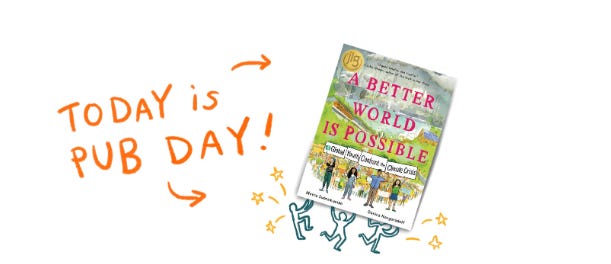
Woohoo! A Better World Is Possible: Global Youth Confront the Climate Crisis, my new graphic novel made in collaboration with Danica Novgorodoff, is OUT TODAY!

I hope you’ll order your copy of the book and/or come to one of our book release events:

TONIGHT! March 3, 2026: Titcomb’s Bookshop & Sturgis Library
5:30 pm ET | 3090 Main Street, Barnstable, MA
with Meera

March 5, 2026: Carmichael’s Bookstore
7:00 pm ET | 2720 Frankfort Avenue, Louisville, KY
Danica in conversation with Festival of Faiths Program Manager
Sally Evans & climate journalist Lyndsey Gilpin

April 2, 2026: All Peoples Unitarian Universalist Congregation
7:00 pm ET | 4936 Brownsboro Rd, Louisville, KY
Danica at All Peoples Justice Center book event on religion & climate change

April 2, 2026: University of Rhode Island Metcalf Institute
Reception at 5:30 pm ET, followed by conversation at 6:00 pm | Hope Room, URI Welcome Center, Kingston, RI
Meera in conversation with author Elizabeth Rush

April 8, 2026: MassEnergize Community Climate Leaders Annual Conference
8:00 am – 5:00 pm ET | Bentley University, 175 Forest Street, Waltham, MA
with Meera

April 14, 2026: Greenlight Bookstore
7:30 pm ET | 686 Fulton Street, Brooklyn, NY
Danica & Meera and special guests, Jamie Margolin & Shiv Soin, youth climate activists featured in book

April 18, 2026: Society of Environmental Journalists Conference
3:15 pm CT | 725 W Roosevelt Rd, Chicago, IL
Meera part of author program along with Joseph Lee & others.

See the full list of events here

(SLIGHT) SPOILER ALERT: this book ends with a view of the Grand Canyon, and the idea that while we are each as small as individual raindrops, we can come together in community to form a river—a movement, the climate movement—with immense power and agency.

Here were my first scribblings as that scene came together in my head…

Both Danica and I have made it to the Grand Canyon since we crafted that scene. To enter such deep geologic time, literally descending through millions of years of rock and earth, is to gain perspective.

Like Danica experienced, too, I was in such awe of the landscape and felt so much renewed passion to protect the natural world, which is the only world we have. School Library Journal’s review of A Better World states:

“This title not only answers the question, ‘how can I help?’ but also offers readers a glimmer of hope… This brilliantly ­illustrated ­graphic novel explores the actual crisis, as research shows, the world is facing—climate change.

By ­allowing readers to see the interconnectedness of the issues and how typical teenagers took small actions to build community and organize advocacy events on behalf of protecting our world, it is easy to understand the following quote: ‘Every single action is a raindrop. They flow together, becoming a force unstoppable as that of ­gravity. Remember that water has the power to cut through rock.’

This would be a powerful addition to any ­collection.”

I hope you will join us—in the movement, at a book event, in standing against inaction and despair, in building hope.

“Another world is not only possible, she is on her way. On a quiet day, I can hear her breathing.” —Arundhati Roy

Thank you to the everyone who helped breathe this book into life. The four powerful youth who shared their stories with us (Xiye Bastida, Jamie Margolin, Rebeca Sabnam & Shiv Soin). The whole team at First Second Books (Robyn Chapman, Benjamin A. Wilgus, Michael Moccio, Sunny Lee, Mark Siegel, Morgan Rath, & so many others). Fact-checkers (Amy Westervelt, Susan Joy Hassol, Lucy Prothero, & Rose Andreatta). And Stephen Prothero, who was there every step of the way. And finally to the readers, past, present and future. Everything is possible.

Love,
Meera

Coda….

Also, I saw the lunar eclipse this morning, bundled up in 18-degree weather, a warm coffee my husband fixed for me in my hand and his body behind me to keep me warm as we watched the nearly full moon vanish, our earth’s shadow cast across the only true earth satellite. There are dark forces at play in the world. Seek out the light and people to nurture it with. Onwards, friends.

Filed Under: A Better World Is Possible, climate change, events, journalism, News Tagged With: A Better World Is Possible, book tour, books, cape cod, climate change, journalism, luna eclipse

Hold onto the light

January 26, 2026 By meerasub Leave a Comment

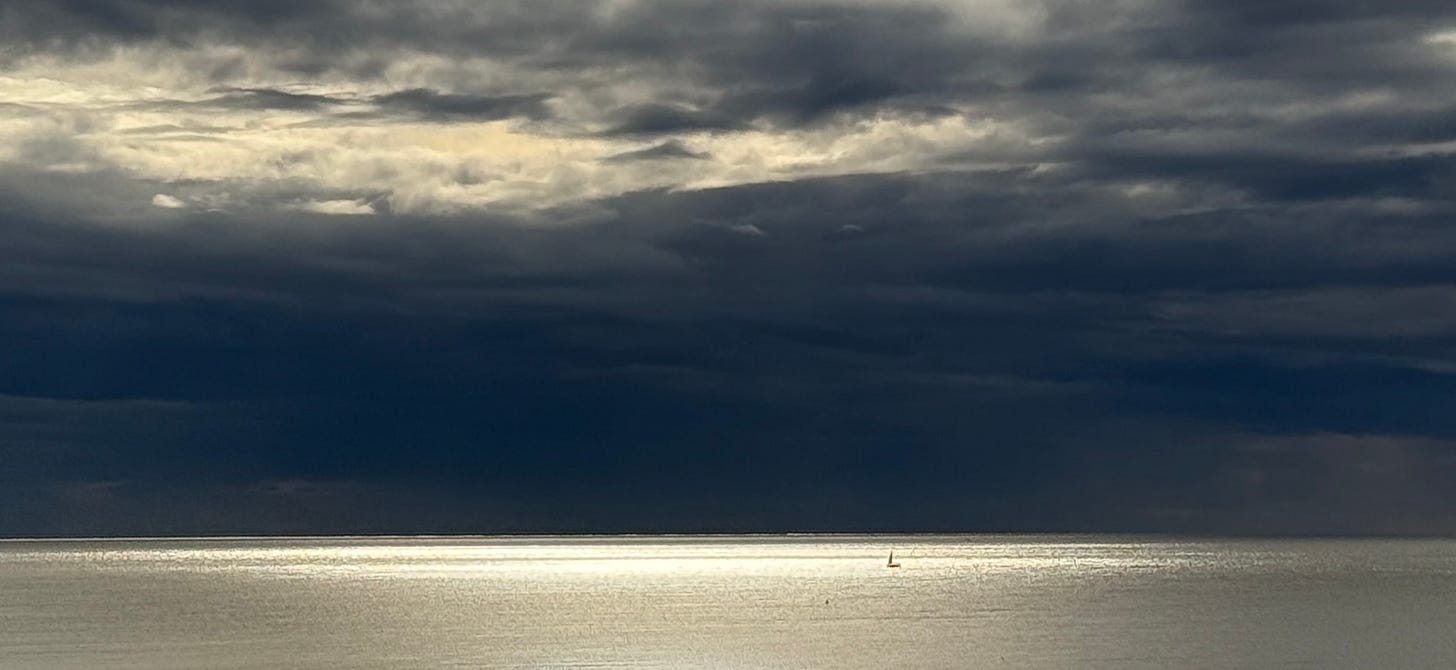
silver water with a black sky above

We are in stormy times, and I am not just talking about the snow, which blankets the world into chiaroscuro. White men in black are murdering peaceful protesters on the streets of America. Ten shots. At least. We are witnessing, in real time, the deliberate unraveling of a developed nation into something barbaric and backwards. I hold onto two things from the past week. One is the speech by Canada’s PM Mark Carney in Davos, who spoke “about a rupture in the world order,” and beckoned the middle powers to unite against the hegemony. He invoked the Czech dissident Václav Havel and the power that emerges when the greengrocer takes down the propaganda sign of political support that he never believed in. “The system’s power comes not from its truth, but from everyone’s willingness to perform as if it were true,” Carney said, “and its fragility comes from the same source.”

The second shard of light comes from seeing the thousands of people in the frigid streets of Minneapolis. Each one a version of the greengrocer, taking down the sign and revealing the fragility. No more. The statement from Alex Pretti’s parents rings out: “The sickening lies told about our son by the administration are reprehensible and disgusting.” They are not just taking down the sign. They are setting it on fire.

Those of us who write about the climate crisis struggle when our work is to “direct your attention toward the horizon,” as Emily Atkins so eloquently put it in her latest Heated Substack. But, she reminds us, climate change is state violence, too. I think of the “slow violence,” as Robert Nixon coined it, that takes lives far from phone cameras and newsfeeds. This slow violence is not nearly as slow as it used to be. Climate is the undercurrent as the hegemon invades and threatens Venezuela and Greenland in a grab for resources. It’s the water crisis fueling the unrest in Iran, where protesters demand, “Water, electricity, life – our basic right.” It’s the storm covering the country that could be worsened by the conditions created by human-caused climate change.

Still, a new generation is rising into adulthood. People go into the streets to fight for their children’s future, maybe more than their own. It is dark, but we need color. We need to keep looking to the horizon. We need to hold on to the belief that…

A Better World Is Possible

Colorful cover of A Better World Is Possible graphic novel

Pre-order today!

Book promotion is tough at times like this, but I’m still hoping you’ll hit the button and pre-order our graphic novel, A Better World Is Possible: Global Youth Confront the Climate Crisis, so when it comes out in a month, you can immediately place it in the hands of a young person you adore. An antidote to everything they are absorbing from the news shaping their young lives. People are saying nice things:

“As this lovely book points out, ‘we don’t have the luxury of time anymore.’ This book is an urgent, helpful, and hopeful portrait of what’s possible when young people come together to fight for a better world.”
~John Green, author of The Fault in Our Stars

“Novgorodoff’s watercolor style is absolutely perfect for this topic, showcasing both the power of visual comics metaphors and the beauty of the natural world.”
~Booklist, starred review

“A heart-warming and planet-cooling book about how change happens–anyone reading this will be much better prepared to help in the fight for the planet’s future.”
~Bill McKibben, author of Here Comes the Sun

When does the idea of a book begin? Artist Danica Novgorodoff began thinking about a graphic novel for young adults about climate change many years ago. I joined her in 2020, when I reconnected with Danica at a book event of our mutual friend, Jeff Sharlet, on the eve of the pandemic shutting down world, and we decided to team up. But in some ways, seeds in my mind were planted lifetimes ago, maybe at the base of the maple tree in my front yard as a kid, or in the duff of Oregon’s old-growth forests, or on the streets of Seattle during the 1999 WTO protests.

The response to crisis is to gather. Find others. “We take care of each other,” as an elder in Alakanuk, Alaska told Emily Raboteau. Collaborating with Danica over the past handful of years and immersing myself in the stories of the four climate youth we feature in the book—Jamie Margolin, Xiye Bastida, Shiv Soin and Rebeca Sabnam—has kept the light on for me, added color to my concept of a future.

cover of rrrrl girlz zine

The process brought back the joy I felt when I did a zine with girlfriends years ago, back in Oregon, before the internet changed everything. When our collective of “city babes and country chicks with shit on their minds” stayed up late with pens and scissors and magazine clippings from the 1940s and a commandeered copy machine to be creative and map out the world we wanted to live in.

tulips blooming inside, a snowy landscape beyond the window

In these dark times, keep fighting the powers that be, find the slivers of light and bursts of color, gather with your comrades, and make the world you want to inhabit.

Journalists & writer friends, take note…

  • Come study with me. I have the great good fortune of going to Sewanee, Tennessee each summer to teach creative nonfiction for the School of Letters MFA program. The setting is stunning, and the community that forms when you bring together talented faculty and just the right number of students creates a certain alchemy where good writing emerges. Feel free to DM me or director Justin Taylor to learn more. Rolling application.
  • Mid-career journalists: applications now being accepted for the University of Colorado Ted Scripps Fellowship. You can spend a year in stunning Boulder, taking classes to deepen your understanding of environmental issues. Oh, also, get paid $80,000. I’m on the Advisory Board and this is truly an amazing opportunity. Deadline: March 1
  • Do you have an ambitious reporting project about a story that uncovers the truths of the human condition? Apply now for the Matthew Power Literary Reporting Award, honoring my ole friend and Brooklyn housemate Matt, who was as delightfully obsessed with the plants in the backyard as the stories of every person he met on assignment. I still miss him dearly. {Here’s a new Atlantic story from past award winner Shayla Love} Deadline February 22
  • The Institute for Independent Journalists, founded by former Knight Science Journalism Project Fellow Katherine Lewis, is having its 2026 Freelance Journalism Conference March 5-6, a “conference for independent journalists and creators to find community and build thriving businesses.”
  • Introducing the Science Reporting Navigator from the good folks at The Open Notebook. Believing “every story is a science story,” they partnered with Relief Applications and designed a resource to help reporters who might not always be on the science beat get quickly informed. Here you can find dozens of short lessons within ten topics, such as “how to find scientific sources,” “how to navigate scientific data,” and “how to critically evaluate claims.”
  • I’ll be at two powerhouse journalism conferences this spring. Hope to see you at Boston University’s The Power of Narrative Conference (March 27-28) and/or the Society of Environmental Journalists Annual Conference in Chicago (April 15-18)

And from the Department of Good News…

  • A Better World Is Possible is #1 on Amazon in the New Releases in Teen & Young Adult Environmental Conservation & Protection. Keep those pre-orders coming to help feed the algorithmic beast (ya know, in the good way), but I encourage you to do it from your local bookshop. And give me a shout if you’d like an advance copy for review. Our spring book tour is taking shape so perhaps we’ll see on the road as the flowers emerge. More on that soon.
  • Metcalf Institute at University of Rhode Island is an incredible science communication training center. I’ve benefitted from multiple fellowships that made me a better journalist. Honored to be featured as they kick off their alumni newsletter.

I’m reading/watching…

  • While this administration continues its assault on climate action alongside its attack on citizens, thanks to Isabella Kaminski at the Guardian to remind us that there were many legal climate wins around the globe.
  • To balance most of my days, which revolve around the above, escaping into a novel is requisite. I thoroughly enjoyed the messages of loss, letting go, and transformation in Emily Habeck’s debut novel, Shark Heart. It’s a bittersweet love story that emerges when a newlywed couple faces a diagnosis: the husband is turning into a great white shark. Also, the wife makes friends with a woman pregnant with twin birds.
  • I saw the magnificent documentary Folktales at the Woods Hole about a traditional “folk school” in the Arctic wilds of Norway. The relationship between the struggling kids, their teachers and the sled dogs is breathtaking. It’s the visual version of Blair Braverman’s excellent memoir, Welcome to the Goddamn Ice Cube.

Coda…

underwater images of remoras attached to a whale

With things on land being dire these days, I have been holding on to images of water during meditations (and three-in-the-morning-try-to-get-back-to-sleep moments). So I found this video of remoras enchanting, hypnotic. Imaging clinging, (how?!), steadfast, to the back of a humpback whale, and then—just at the moment she is about to breach—releasing yourself, racing along ‘til she returns to the water. Then, reattaching. Like skipping rope. Underwater. At speed. There’s a metaphor there, of holding on, of letting go, and holding on again. Steadfast.

Stay warm, friends. Stay safe.

[Read more…]

Filed Under: A Better World Is Possible, climate change, dissent, News, peregrinations, Substack

On the Move: Bilbao to Tarifa, in pursuit of good energy

March 15, 2025 By meerasub Leave a Comment

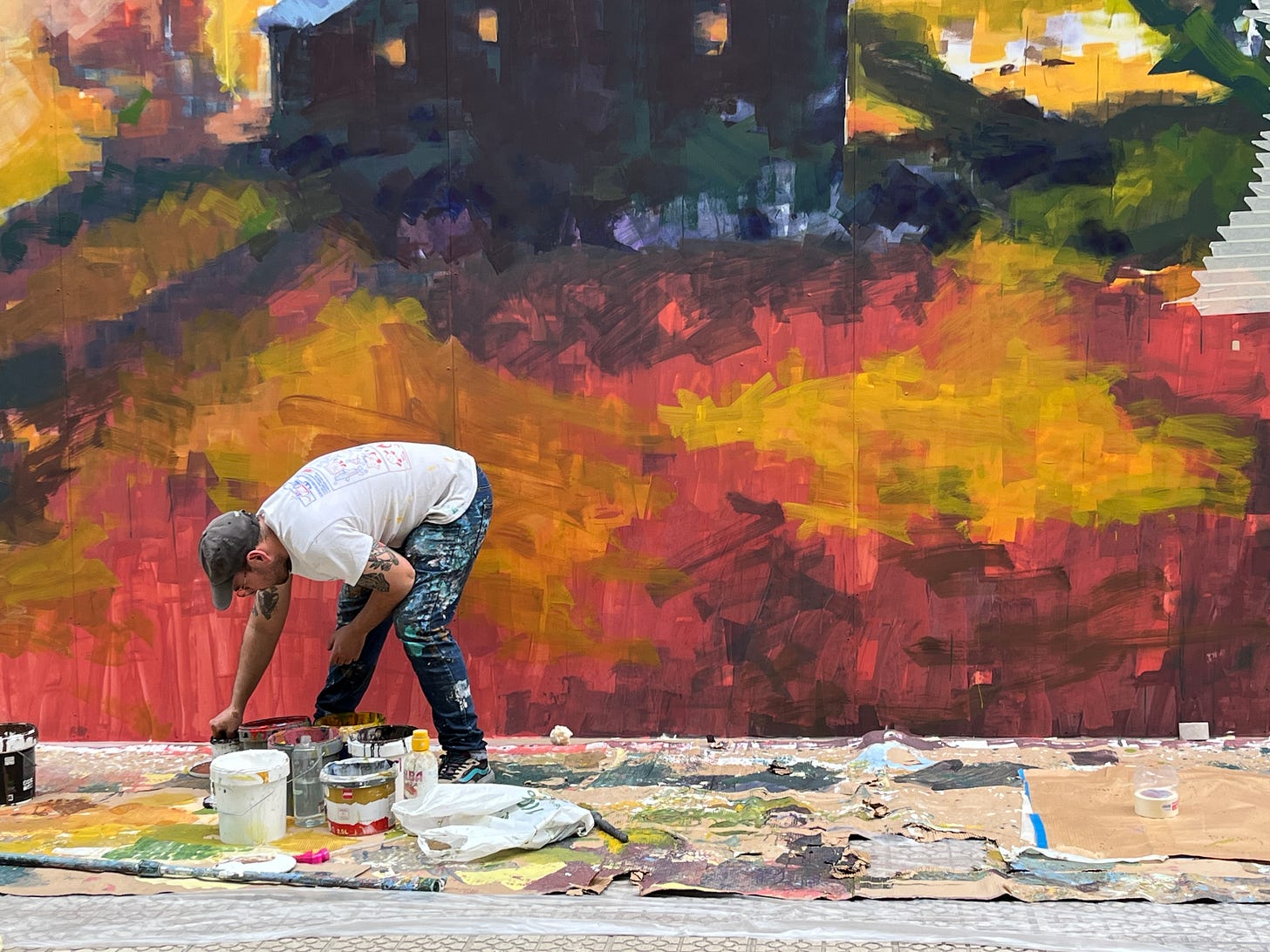
man bent over paints with a wash of color on wall behind him.

Muralist at work, Bilbao. Photo by Meera Subramanian.

{Latest Substack}

Peregrinations are underway. I’m more than two months into my FRONTIERS fellowship, the first half of which was spent in Bilbao at the Basque Center or Climate (BC3) Change. I came here with the question: can renewable energy projects be built in a way that’s better for biodiversity, people, and place?

It’s complicated.

But like the muralist I caught mid-stream as he transformed a construction blind into a work of art, it takes layers of paint, layers of understanding. I’m thankful for the FRONTIERS grant to have the time to keep digging. The researchers at BC3 helped give me a crash course in understanding the renewable energy landscape, and I’ve been busy conducting dozens of interviews, in Spanish and English, with BC3 staff as well as people all over Spain and in France. They’ve included researchers in agrivoltaics, ornithology and environmental conflict; organizations such as Greenpeace, Eudemon and Renewable Energy Foundation; political representatives such as mayors of small towns with renewable energy projects; reps from renewable energy companies; and many others.

When I arrived in Spain, Biden was still president. A week later, he wasn’t. Nowhere is far enough away from the new president’s wrath. BC3 researchers lost US partners when funding was frozen. A cousin lost his job in Bangkok related to USAID. A friend lost a year’s worth of climate work on New Jersey organic farms. A niece’s new position at NOAA as a fledging applied ecologist feels tenuous. But also, my stepdaughter, who is an environmental lawyer for Earthjustice, was part of the team that just sued Trump and the USDA to release IRA funds that were contractually promised and are now frozen. The lawsuits against the administration are piling up.

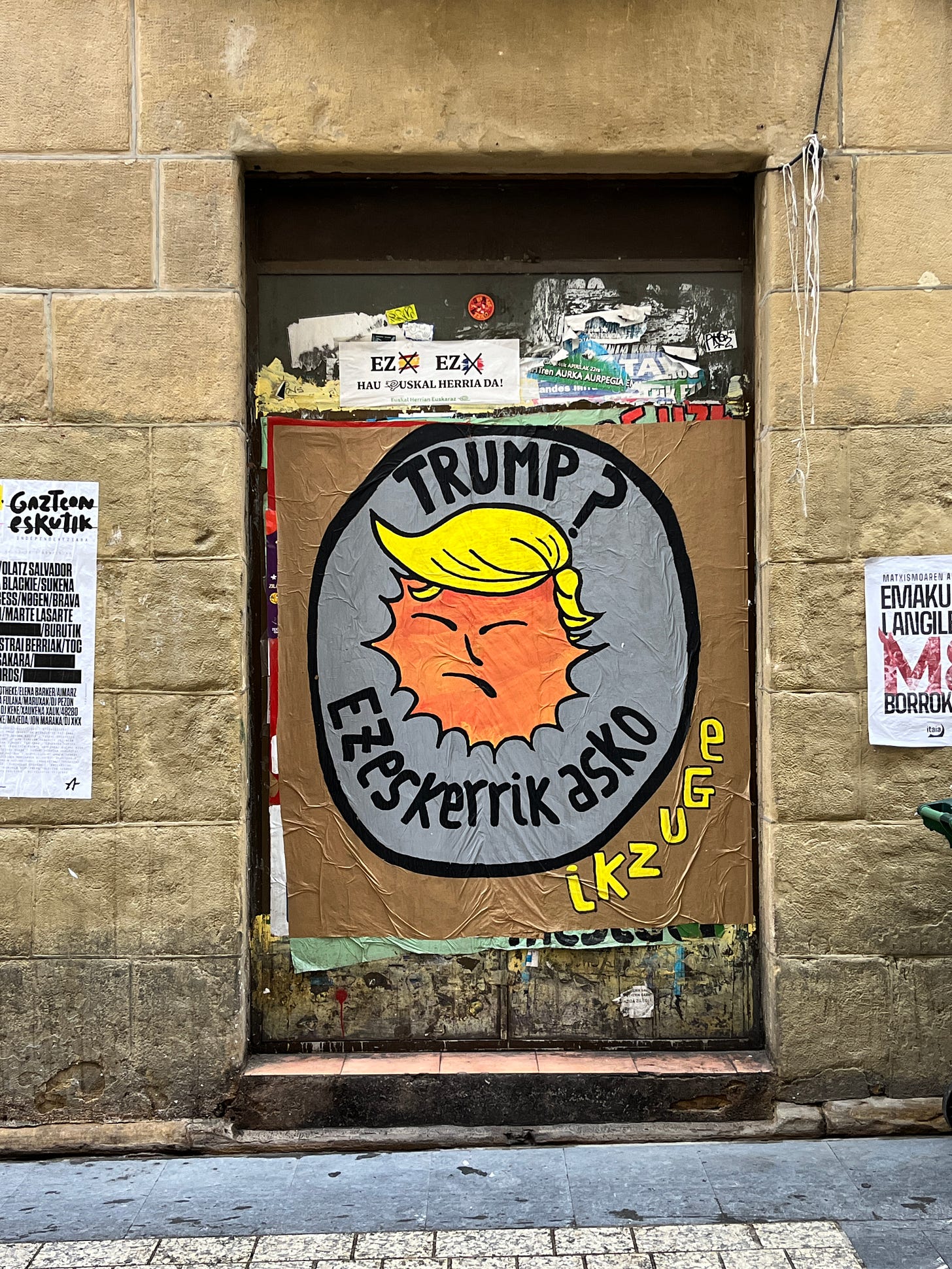
Here in Europe, the mood is jittery. (Also, I am fielding the repeated baffled question/accusation: how could you Americans have voted him in … again?!) I attended The Climate Agenda in the New European Legislature and Its Impact in the Basque Country, an event in Bilbao on January 31, when the wrecking ball was taking its first wild swings. Panelists included local politicians and journalists from other parts of Europe, offering a lens into the dynamics and tensions around renewable energy, especially in the wake of the inauguration of Donald Trump. Europe is readying itself for … well, just about anything. There is the tension between the desperate need to ramp up the clean energy transition to achieve energy independence butting against the need to divert resources to build war chests. Bolstering nuclear power keeps coming up. So does resistance:

graffiti in Basque Country, Spain

Spotted on a wall in San Sebastian, a play on an anti-nukes image, “Nuclear power? No thanks,” in Basque. Photo by Meera Subramanian.

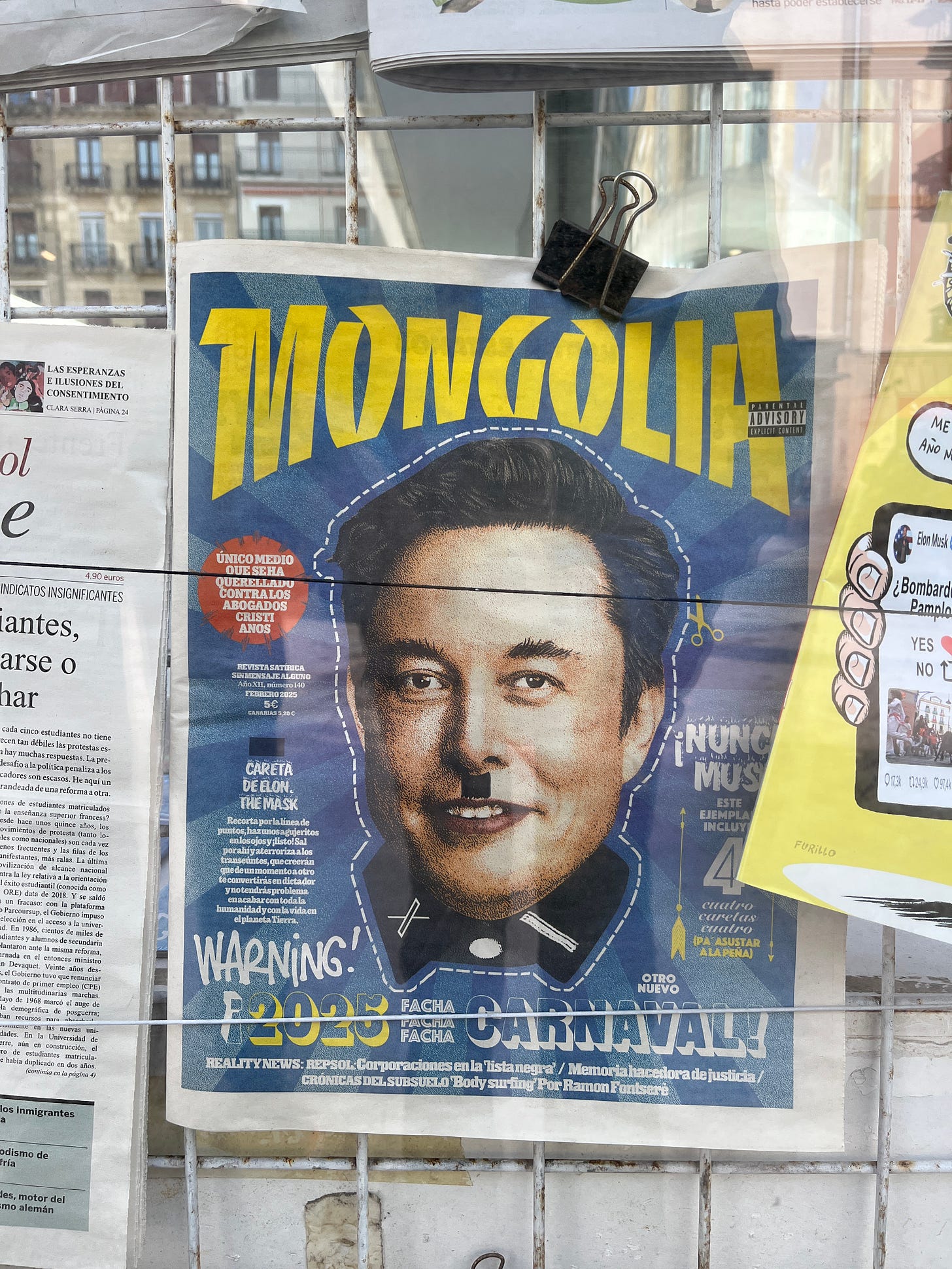
Also spotted at a news stand:

Photos by Meera Subramanian.

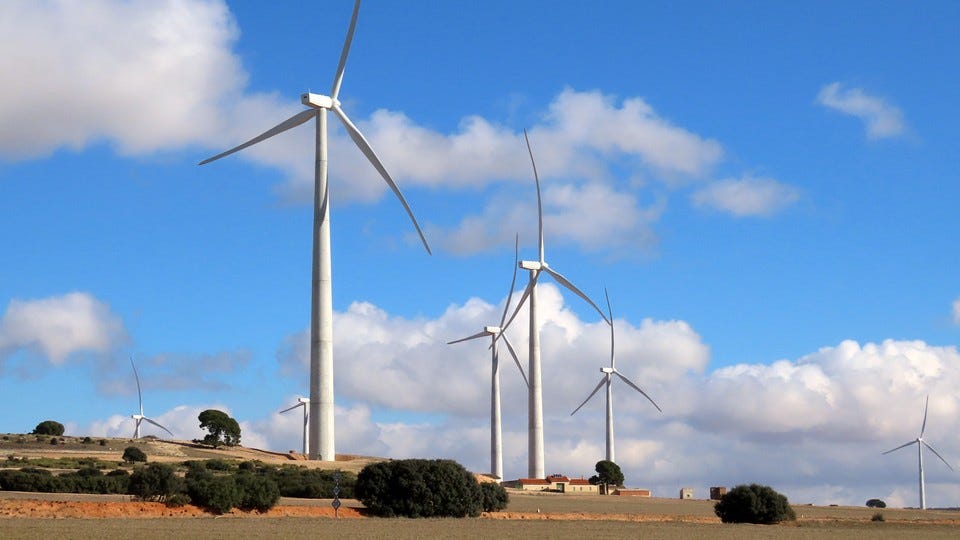
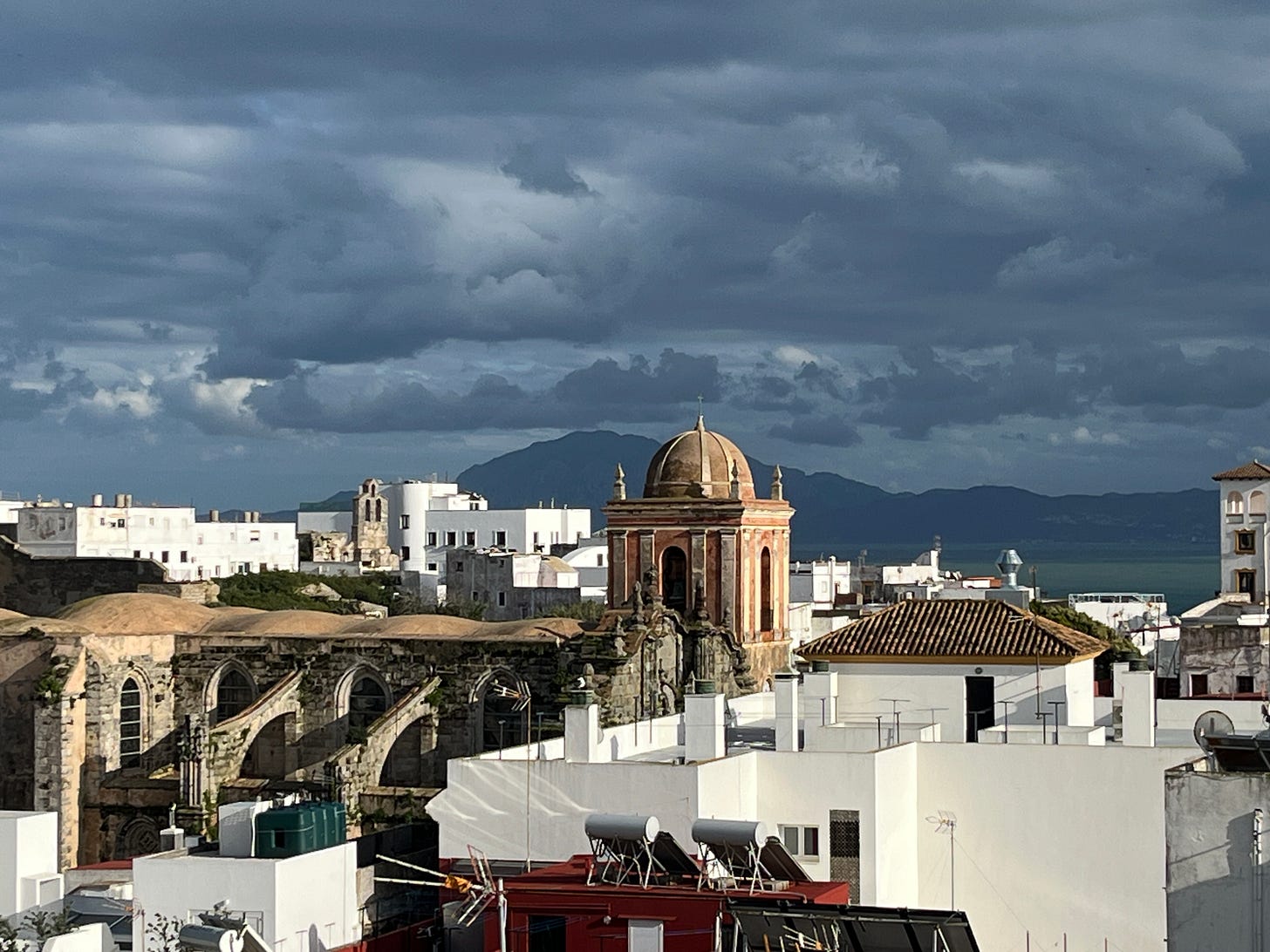
But I could only do so much from Bilbao. I’m spending the second half of my time here reporting, going to see solar and wind farms that are trying to do things better for birds and farmers and towns. Now, I write from Tarifa, the southernmost tip of Spain, a windy passage where Europe meets Africa, the Atlantic Ocean meets the Mediterranean Sea. It is difficult to concentrate on the screen, because I’ve come here to look at the sky, the bird migration just beginning. Wind turbines spin behind me up the hillsides of Spain, as well as across the waters of the Strait of Gibraltar, atop Morocco’s mountains. It’s a slalom course for migrating birds, but I’m here to see the efforts to lessen the impact.

Tarifa, Spain, looking across the Strait of Gibraltar to Morocco

Tarifa, Spain, looking across the Strait of Gibraltar to Morocco. Photo by Meera Subramanian.

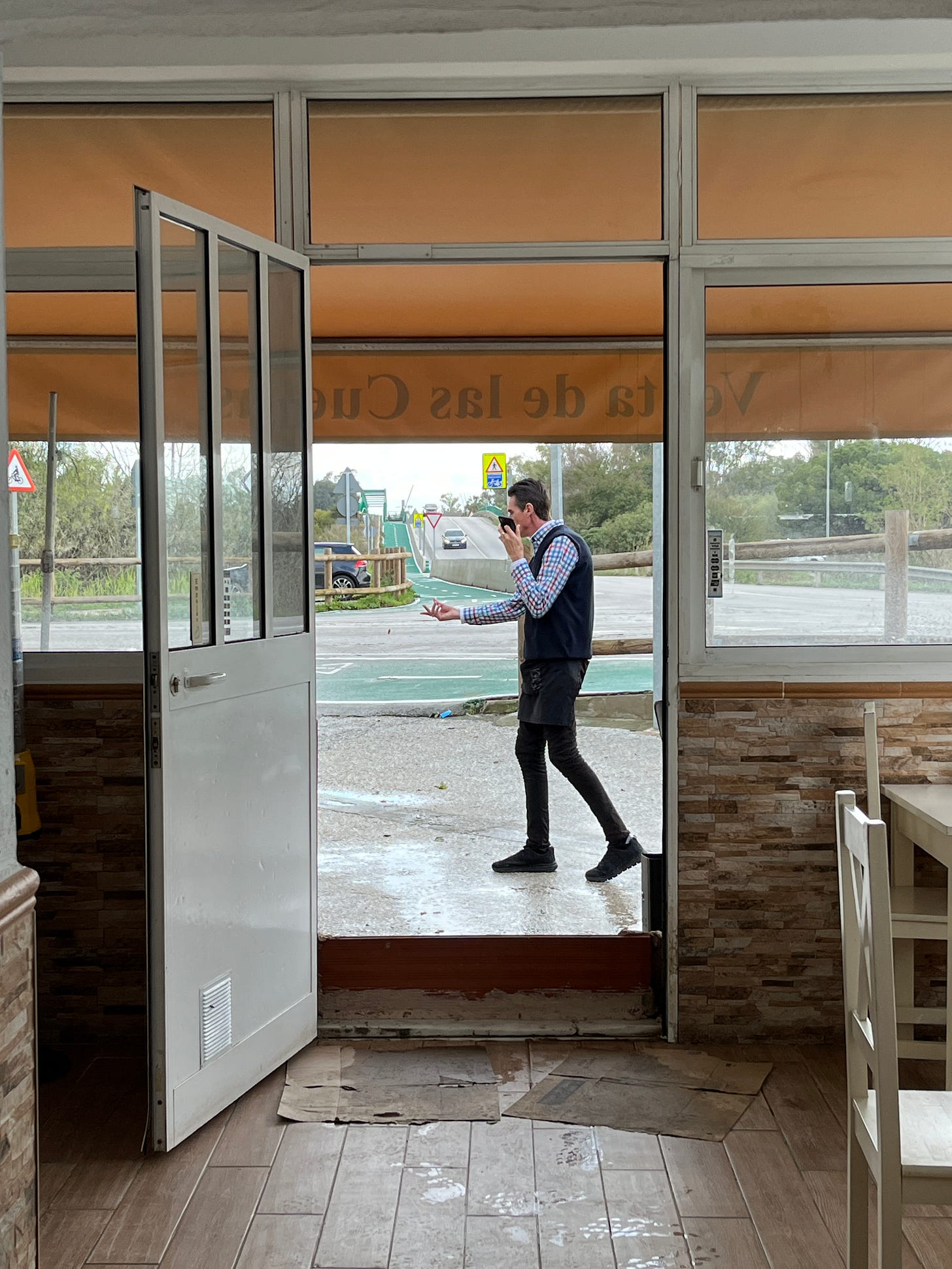
I am thankful for a moment of sun. Andalucia, like most of Spain, has been under a deluge of rain. So much that I couldn’t make it to some of the solar farms on my itinerary, so mired they were in mud. The rain is good, in some ways, needed to alleviate a drought, but it’s also coming too quick, too much, rivers rising. Causing a different type of jitters, with the Valencia floods that killed hundreds last fall still in close memory. I stopped in a cafe for a quick coffee and had to step over the barrier constructed to keep out the rain. It wasn’t enough. The man who passed me a steaming cafe con leche said that, a week and half ago, the place was filled with a half-meter of water. Too early to attribute these weeks of rain to climate change, but it fits the pattern of more extreme weather. More drought, followed by heavier, more intense rains.

man outside, and lower part of doorway blocked.

Blocked threshold to keep rain out. Photo by Meera Subramanian.

One can only hope that the lush green of this wet spring’s growth is not fuel for wildfires of the future. And that the stories I’m finding offer models that can be implemented—quick! now! yesterday!—to get off fossil fuels and onto clean energy sources in a way that doesn’t cause greater harm or collateral damage. Stay posted for more stories to come. 

Journalists & writer friends, take note…

  • Orion Environmental Writers Workshop Join a community of writers, improve your craft, and reimagine how you think about nature. March 15 (today!) for early bird tuition rate.
  • Covering Climate Now is offering a free training program aimed at helping newsrooms grow their audiences by telling the climate story better. Check out trainings on offer: Climate Journalism Training Catalog.
  • The Sharon Begley Science Reporting Award is open for entries. Deadline: April 30.
  • FRONTIERS open call for round three, specifically for early-career journalists Deadline: May 6, 17:00 (CEST).
  • Dart Center forJournalism and Trauma, the C.A.R.E.S. (Connecting Audiences, Reporters, Emotions, and Sources) Media Initiative is conducting research to better understand the resources that journalists on the climate/environment beat need to do their work. Take a moment to do this survey.
  • Trying to keep track of the Trump administration’s dismantling of climate regulations? Options include: “A Running Tally of Trump’s Climate Impacts” from Drilled, and the Climate Backtracker from the Sabin Center for Climate Change Law at the Columbia Law School.
  • NYU Stern Climate Economics Journalism Fellowship will bring a group of journalists to NYU Stern’s Greenwich Village campus, September 18–19, 2025, to learn from globally recognized experts in the emerging field of climate economics. Open to new and experienced journalists (staffers and freelancers) covering the interface between climate and the economy. Here are details and application.

And from the Department of Good News…

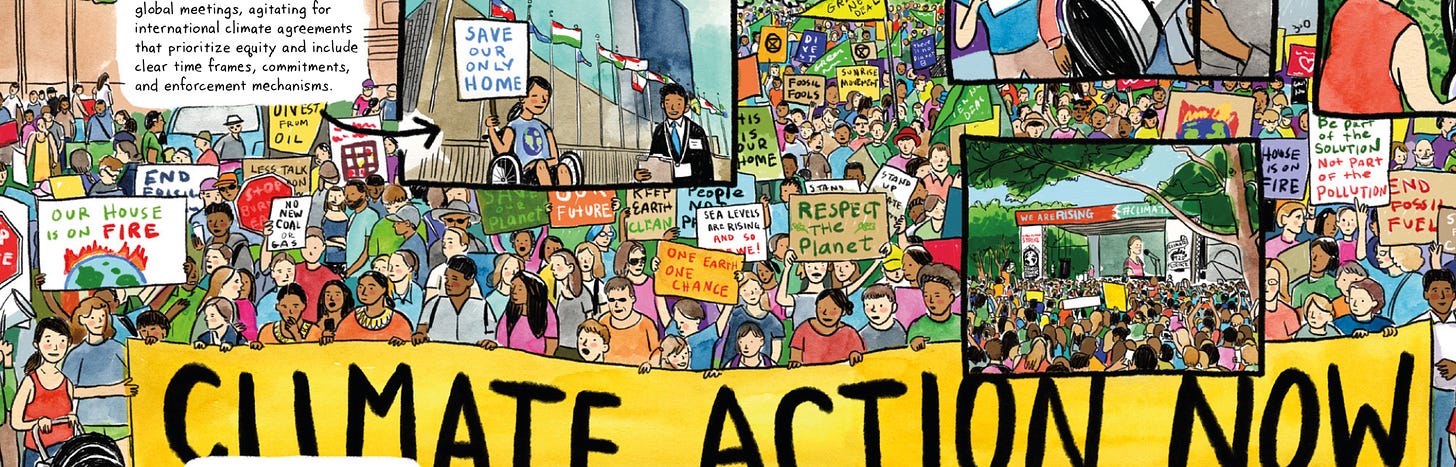
illustration of climate march

Illustration by Danica Novgorodoff

  • A Better World Is Possible, a nonfiction YA graphic novel I’ve been working on with the talented illustrator Danica Novgorodoff is working its way to publication (First Second, 2026). It reveals the pressing danger of the climate crisis through the stories of four youth climate activists who demonstrate the potential of teen power. I’m excited to announce that I received a Grant for Creative Individuals from the Mass Cultural Council that I’ll be putting towards helping this book find its way into the world. THANKS, MCC!
  • I received the Staige D. Blackford Prize for Nonfiction for my piece about the decision to donate a kidney, published in the Virginia Quarterly Review last fall. This feels deeply full circle; VQR was so generous to honor my piece about India’s vultures with this prize back in 2011. I was only a few years out of grad school, I hadn’t done any truly long-form, and VQR editor Ted Genoways took a chance on me. When that prize happened, it transformed the trajectory of my struggling freelance life. Truly. To receive the prize again, after all these years, for this piece that felt so risky in a completely different way, is the deepest of honors. Thanks to editor Paul Reyes and the whole VQR team.
  • I’m also am a True Story Award finalist, for my New Yorker piece, Consider the Vulture.
  • And I’ll be back in the US soon, for better or worse, in time to give a talk about South Asian vultures—their monumental decline and the efforts to bring them back—for the Brookline Bird Club, April 25, at the Harvard Geological Lecture Hall. In person and on Zoom. More details to come.

I’m reading…

  • To keep my reading mind in Spain, there’s been Ben Lerner’s Leaving Atocha Station, which exquisitely captured the hungry creative young mind as he makes an infinite number of poor decisions, and I’m midway through Carlos Ruiz Zafón’s Shadow of the Wind.
  • I listened to The Buried Giant, by Kazuo Ishiguro, at the recommendation of my (former) Orion editor, Sumanth Prabhaker. As our own country tumbles towards civil war (slowly, but quickening, according to Jeff Sharlet), I found this exploration of memory and forgetting—when is it necessary to wipe one’s mind clean in order to live in peace?—haunting. And, in spite of there being dragons and knight errants, it reminded me of similar themes explored in Severance, which I am totally hooked on.
  • I got an early look at Sadie Babits’ forthcoming Hot Takes: Every Journalist’s Guide to Covering Climate Change (Island Press). I had the pleasure of serving with Sadie on the SEJ Board, and she followed me as president. Now, she’s the lead climate editor at NPR. Get this book on your radar!
  • Erica Berry’s book Wolfish was a brilliant exploration of fear and wildness, and her new piece, “The Fault of Time,” in Emergence, is equally captivating. Here’s her Substack.
  • I found “The End of Children” by Gideon Lewis-Kraus in The New Yorker fascinating and as troubling as it was intended to be. It explored so many facets of the transformation underway, but I also wanted more about the infertility that may be linked to environmental factors, and also the hesitancy I have heard many younger people express about bringing children into a world increasingly ravaged by climate change and other environmental disasters. Still very much worth a read.
  • And I’ll wait to buy Sewanee School of Letter’s colleague Tiana Clark’s new book of prose poems, Scorched Earth, in person from her this summer, but I had the pleasure of hearing her read some her work in the past. You don’t have to to wait. Available at all the good places (and the bad places, too) where you can buy books.

I leave you with this, pure joy and delight of a song sung in public, crammed in a narrow alley of Old Town, just last night. The rains cancelled Carnaval in Tarifa last week, but they’re happening this weekend. The town is all dressed up. People don themed costumes with their friends and families that are about not about your single individual uniqueness, but about what you can create in concert with your community. I couldn’t catch all the lyrics of this long song, but it seemed a ballad, each stanza ending with a punchline that made the crowd laugh and led to the next round of the story. I’ll have bum-bum-bum-bum-bum running through my head for days, making me smile each time. Hope it’s contagious.

{For video go to Substack}

Be well, friends. Be fierce. Be ready.

[Read more…]

Filed Under: awards, climate change, drought, journalism, News, peregrinations, Substack, travels

Consider the Vulture

January 31, 2024 By meerasub Leave a Comment

Line of vultures on curving branch

Vultures stay close to the feeding grounds of the Jatayu Vulture Restaurant, Nepal. Photo by Alisha Vasudev ©


For close to twenty years, I’ve covered the catastrophic decline, and tentative recovery, of South Asia’s vultures. In my book A River Runs Again, I took a deep dive into the situation in India. Last year, I went to Nepal to cover a new chapter in the story, as the country’s captive-breeding program came to a close, and the last birds were released back into the wild. The story was published today at The New Yorker. Here’s a bit:

We were in a microcosm of abundance in a landscape of loss: most of the nine vulture species found in South Asia were there in front of us. We watched white-rumped vultures, whose neck ruffles look like seventeenth-century formal wear, and Himalayan griffons, which are larger and paler. We also saw an immense cinereous vulture; a red-headed vulture with fuschia wattles; and a small Egyptian vulture. Nepali pointed out a slender-billed vulture. According to the I.U.C.N. Red List of Threatened Species, there are less than one thousand mature individuals left in the world.

One bird tugged at the cow’s head, which was now detached. The vultures were so gross that they were gorgeous. It’s easy to shun vultures as dirty and disgusting, or as harbingers of death, but they are more like undertakers, performing an essential job and receiving little thanks for their work. As obligate scavengers, vultures survive almost exclusively on what is already dead.

[Read more…]

Filed Under: A River Runs Again, elemental india, journalism, National Geographic Explorer, News Tagged With: A River Runs Again, Alisha Vasudev, Asia, birds, birds of prey, captive breeding, conservation, diclofenac, Elemental India, extinction, india, Nepal, pollution environment, The New Yorker, Tulsi Rauniyar, vultures

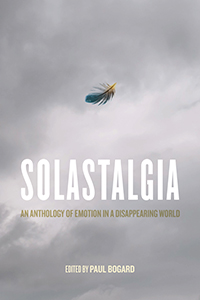
Solastalgia: An Anthology of Emotion in a Disappearing World

February 14, 2023 By meerasub Leave a Comment

Cover of Solastalgia with a feather floating in a grey sky.34 writers. One planet in flux. How are we processing the changes underfoot and overhead? Join me and other educators, journalists, poets, and scientists as we try to put words to the experience of what Australian philosopher Glenn Albrecht coined “solastalgia”… “the homesickness we feel while still at home.” Edited by Paul Bogard, author of The End of Night and many other books.

Perfectly fitting to release it today. A valentine for the planet. <3

Find your copy today. 


Filed Under: anthologies, climate change, News Tagged With: anthology, climate change, climate crisis, eco-grief, Paul Bogard, solastalgia

Person Place Thing… Strangers!

May 2, 2022 By meerasub Leave a Comment

I’ve got a couple of events coming up this week. Hope you can join us!

Person Place Thing / Orion

The first is tomorrow (Tues. 5/3) at 6:30 pm ET. I’ll be in conversation for a live virtual recording with Randy Cohen, the delightful host of the podcast Person Place Thing, an interview show based on the idea that people are particularly engaging when they speak not directly about themselves but about something they care about. I’m trying not to think about the fact that his prior guest was Ken Burns. The man definitely has more stories than me!

The event is co-hosted by Orion Magazine, and here’s the link to register: https://orionmagazine.org/event/person-place-thing-orion-live-podcast-recording/


Letter to a Stranger

The second event is on Wed (5/4) at 8:30 pm ET. A wonderful new book emerged into the world recently called Letter to a Stranger. It’s an anthology of short, searing letters written to people that haunt them for all sorts of reasons, stories of love and regret and wonder and mystery. I’ll be joining editor Colleen Kinder and fellow contributors, Lavinia Spalding (dear friend and sister-in-law!), Akemi Johnson, Faith Adiele, Emmanuel Iduma, and Anna Vodicka. You can just jump into Zoomlandia directly the night of the event at this link: https://www.bookpassage.com/lettertoastranger

Hope to see you!

Filed Under: anthologies, audio, events, News

Introducing…the Religion & Environment Story Project

June 7, 2021 By meerasub Leave a Comment

Here’s a kitchen-table story for you. I’m a science journalist who has been thinking about how humans relate to their environment for decades. I’m also an atheist … who fell in love with a religious studies professor.

While I’d be off on reporting trips from West Virginia to India, Stephen Prothero would be teaching religious literacy to students at Boston University. Over the years, our kitchen-table conversations revealed how much our two arenas rarely overlap and how much is lost because of the divide.

We wanted to try to reconcile the split between these siloed beats of religion and the environment so, with funding from the Arthur Vining Davis Foundations and a base at Boston University, we launched the Religion & Environment Story Project, or RESP.

Our goal is to bridge the divide between religion and science reporting, and to promote new thinking and new narratives that will inform and educate the public, especially on the climate crisis.

In May, RESP partnered up with the Society of Environmental Journalists and the Religion News Association for a webinar entitled “Missing Stories: Uncovering Environment-Climate-Religion Connections.” Watch the whole event, or read the summary in this piece in SEJ News.

Part of this inaugural event was to announce two great opportunities to help journalists find these missing stories. The shared deadline is fast approaching.

  • SEJ’s Fund for Environmental Journalism is offering story grants of up to $5,000 for stories that cover religion and the environment.
  • RESP is offering a paid 6-month fellowship open to journalists, editors and public-facing academics who are producing — or want to learn how to produce — stories at the intersection of religion and the environment.

Deadline for both the story grants and the fellowship is June 15. Apply now and spread the word to others who might be interested.

For more information on these opportunities — and on stories that cut across religion, spirituality and climate change, follow RESP on Twitter at @ReligionEnviro.

Filed Under: climate change, journalism, News, religion, RESP Tagged With: fellowships, grants

(Cancelled) New Imaginings: Storytelling, Science & Activism

February 22, 2020 By meerasub Leave a Comment

Imagery: Jules Bartl/BBC World Service

*Due to the coronavirus/COVID-19 crisis, this event has been cancelled*

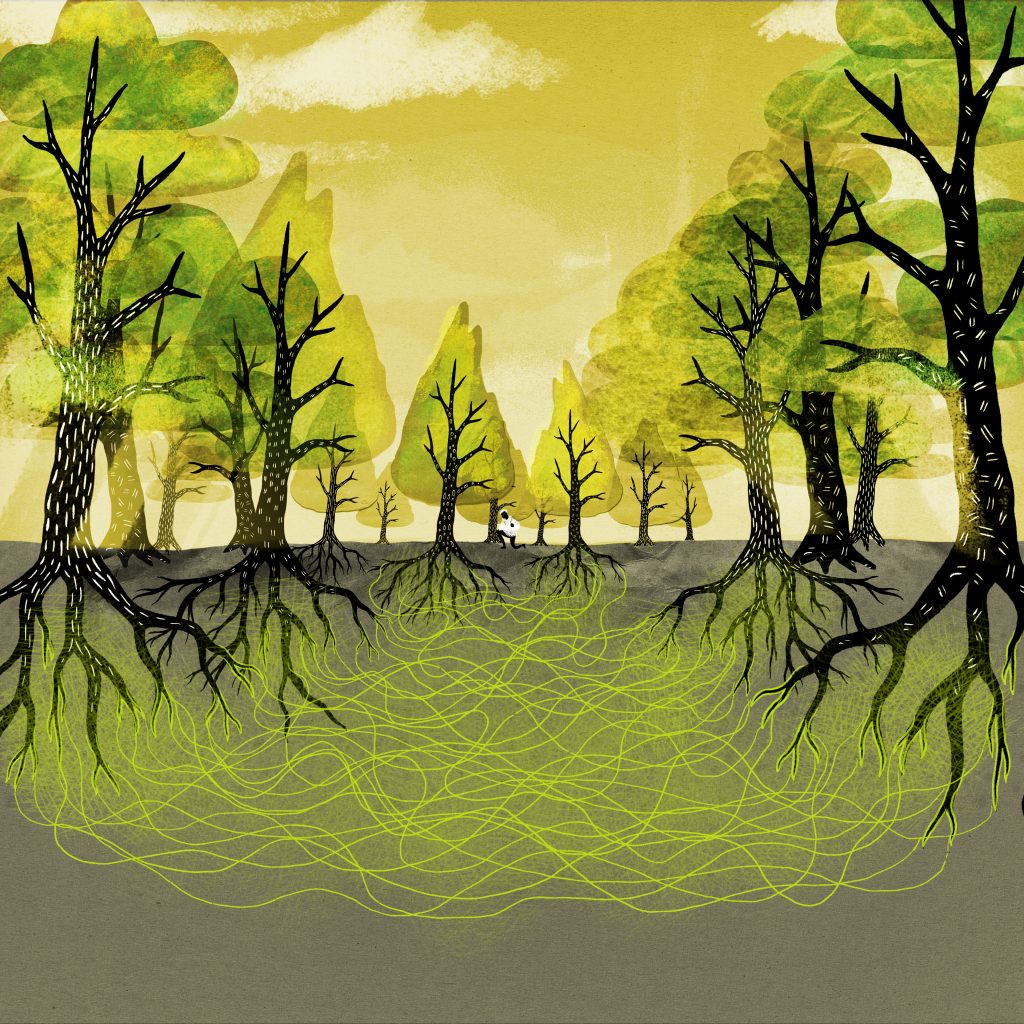
During my time at Princeton University, I have the pleasure of organizing an event, and I decided to shape it around the powerful novel The Overstory. If you’re in the Princeton area on March 26, please join me. And thanks to Jules Bartl and the BBC for letting us use this exquisite image for the event (check out the short animated film!).

More event info here.

Award-winning environmental journalist Meera Subramanian will host the discussion “New Imaginings: Storytelling, Science and Activism” featuring Pulitzer Prize-winning novelist Richard Powers, author of The Overstory; Robin Wall Kimmerer, SUNY professor of environmental biology and author of Braiding Sweetgrass; and forest activist Timothy Ingalsbee, executive director of Firefighters United for Safety, Ethics and Ecology.

Subramanian, the 2019-20 PEI Barron Visiting Professor in the Environment and the Humanities, will lead a conversation exploring how the work of scientists, artists and activists come together to inspire fundamental shifts in perspective. From the underground networks that feed forests to how human activity impacts the upper atmosphere, our understanding of how the world works shapes our minds, the stories we tell, and the way we act.

This event is free and open to the public. Books will be available for purchase from Labyrinth Books.

Thu, Mar 26, 2020
4:30 PM
 – 7:00 PM
Princeton University, McCosh Hall, Room 10


Related show

  • Author: Meera Subramanian
  • Tour: Teaching/Workshops
  • Date: March 26, 2020
  • Time: 4:30pm
  • Venue: Princeton University: McCosh Hall
  • City: Princeton , NJ
  • Address: McCosh Hall, Room 10
  • Country: United States
  • Cancelled
  • More information
  • Notes: Award-winning environmental journalist Meera Subramanian will host the discussion “New Imaginings: Storytelling, Science and Activism” featuring Pulitzer Prize-winning novelist Richard Powers, author of The Overstory; Robin Wall Kimmerer, SUNY professor of environmental biology and author of Braiding Sweetgrass; and forest activist Timothy Ingalsbee, executive director of Firefighters United for Safety, Ethics and Ecology. Subramanian, the 2019-20 PEI Barron Visiting Professor in the Environment and the Humanities, will lead a conversation exploring how the work of scientists, artists and activists come together to inspire fundamental shifts in perspective. From the underground networks that feed forests to how human activity impacts the upper atmosphere, our understanding of how the world works shapes our minds, the stories we tell, and the way we act.

Filed Under: climate change, events, News, readings, teaching Tagged With: climate change, ecology, event, forest, Princeton University, Richard Powers, Robin Wall Kimmerer, Tim Ingalsbee

Chennai’s Water Crisis

July 15, 2019 By meerasub Leave a Comment

Rebecca Conway for The New York Times


While researching and reporting A River Runs Again (aka Elemental India), I explored small-scale, across-the-landscape solutions for water crises in India. Even just a few years later, the world is warmer and there are more people in need of water. When the major South Indian city of Chennai, where my father is from and where many in my extended family live, ran out of piped water during its current drought, I wrote an op-ed for The New York Times about how India might consider a new approach to development that might embrace the methods I wrote about in the book. Here’s how it begins:

India’s water crisis offers a striking reminder of how climate change is rapidly morphing into a climate emergency. Piped water has run dry in Chennai, the capital of the southern state of Tamil Nadu, and 21 other Indian cities are also facing the specter of “Day Zero,” when municipal water sources are unable to meet demand.

Chennai, a city of eight million on the Bay of Bengal, depends on the fall monsoon to provide half of the city’s annual rainfall. Last year, the city had 55 percent less rainfall than normal. When the monsoon ended early, in December, the skies dried up and stayed that way. Chennai went without rain for 200 days. As winter passed into spring and the temperature rose to 108 degrees Fahrenheit, its four water reservoirs turned into puddles of cracked mud.

Some parts of the city have been without piped water for five months now. Weary women with brightly colored plastic jugs now await water tankers, sometimes in the middle of the night. On June 20, the delayed summer monsoon arrived as a disappointing light shower.

These water crises are now global and perennial….

Read the rest of “India’s Terrifying Water Crisis” here at The New York Times.

Filed Under: A River Runs Again, climate change, drought, elemental india, journalism, News Tagged With: Chennai, climate change, dams, development, drought, india

Announcing: visiting professorship at Princeton University

April 9, 2019 By meerasub Leave a Comment

I’m pretty sure I have been well behind the curve when it comes to the field of environmental humanities. What I didn’t realize as I criss-crossed India working on A River Runs Again was that my method of reporting and research was just that: taking a systems approach and thinking about the interconnected, interdisciplinary aspects to the complicated realm of environmental stories I was exploring. It led me to understand, for example, that designing a clean cookstove was a gender issue as much as (or more than) a technological one and that the disappearance of vultures could have religious as well as ecological implications. I had stepped, without realizing it, into the world of environmental humanities.

So — to bury the lede — it’s with great delight that I announce that for the 2019-2020 academic year, I’ll be the Currie C. and Thomas A. Barron Visiting Professor in the Environment and the Humanities at Princeton University. I’ll be rooted within the Princeton Environmental Institute (PEI). In their words: [Read more…]

Filed Under: News Tagged With: environmental humanities, Princeton University, teaching

  • 1
  • 2
  • 3
  • Next Page »

Follow Meera on Substack

for the very occasional bit of news.

Categories

Tags

Alaska anthology A River Runs Again Art awards birds birds of prey books book tour Cambridge cape cod climate change conservation death dissent Elemental India energy events Fulbright india InsideClimate News journalism kenya Knight Science Journalism Nature New York City organic farming Orion peregrine falcon pesticides photography politics pollution environment Princeton University radio readings religion reviews science Society of Environmental Journalists teaching travel USA vulture water

Archives by Month

Connect

  • Bluesky
  • Facebook
  • Instagram
  • LinkedIn

© 2026 Meera Subramanian. | All Rights Reserved. | Mastodon | Website design by Sumy Designs, LLC

Green_14