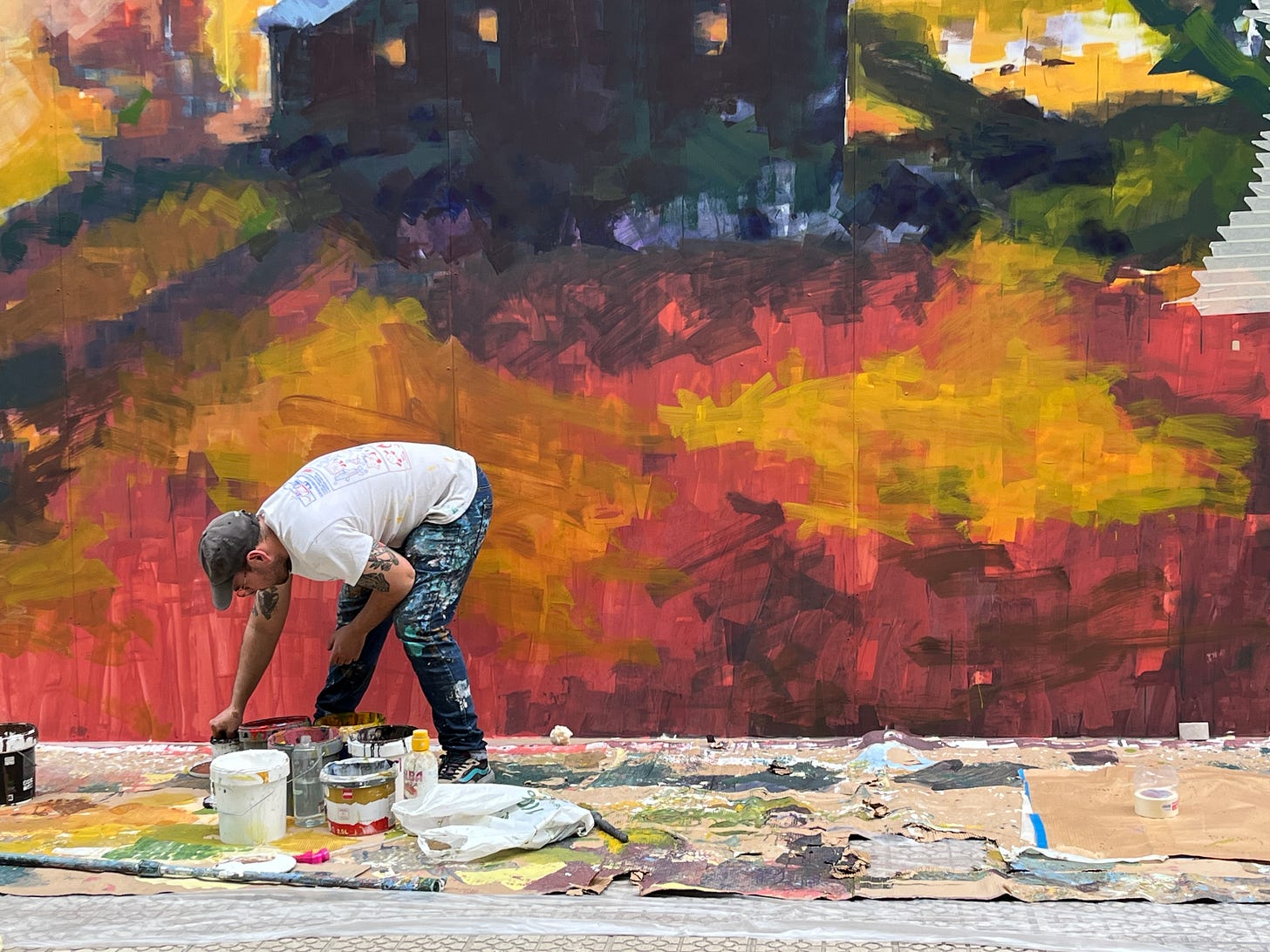
Muralist at work, Bilbao. Photo by Meera Subramanian.
{Latest Substack}
Peregrinations are underway. I’m more than two months into my FRONTIERS fellowship, the first half of which was spent in Bilbao at the Basque Center or Climate (BC3) Change. I came here with the question: can renewable energy projects be built in a way that’s better for biodiversity, people, and place?
It’s complicated.
But like the muralist I caught mid-stream as he transformed a construction blind into a work of art, it takes layers of paint, layers of understanding. I’m thankful for the FRONTIERS grant to have the time to keep digging. The researchers at BC3 helped give me a crash course in understanding the renewable energy landscape, and I’ve been busy conducting dozens of interviews, in Spanish and English, with BC3 staff as well as people all over Spain and in France. They’ve included researchers in agrivoltaics, ornithology and environmental conflict; organizations such as Greenpeace, Eudemon and Renewable Energy Foundation; political representatives such as mayors of small towns with renewable energy projects; reps from renewable energy companies; and many others.
When I arrived in Spain, Biden was still president. A week later, he wasn’t. Nowhere is far enough away from the new president’s wrath. BC3 researchers lost US partners when funding was frozen. A cousin lost his job in Bangkok related to USAID. A friend lost a year’s worth of climate work on New Jersey organic farms. A niece’s new position at NOAA as a fledging applied ecologist feels tenuous. But also, my stepdaughter, who is an environmental lawyer for Earthjustice, was part of the team that just sued Trump and the USDA to release IRA funds that were contractually promised and are now frozen. The lawsuits against the administration are piling up.
Here in Europe, the mood is jittery. (Also, I am fielding the repeated baffled question/accusation: how could you Americans have voted him in … again?!) I attended The Climate Agenda in the New European Legislature and Its Impact in the Basque Country, an event in Bilbao on January 31, when the wrecking ball was taking its first wild swings. Panelists included local politicians and journalists from other parts of Europe, offering a lens into the dynamics and tensions around renewable energy, especially in the wake of the inauguration of Donald Trump. Europe is readying itself for … well, just about anything. There is the tension between the desperate need to ramp up the clean energy transition to achieve energy independence butting against the need to divert resources to build war chests. Bolstering nuclear power keeps coming up. So does resistance:
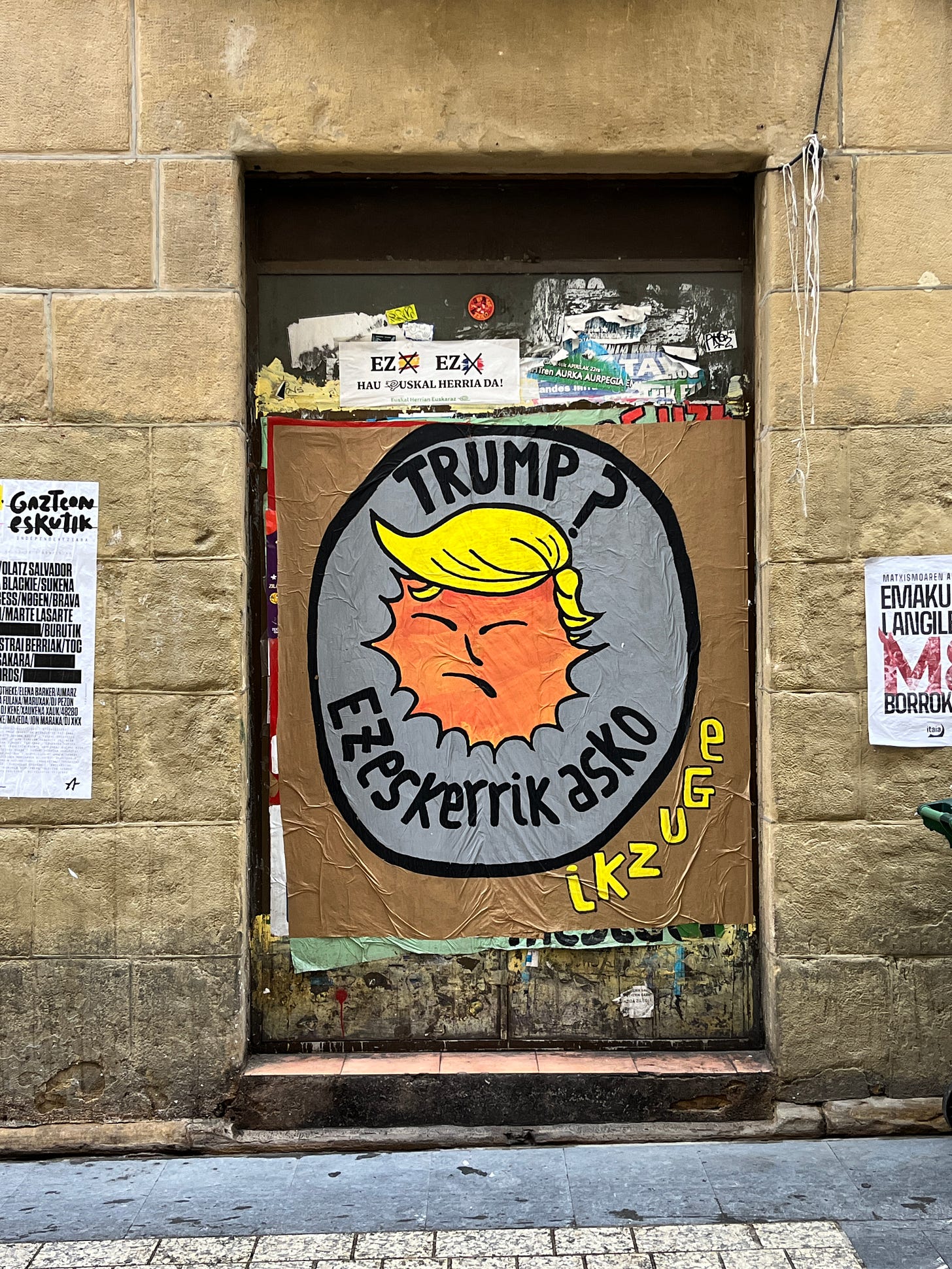
Spotted on a wall in San Sebastian, a play on an anti-nukes image, “Nuclear power? No thanks,” in Basque. Photo by Meera Subramanian.
Also spotted at a news stand:

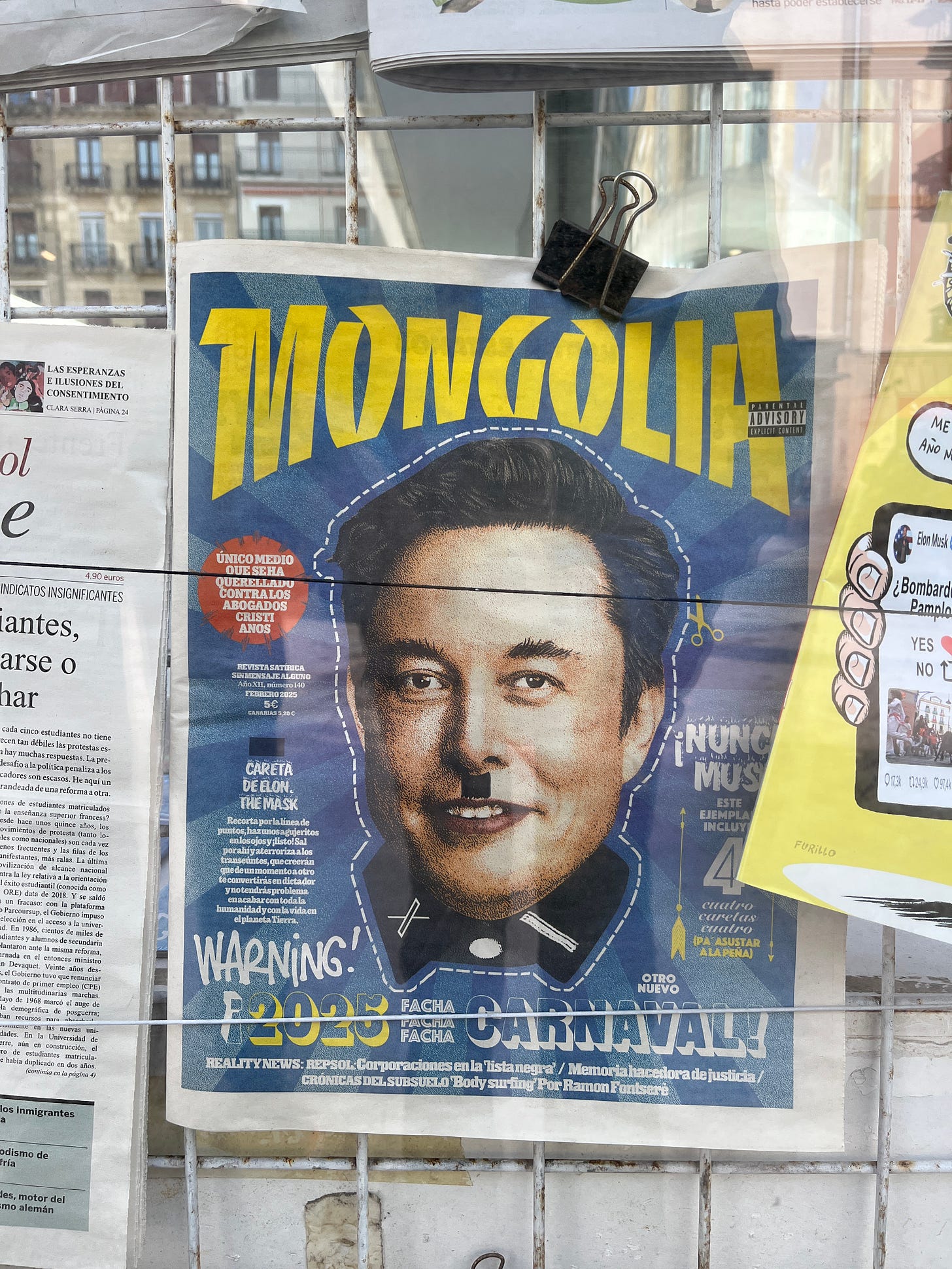
Photos by Meera Subramanian.
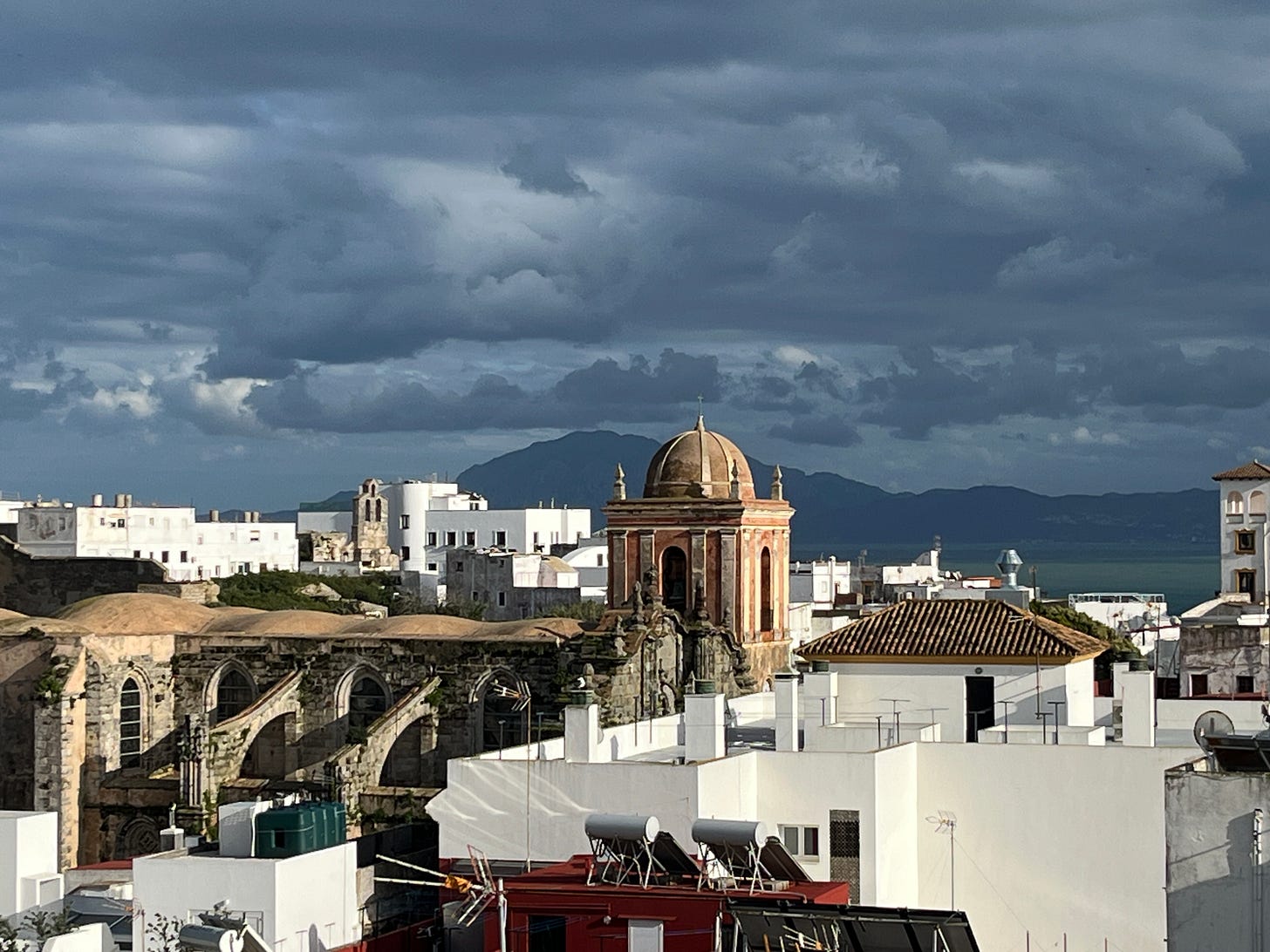
Tarifa, Spain, looking across the Strait of Gibraltar to Morocco. Photo by Meera Subramanian.
I am thankful for a moment of sun. Andalucia, like most of Spain, has been under a deluge of rain. So much that I couldn’t make it to some of the solar farms on my itinerary, so mired they were in mud. The rain is good, in some ways, needed to alleviate a drought, but it’s also coming too quick, too much, rivers rising. Causing a different type of jitters, with the Valencia floods that killed hundreds last fall still in close memory. I stopped in a cafe for a quick coffee and had to step over the barrier constructed to keep out the rain. It wasn’t enough. The man who passed me a steaming cafe con leche said that, a week and half ago, the place was filled with a half-meter of water. Too early to attribute these weeks of rain to climate change, but it fits the pattern of more extreme weather. More drought, followed by heavier, more intense rains.
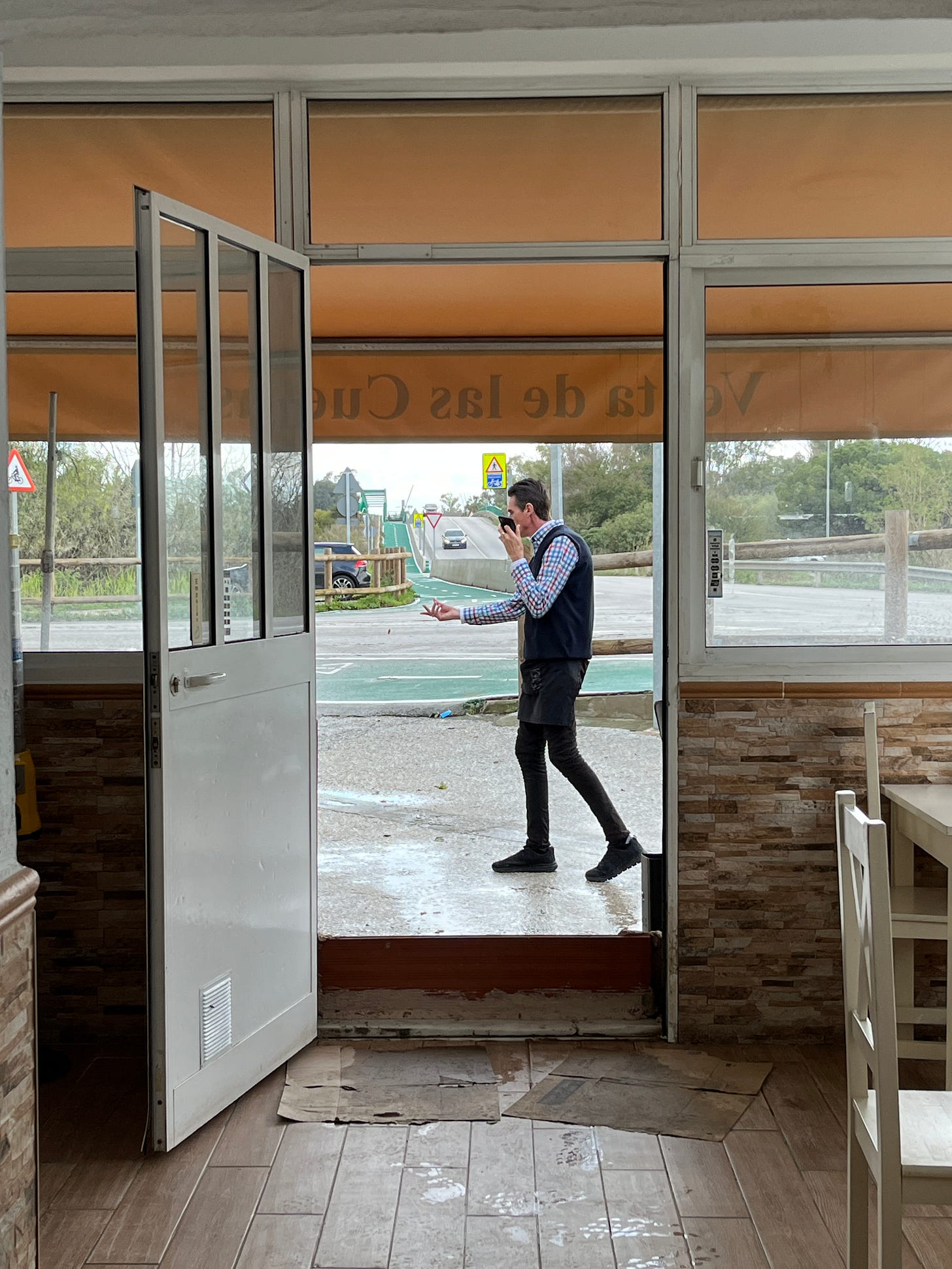
Blocked threshold to keep rain out. Photo by Meera Subramanian.
One can only hope that the lush green of this wet spring’s growth is not fuel for wildfires of the future. And that the stories I’m finding offer models that can be implemented—quick! now! yesterday!—to get off fossil fuels and onto clean energy sources in a way that doesn’t cause greater harm or collateral damage. Stay posted for more stories to come.
Journalists & writer friends, take note…
- Orion Environmental Writers Workshop Join a community of writers, improve your craft, and reimagine how you think about nature. March 15 (today!) for early bird tuition rate.
- Covering Climate Now is offering a free training program aimed at helping newsrooms grow their audiences by telling the climate story better. Check out trainings on offer: Climate Journalism Training Catalog.
- The Sharon Begley Science Reporting Award is open for entries. Deadline: April 30.
- FRONTIERS open call for round three, specifically for early-career journalists Deadline: May 6, 17:00 (CEST).
- Dart Center forJournalism and Trauma, the C.A.R.E.S. (Connecting Audiences, Reporters, Emotions, and Sources) Media Initiative is conducting research to better understand the resources that journalists on the climate/environment beat need to do their work. Take a moment to do this survey.
- Trying to keep track of the Trump administration’s dismantling of climate regulations? Options include: “A Running Tally of Trump’s Climate Impacts” from Drilled, and the Climate Backtracker from the Sabin Center for Climate Change Law at the Columbia Law School.
- NYU Stern Climate Economics Journalism Fellowship will bring a group of journalists to NYU Stern’s Greenwich Village campus, September 18–19, 2025, to learn from globally recognized experts in the emerging field of climate economics. Open to new and experienced journalists (staffers and freelancers) covering the interface between climate and the economy. Here are details and application.
And from the Department of Good News…
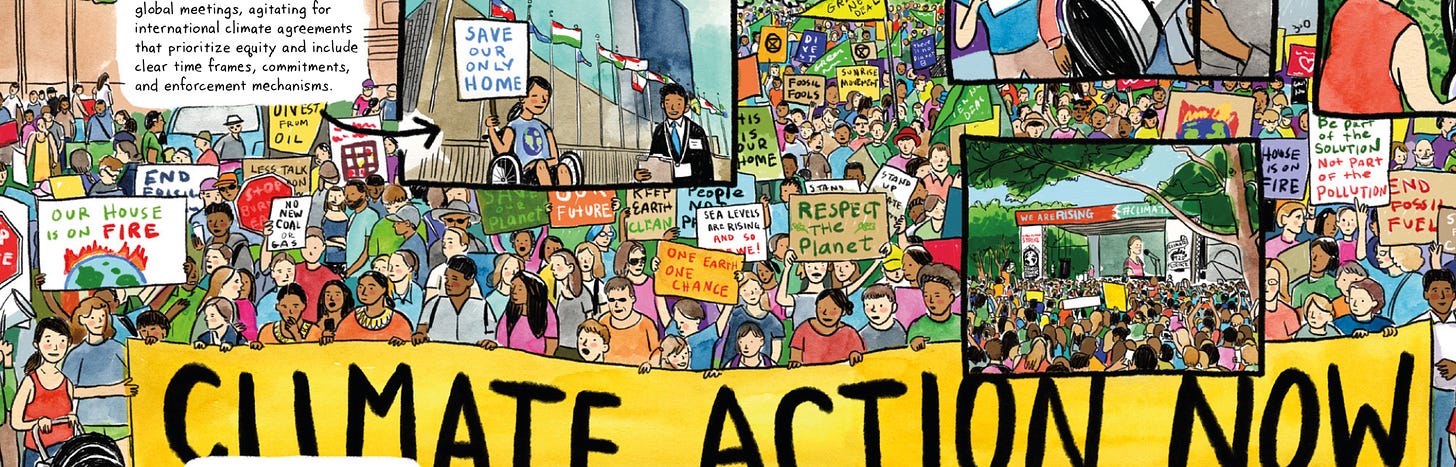
Illustration by Danica Novgorodoff
- A Better World Is Possible, a nonfiction YA graphic novel I’ve been working on with the talented illustrator Danica Novgorodoff is working its way to publication (First Second, 2026). It reveals the pressing danger of the climate crisis through the stories of four youth climate activists who demonstrate the potential of teen power. I’m excited to announce that I received a Grant for Creative Individuals from the Mass Cultural Council that I’ll be putting towards helping this book find its way into the world. THANKS, MCC!

- I received the Staige D. Blackford Prize for Nonfiction for my piece about the decision to donate a kidney, published in the Virginia Quarterly Review last fall. This feels deeply full circle; VQR was so generous to honor my piece about India’s vultures with this prize back in 2011. I was only a few years out of grad school, I hadn’t done any truly long-form, and VQR editor Ted Genoways took a chance on me. When that prize happened, it transformed the trajectory of my struggling freelance life. Truly. To receive the prize again, after all these years, for this piece that felt so risky in a completely different way, is the deepest of honors. Thanks to editor Paul Reyes and the whole VQR team.
- I’m also am a True Story Award finalist, for my New Yorker piece, Consider the Vulture.
- And I’ll be back in the US soon, for better or worse, in time to give a talk about South Asian vultures—their monumental decline and the efforts to bring them back—for the Brookline Bird Club, April 25, at the Harvard Geological Lecture Hall. In person and on Zoom. More details to come.
I’m reading…
- To keep my reading mind in Spain, there’s been Ben Lerner’s Leaving Atocha Station, which exquisitely captured the hungry creative young mind as he makes an infinite number of poor decisions, and I’m midway through Carlos Ruiz Zafón’s Shadow of the Wind.
- I listened to The Buried Giant, by Kazuo Ishiguro, at the recommendation of my (former) Orion editor, Sumanth Prabhaker. As our own country tumbles towards civil war (slowly, but quickening, according to Jeff Sharlet), I found this exploration of memory and forgetting—when is it necessary to wipe one’s mind clean in order to live in peace?—haunting. And, in spite of there being dragons and knight errants, it reminded me of similar themes explored in Severance, which I am totally hooked on.
- I got an early look at Sadie Babits’ forthcoming Hot Takes: Every Journalist’s Guide to Covering Climate Change (Island Press). I had the pleasure of serving with Sadie on the SEJ Board, and she followed me as president. Now, she’s the lead climate editor at NPR. Get this book on your radar!
- Erica Berry’s book Wolfish was a brilliant exploration of fear and wildness, and her new piece, “The Fault of Time,” in Emergence, is equally captivating. Here’s her Substack.
- I found “The End of Children” by Gideon Lewis-Kraus in The New Yorker fascinating and as troubling as it was intended to be. It explored so many facets of the transformation underway, but I also wanted more about the infertility that may be linked to environmental factors, and also the hesitancy I have heard many younger people express about bringing children into a world increasingly ravaged by climate change and other environmental disasters. Still very much worth a read.
- And I’ll wait to buy Sewanee School of Letter’s colleague Tiana Clark’s new book of prose poems, Scorched Earth, in person from her this summer, but I had the pleasure of hearing her read some her work in the past. You don’t have to to wait. Available at all the good places (and the bad places, too) where you can buy books.
I leave you with this, pure joy and delight of a song sung in public, crammed in a narrow alley of Old Town, just last night. The rains cancelled Carnaval in Tarifa last week, but they’re happening this weekend. The town is all dressed up. People don themed costumes with their friends and families that are about not about your single individual uniqueness, but about what you can create in concert with your community. I couldn’t catch all the lyrics of this long song, but it seemed a ballad, each stanza ending with a punchline that made the crowd laugh and led to the next round of the story. I’ll have bum-bum-bum-bum-bum running through my head for days, making me smile each time. Hope it’s contagious.
{For video go to Substack}
Be well, friends. Be fierce. Be ready.




