Meera Subramanian
  • Home
  • Books
  • Writing
  • Bio
  • Blog
  • Photos
  • Events
  • Speaking
  • Contact

Hold onto the light

January 26, 2026 By meerasub Leave a Comment

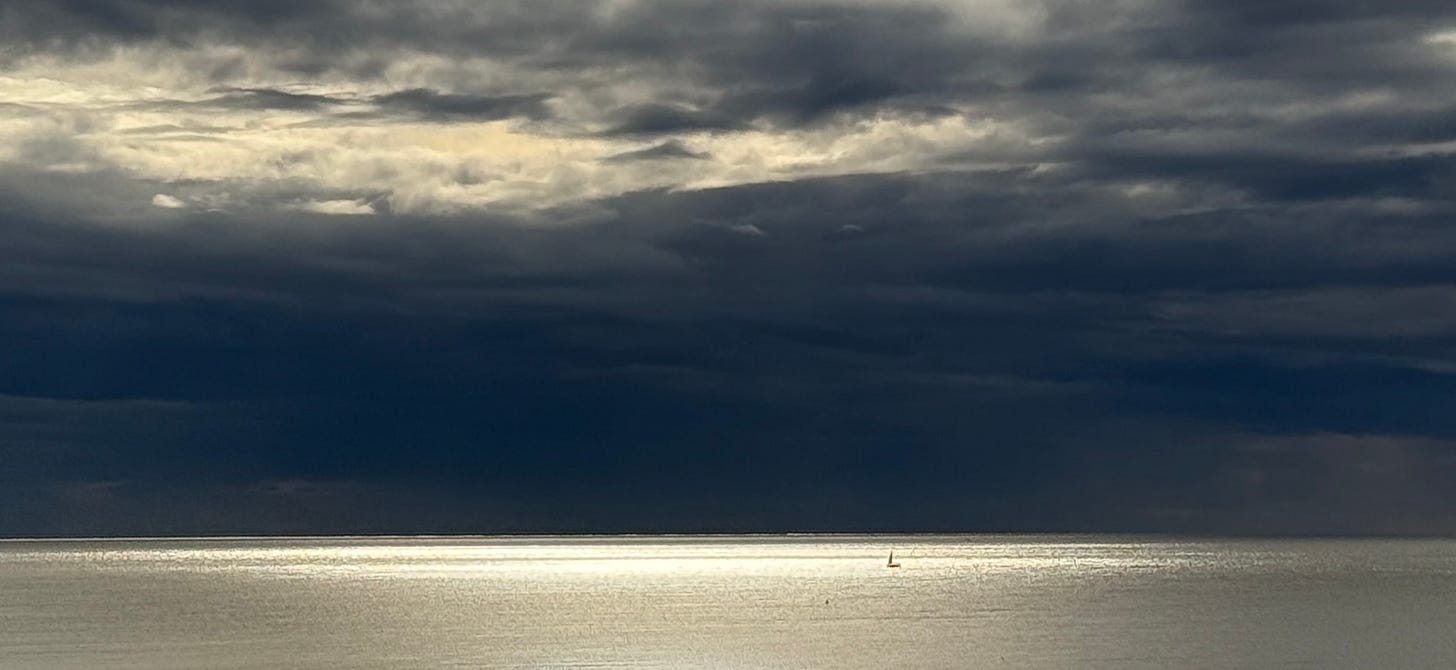
silver water with a black sky above

We are in stormy times, and I am not just talking about the snow, which blankets the world into chiaroscuro. White men in black are murdering peaceful protesters on the streets of America. Ten shots. At least. We are witnessing, in real time, the deliberate unraveling of a developed nation into something barbaric and backwards. I hold onto two things from the past week. One is the speech by Canada’s PM Mark Carney in Davos, who spoke “about a rupture in the world order,” and beckoned the middle powers to unite against the hegemony. He invoked the Czech dissident Václav Havel and the power that emerges when the greengrocer takes down the propaganda sign of political support that he never believed in. “The system’s power comes not from its truth, but from everyone’s willingness to perform as if it were true,” Carney said, “and its fragility comes from the same source.”

The second shard of light comes from seeing the thousands of people in the frigid streets of Minneapolis. Each one a version of the greengrocer, taking down the sign and revealing the fragility. No more. The statement from Alex Pretti’s parents rings out: “The sickening lies told about our son by the administration are reprehensible and disgusting.” They are not just taking down the sign. They are setting it on fire.

Those of us who write about the climate crisis struggle when our work is to “direct your attention toward the horizon,” as Emily Atkins so eloquently put it in her latest Heated Substack. But, she reminds us, climate change is state violence, too. I think of the “slow violence,” as Robert Nixon coined it, that takes lives far from phone cameras and newsfeeds. This slow violence is not nearly as slow as it used to be. Climate is the undercurrent as the hegemon invades and threatens Venezuela and Greenland in a grab for resources. It’s the water crisis fueling the unrest in Iran, where protesters demand, “Water, electricity, life – our basic right.” It’s the storm covering the country that could be worsened by the conditions created by human-caused climate change.

Still, a new generation is rising into adulthood. People go into the streets to fight for their children’s future, maybe more than their own. It is dark, but we need color. We need to keep looking to the horizon. We need to hold on to the belief that…

A Better World Is Possible

Colorful cover of A Better World Is Possible graphic novel

Pre-order today!

Book promotion is tough at times like this, but I’m still hoping you’ll hit the button and pre-order our graphic novel, A Better World Is Possible: Global Youth Confront the Climate Crisis, so when it comes out in a month, you can immediately place it in the hands of a young person you adore. An antidote to everything they are absorbing from the news shaping their young lives. People are saying nice things:

“As this lovely book points out, ‘we don’t have the luxury of time anymore.’ This book is an urgent, helpful, and hopeful portrait of what’s possible when young people come together to fight for a better world.”
~John Green, author of The Fault in Our Stars

“Novgorodoff’s watercolor style is absolutely perfect for this topic, showcasing both the power of visual comics metaphors and the beauty of the natural world.”
~Booklist, starred review

“A heart-warming and planet-cooling book about how change happens–anyone reading this will be much better prepared to help in the fight for the planet’s future.”
~Bill McKibben, author of Here Comes the Sun

When does the idea of a book begin? Artist Danica Novgorodoff began thinking about a graphic novel for young adults about climate change many years ago. I joined her in 2020, when I reconnected with Danica at a book event of our mutual friend, Jeff Sharlet, on the eve of the pandemic shutting down world, and we decided to team up. But in some ways, seeds in my mind were planted lifetimes ago, maybe at the base of the maple tree in my front yard as a kid, or in the duff of Oregon’s old-growth forests, or on the streets of Seattle during the 1999 WTO protests.

The response to crisis is to gather. Find others. “We take care of each other,” as an elder in Alakanuk, Alaska told Emily Raboteau. Collaborating with Danica over the past handful of years and immersing myself in the stories of the four climate youth we feature in the book—Jamie Margolin, Xiye Bastida, Shiv Soin and Rebeca Sabnam—has kept the light on for me, added color to my concept of a future.

cover of rrrrl girlz zine

The process brought back the joy I felt when I did a zine with girlfriends years ago, back in Oregon, before the internet changed everything. When our collective of “city babes and country chicks with shit on their minds” stayed up late with pens and scissors and magazine clippings from the 1940s and a commandeered copy machine to be creative and map out the world we wanted to live in.

tulips blooming inside, a snowy landscape beyond the window

In these dark times, keep fighting the powers that be, find the slivers of light and bursts of color, gather with your comrades, and make the world you want to inhabit.

Journalists & writer friends, take note…

  • Come study with me. I have the great good fortune of going to Sewanee, Tennessee each summer to teach creative nonfiction for the School of Letters MFA program. The setting is stunning, and the community that forms when you bring together talented faculty and just the right number of students creates a certain alchemy where good writing emerges. Feel free to DM me or director Justin Taylor to learn more. Rolling application.
  • Mid-career journalists: applications now being accepted for the University of Colorado Ted Scripps Fellowship. You can spend a year in stunning Boulder, taking classes to deepen your understanding of environmental issues. Oh, also, get paid $80,000. I’m on the Advisory Board and this is truly an amazing opportunity. Deadline: March 1
  • Do you have an ambitious reporting project about a story that uncovers the truths of the human condition? Apply now for the Matthew Power Literary Reporting Award, honoring my ole friend and Brooklyn housemate Matt, who was as delightfully obsessed with the plants in the backyard as the stories of every person he met on assignment. I still miss him dearly. {Here’s a new Atlantic story from past award winner Shayla Love} Deadline February 22
  • The Institute for Independent Journalists, founded by former Knight Science Journalism Project Fellow Katherine Lewis, is having its 2026 Freelance Journalism Conference March 5-6, a “conference for independent journalists and creators to find community and build thriving businesses.”
  • Introducing the Science Reporting Navigator from the good folks at The Open Notebook. Believing “every story is a science story,” they partnered with Relief Applications and designed a resource to help reporters who might not always be on the science beat get quickly informed. Here you can find dozens of short lessons within ten topics, such as “how to find scientific sources,” “how to navigate scientific data,” and “how to critically evaluate claims.”
  • I’ll be at two powerhouse journalism conferences this spring. Hope to see you at Boston University’s The Power of Narrative Conference (March 27-28) and/or the Society of Environmental Journalists Annual Conference in Chicago (April 15-18)

And from the Department of Good News…

  • A Better World Is Possible is #1 on Amazon in the New Releases in Teen & Young Adult Environmental Conservation & Protection. Keep those pre-orders coming to help feed the algorithmic beast (ya know, in the good way), but I encourage you to do it from your local bookshop. And give me a shout if you’d like an advance copy for review. Our spring book tour is taking shape so perhaps we’ll see on the road as the flowers emerge. More on that soon.
  • Metcalf Institute at University of Rhode Island is an incredible science communication training center. I’ve benefitted from multiple fellowships that made me a better journalist. Honored to be featured as they kick off their alumni newsletter.

I’m reading/watching…

  • While this administration continues its assault on climate action alongside its attack on citizens, thanks to Isabella Kaminski at the Guardian to remind us that there were many legal climate wins around the globe.
  • To balance most of my days, which revolve around the above, escaping into a novel is requisite. I thoroughly enjoyed the messages of loss, letting go, and transformation in Emily Habeck’s debut novel, Shark Heart. It’s a bittersweet love story that emerges when a newlywed couple faces a diagnosis: the husband is turning into a great white shark. Also, the wife makes friends with a woman pregnant with twin birds.
  • I saw the magnificent documentary Folktales at the Woods Hole about a traditional “folk school” in the Arctic wilds of Norway. The relationship between the struggling kids, their teachers and the sled dogs is breathtaking. It’s the visual version of Blair Braverman’s excellent memoir, Welcome to the Goddamn Ice Cube.

Coda…

underwater images of remoras attached to a whale

With things on land being dire these days, I have been holding on to images of water during meditations (and three-in-the-morning-try-to-get-back-to-sleep moments). So I found this video of remoras enchanting, hypnotic. Imaging clinging, (how?!), steadfast, to the back of a humpback whale, and then—just at the moment she is about to breach—releasing yourself, racing along ‘til she returns to the water. Then, reattaching. Like skipping rope. Underwater. At speed. There’s a metaphor there, of holding on, of letting go, and holding on again. Steadfast.

Stay warm, friends. Stay safe.

[Read more…]

Filed Under: A Better World Is Possible, climate change, dissent, News, peregrinations, Substack

Anger & Angels: Artist Edith Vonnegut Responds to Trump

December 19, 2020 By meerasub Leave a Comment

After President Trump’s inauguration in 2017, artist Edith Vonnegut was outraged. Her response? She embarked on a creative frenzy of artistic works, one a day, for the first 100 days (except on the days that the new president was playing golf), with a few pranks along the way.

Meanwhile, I was a Knight Science Journalism fellow at MIT, taking a class in short docs with Vivek Bald. Thanks to Edie for letting me follow her around, filming, learning as I went along.

Here’s her story.

Filed Under: dissent, Knight Science Journalism, video Tagged With: Art, cape cod, Edith Vonnegut, Knight Science Journalism, Trump

pick your poison

May 30, 2012 By Meera Leave a Comment

I once helped draw blood from a wild falcon, its lithe wings gently lashed, its head covered to calm it. Biologists have been taking such tests for more than thirty years, tracking toxins in the predatory birds as they make landfall after spending months in Central and South America, where chemicals such as DDT and PCB aren’t banned like they are in the United States, since the 1970s. A month earlier I’d heard Charles Henny, a U.S. Geological Survey wildlife biologist with a focus on toxicology, say that by 2004 there was almost no detectable DDT in these falcons, whose populations had crashed due to DDT but then recovered. But there was something new on his radar. “There’s other stuff that’s replaced it,” he said. “My concern right now is the flame retardants.”

Read the rest at Dissent…

Filed Under: dissent, journalism Tagged With: dissent, emerging contaminants

climate change – are you a believer?

November 18, 2011 By Meera Leave a Comment

In graduate school I studied under religion writer Jeff Sharlet. It was through him that I learned how every story is a story of faith. The debate around climate change—is it happening, how bad is it, if it is happening what’s causing it, what should we do about it?—really comes down to a question of belief.

This summer, Andrew Hoffman had a piece in the Christian Science Monitor that addressed this fundamental notion of worldviews and cultural beliefs underlying the divide between climate skeptics and believers. He wrote, “For skeptics, climate change is inextricably tied to a belief that climate science and policy are a covert way for liberal environmentalists and the government to diminish citizens’ personal freedom.” For the skeptics, the science is merely a guise for a liberal anti-capitalist agenda.

But does the public agree?

Read the rest at Dissent...

Filed Under: dissent, journalism Tagged With: climate change, dissent, faith

weight of the world

November 1, 2011 By Meera Leave a Comment

On Monday, the Worldometers clock, which rapidly ticks off the ever-increasing number of humans inhabiting our planet, leapt across the seven-billion mark. In honor of the staggering sum (and with a hat tip to Harper’s), let’s look at some other numbers relating to population.

• Cost of raising a child, birth to age eighteen, excluding college, for a middle-income, two-parent family in the United States as of 2010: $226,920 [Read more…]

Filed Under: dissent, journalism Tagged With: conservation, population

shout out for the sea – part three

October 26, 2011 By Meera Leave a Comment

Pacific Problems

First we basked with whales, then we explored the aquatic food chain, from the micro to the mouthwatering. In the final part of this mini-series on the state of the sea, let’s turn our gaze to the Pacific Ocean, where coral reefs are tumbling into oblivion, plastic is taking on the form of large land masses, and rampaging rubber duckies are on the loose. There’s some good news too.

Coral reefs are the oases of the oceans, the “rainforests of the sea,” sustaining a quarter of all marine species though they occupy less than 0.1 percent of the world’s watery surface. They are living structures formed by colonies of small creatures that exude calcium carbonate as an exoskeleton, creating masses that are underwater havens of life.

But they’re picky buggers, worse than that prima donna Goldilocks….

Read the rest at Dissent...

Filed Under: dissent, journalism Tagged With: conservation, dissent, oceans, plastic

shout out for the sea – part two

September 14, 2011 By Meera Leave a Comment

Phytoplankton and Fisheries

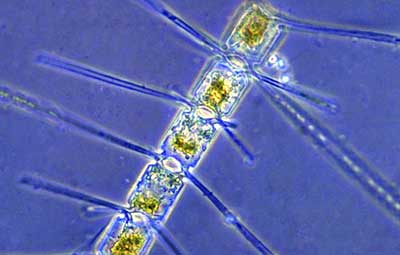
Last time I wrote, we were out watching whales, the biggest creatures in the ocean. This time, let’s start small, with those phytoplankton that are the foundation of the marine food web, the organisms that make water so blue to our eyes. According to NASA’s Earth Observatory, phytoplankton serve as a “biological carbon pump” that transfers about 10 gigatonnes of carbon from the atmosphere to the deep ocean each year. They bloom and retreat. They move and wander through the ocean. They provide sustenance for everything from teeny tiny fish to the great whales I saw off Cape Cod.

Read the rest at Dissent...

Filed Under: dissent, journalism Tagged With: conservation, dissent, fisheries, oceans

shout out for the sea – part one

August 18, 2011 By Meera Leave a Comment

Last month I boarded a small ship in Cape Cod and headed out to sea in search of whales. The going was easy, the day pleasant, the seas calm. The voice of a naturalist wafted from the loudspeakers, filling our heads with biological facts and pointing out shearwaters as they skimmed above the surface of the water on lance-like wings. And the whales! We observed cetaceans of the filter-feeding mysticetes variety. Humpbacks rose from the water, just a hint of their immense size revealed with each surfacing, “carrying their tonnage / of barnacles and joy,” in the words of poet Mary Oliver. Three traveled together, each emergence and descent repeated in the same order…one, two, three. One minke whale penetrated the surface of the water just off the ship’s starboard side, and vanished a second later.

At any one moment, only a fraction of the leviathans were visible, but even with their immensity, the whales only represented an infinitesimal percentage of the abundance of life we witnessed that day. The color of the water revealed much of the rest. Water, alone, is colorless. Come winter I’ll crave the crystal-clear liquid that hugs the equator, warm and wet, as will the humpbacks that will travel there to calve. But those tropical waters are aquatic deserts where life hovers only around the oases of coral reefs, many of which are dying. Here in the North Atlantic, the deep blue-green waters teem with untold existence—carbon-sucking, oxygen-generating, bottom-of-the-food-chain, maybe-not-so-charismatic-but-unbelievably-important phytoplankton. Without these creatures, an entire web would unravel.

That day, we were in Stellwagen Bank National Marine Sanctuary, a federally protected marine habitat, but “protected” is a hugely ambiguous word….

Read the rest at Dissent...

Filed Under: dissent, journalism Tagged With: conservation, dissent, oceans, whales

charging for conservation

August 5, 2011 By Meera Leave a Comment

ELODIE SAMPERE and I are behind the bushes with our pants down. We’d just met a few hours earlier when she’d handed me some homemade twice-fried chicken while someone else passed along a Bloody Mary. It was about eight in the morning. Now, as we pee behind the acacia brush after scouting for snakes, she tells me about how at the previous year’s Rhino Charge, the driver of their team, Pinks in Charge, had nearly died. The dust and the heat at Magadi had kicked up her asthma and landed her in the hospital for two weeks.

“So I assume she’s not coming this year,” I say, as we wiggle and shake and zip up.

“No, no, of course she’s coming!” she replies.

It’s time for Rhino Charge, an annual pilgrimage…

Read the rest at Dissent.

Filed Under: dissent, journalism Tagged With: conservation, kenya

the messy side of blooming love

May 6, 2011 By Meera Leave a Comment

Another post on Dissent’s Arguing the World blog….

photo by meera subramanian

Sunday is Mother’s Day, and—after calling my mom to tell her how great she is—I’ll be boarding a plane bound for Kenya. Meanwhile, all week long, planes have been leaving Nairobi, laden with sweet-smelling bouquets bound for mothers all over the world.

Europe’s equivalent of the New World’s Colombia, Kenya provides the other side of the pond with a third of its cut flowers—88 million tons of blooming glory each year, worth some $264 million. The vast majority of them are produced at one location at Lake Naivasha, the largest freshwater lake in the Great Rift Valley. I spent weeks on the shores of the lake last year, where zebras and leopards still roam, and where I’ll soon be returning. The scene there is not so—sorry—rosy.

In the so-called Happy Valley, the acacia forest that once ringed the lake is broken in places by swaths of industrial floriculture greenhouses, unending bows of plastic …

Read the full post here. 

Filed Under: dissent, journalism Tagged With: conservation, dissent, kenya, pesticides

  • 1
  • 2
  • Next Page »

Follow Meera on Substack

for the very occasional bit of news.

Categories

Tags

Alaska anthology A River Runs Again Art awards birds birds of prey books book tour Cambridge cape cod climate change conservation death dissent Elemental India energy events Fulbright india InsideClimate News journalism kenya Knight Science Journalism Nature New York City organic farming Orion peregrine falcon pesticides photography politics pollution environment Princeton University radio readings religion reviews science Society of Environmental Journalists teaching travel USA vulture water

Archives by Month

Connect

  • Bluesky
  • Facebook
  • Instagram
  • LinkedIn

© 2026 Meera Subramanian. | All Rights Reserved. | Mastodon | Website design by Sumy Designs, LLC

Green_14