Meera Subramanian
  • Home
  • Books
  • Writing
  • Bio
  • Blog
  • Photos
  • Events
  • Speaking
  • Contact

deadly dinners

May 28, 2014 By meerasub

Cooking on an Envirofit improved cookstove. Photo by Meera Subramanian

Cooking on an Envirofit improved cookstove in Tamil Nadu. Photo by Meera Subramanian

I spent a good chunk of last winter stepping into women’s kitchens in rural India to see what was cooking. Rice. Rotis. Dal. Curries. But regardless of the meal, most rural homes were cooking over open fires. With the incredible support of a Fulbright-Nehru fellowship, I was working on a book about environmental stories across India, including doing research and reporting about what — if anything — was helping women move away from the polluting form of cooking with biomass. Today, the journal Nature published my piece that tells a little bit about what I found. Deadly Dinners (a heavy-handed but unfortunately devastatingly accurate title) begins:

After returning from her nine-and-a-half-hour shift as a security guard, Savita Satish Dadas begins plucking fenugreek leaves from their stems for dinner. She and her two children, along with three of their cousins, gather in a shed-like structure next to their house in the Satara District of Maharashtra, India. As goats and cows settle in for the night a few metres away, Dadas and the children sit down on a packed dirt floor around the family hearth.

Whisps of smoke rise up from their chulha, the Indian name given to a traditional cooking-stove fuelled by wood and other organic matter often gathered from the countryside. Dadas’s stove, like several of her neighbours’, is sculpted out of clay. But many make a rudimentary three-stone fire — a triangle of elevated points to support a pot — that humans have used for millennia. Dadas feeds roughly chopped logs into the stove and her hands shape moistened flour into bhakri bread, the rhythmic movement illuminated by the flickering flames.

With this simple daily act, Dadas shares a connection with more than one-third of the world’s population, the three billion people who depend on solid biomass fuels — such as wood, animal dung, agricultural waste and charcoal — or coal for their cooking needs.
[Read more…]

Filed Under: A River Runs Again, elemental india, Fulbright, journalism, travels Tagged With: A River Runs Again, air quality, cookstoves, Elemental India, energy, environment, india, pollution environment

the city & the sea

April 9, 2014 By meerasub

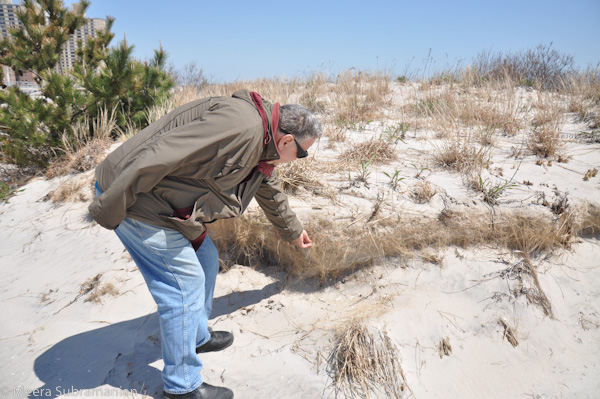
2013.04.27Orion-484

Last year I went to NYC six months after Hurricane Sandy had struck to look at recovery (and retreat) efforts and to explore the issue of coastal infrastructure in a time of changing climate. Here’s an excerpt from the start of the piece, published in the March/April issue of Orion magazine:

ONCE UPON A TIME, about 2 million years ago, the Pleistocene era locked up the world’s water in glaciers miles thick. Then, it warmed. It was about ten thousand years ago when the water of the melting glaciers was released to reshape the world into the coastlines we now associate with modern-day maps.

By all indications, though, the shape of those coastlines is about to change.

The archipelago of New York City’s five boroughs has almost six hundred miles of littoral zone between solid ground and watery sea, a place of straits and river mouths, bays and beachy backshores. It’s also a place whose contours have been radically transformed by its citizens. A large percentage of the city’s edges were created artificially, filled in and built upon with the false confidence that land taken from the sea is permanently allocated for terrestrial use. But on October 29, 2012, the record-breaking storm surge that swept over New York City flooded fifty-one square miles of that falsely allocated land—and like a finger from a watery grave, the high-water mark traced the coastline that once was and may soon be again. The mayor’s office says that, by the 2050s, 800,000 New Yorkers will live in hundred-year flood plains, double the current number. [Read more…]

Filed Under: journalism Tagged With: adaptation, climate change, environment, infrastructure, New York City, Orion

ripple effect

October 10, 2013 By meerasub

One of my absolute favorite photojournalists is Ami Vitale. Here she is talking about her work around the world for a short film by MediaStorm, featuring her photography and videoography, as she talks about the power of the lens, the power of the natural world, and the power of people to make change in their lives.

Filed Under: journalism, travels Tagged With: photography

school poisoning a window into a world of pesticides

August 5, 2013 By meerasub

spraying pesticides on cotton

The death of 23 schoolchildren last month in Bihar after they ate a free school lunch that was tainted with an abundantly used pesticide is just a reminder of the extensive presence of these chemicals in all facets of life in India. Last week, I spoke with radio host Carol Hills of PRI’s The World about the issue. Thanks to Peter Thomson for producing it.

Filed Under: A River Runs Again, elemental india, journalism, News Tagged With: A River Runs Again, Elemental India, india, organic farming, pesticides

bihar’s school deaths highlight india’s struggle with pesticides

July 30, 2013 By meerasub

photo by Amit Dave/Reuters

photo by Amit Dave/Reuters

India is still reeling from the deaths of 23 schoolchildren in the village of Dharmasati Gandawa in Bihar on July 17 after they ate a free school lunch that was made with cooking oil tainted with the pesticide monocrotophos. The police say that the cooking oil might have been kept in a container that once held the pesticide.

The devastating event in Bihar reveals a larger problem in India that stems from the wide use of biocides in myriad forms, in cities and villages, in homes and fields.

Read the rest at New York Times India Ink…

Filed Under: A River Runs Again, elemental india, journalism Tagged With: A River Runs Again, Elemental India, organic farming, pesticides

mucking about

July 17, 2013 By meerasub

BWTWvol9_PGW

It begins something like this…

I was expecting more dead bodies in Varanasi – really, burning bodies everywhere – for this is the place Hindus come to die, hoping for instant liberation from the cycle of birth and rebirth. But instead I discover that only two of the dozens of ghats are “burning ghats,” stacked with wood and smoldering funeral pyres. Most everywhere else, people are just very busy living. Some do cremate their loved ones here, but most engage in more quotidian tasks.

They wash dishes, wash clothes, wash their bodies. Mothers cook, feeding twigs into compact wood cook stoves and food into hungry mouths. People sell things; they buy things. They pray and dunk themselves in the water vigorously, jumping up and down as they fulfill a lifelong Hindu requirement to bathe in the waters of the Ganges. Others light candles and incense and circumambulate the grand broad-leafed pipul trees where I’m sure all these deliciously pagan-disguised-as-Hindu rituals originated, the idea of God and greater things tumbling from the branches like dappled sunlight.

Read the rest of Mucking About: Stepping into the Unknown on the Banks of Ganges here at Gadling.

And, even better, find a bookseller near you next month when The Best Women’s Travel Writing, volume 9 comes out and you can find Mucking About and a profusion of other great tales from travelers of the female persuasion. Or don’t delay and pre-order now.


Filed Under: journalism, News, travels

fulbright-nehru research fellowship

March 19, 2013 By meerasub

Screen Shot 2013-03-19 at 9.37.18 AM

J. William Fulbright was an American senator from the south who fought McCarthyism and the Vietnam War, and in the time in between, set up the Fulbright program in hopes of infusing “a little more reason, and a little more compassion into world affairs.” Jawaharlal Nehru was India’s first prime minister, a man who — in the words of scholar Ananya Vajpeyi — “is himself caught up in the subtle alchemy that transforms him into the leader of all Indians and all Indians into the People of India.”

Their legacies live on in both their countries, and I’m elated to announce I’ll be tapping into that heritage as a Fulbright-Nehru Research Scholar in 2013-14. The funding will allow me to spend five months in India, reporting, researching and writing my first book, Elemental India. To say I’m not quite sure how I would have done it without this support is no small understatement. On behalf of struggling journalists everywhere, I bellow, “Thank you!”

Filed Under: A River Runs Again, awards, elemental india, journalism Tagged With: A River Runs Again, awards, Elemental India, Fulbright, india

rewriting indian legend

December 31, 2012 By meerasub

The Indian woman whose name we don’t yet know is dead. She was twenty-three years old, a medical student who’d gone with her male friend to see a movie at a Delhi mall on the evening of December 16. They stood at the Munirka bus stand, and when a bus pulled up, they stepped onto it. They didn’t realize until it was too late that it was not public transport but a private bus full of joy-riding men. Men who had been drinking. Men who had an iron bar. They used it to beat the man and – along with the weapons they were born with that make them the coveted sex in South Asia – rape the woman so violently that doctors had to remove her intestines. Two weeks after the attack, she died.

This in the land where goddesses’ lyrical names linger in the legends and lore: Lakshmi and Parvati, Durga and Kali, Saraswati and Shakti. They are celebrated and worshipped with holidays, festivals and shrines in their honor across the subcontinent. But little of their divine power seems to translate to ordinary women, who hang lower than their male counterparts on every social tier that is measurable.

Read the rest at the Revealer…

Filed Under: journalism Tagged With: india, women's rights

organic chocolate makes transit

December 18, 2012 By meerasub Leave a Comment

Mott Green aboard the Tres Hombres. photo credit: Fair Transport Company, Holland

I’ve written about the Grenada Chocolate Company before, This latest piece, about their trans-Atlantic wind-powered delivery of chocolate to Europe, was published last month in the print edition of the sailing magazine Cruising World:

Imagine Willy Wonka with a life-long love of sailing, green radical roots, and an anarchist bent and you will begin to get an inkling of what drives Mott Green, one of the founders of the  Grenada Chocolate Company. He and two friends started their small ambitious company in 1998 and have since determinedly stuck to their utopian ideals while creating award-winning organic dark chocolate that has received multiple Academy of Chocolate awards.

First the trio perfected their recipe, carefully crafted from bean-to-bar all on the small West Indian island of Grenada. They refurbished a house into a pastel-hued factory and installed solar panels to power it. To ensure a steady supply of organic cacao, they helped create a cooperative for local farmers, bringing them into the company’s egalitarian folds.

This spring, they realized one more dream that Green had been harboring for years: wind-powered delivery of this “food of the gods.” [Read more…]

Filed Under: journalism

“a heritage takes wing” wins best feature story

December 18, 2012 By meerasub Leave a Comment

Saed Ateq Al Mansori, Falconry Festival, UAE

About a year ago this time, I was in the UAE covering a story about falconry receiving a UNESCO Intangible Cultural Heritage designation. The story, “A Heritage Takes Wing,” was published by Saudi Aramco World magazine, and I recently found out it received an award. My editor sent along this dispatch:

The March/April 2012 Saudi Aramco World cover story on falconry, “A Heritage Takes Wing,” was named Best Feature Article in the Association/Custom/B-to-B magazine division at this year’s annual national magazine contest sponsored by Folio in New York.

Here’s their announcement. While Saudi Aramco World is officially a trade magazine, it reads more like the Smithsonian of the Middle East, with smart, well-reported stories about culture, food, travel, history and the like. And it’s free. Yup. You should most certainly check it out.

Filed Under: awards, journalism Tagged With: awards, birds of prey, falconry, middle east

  • « Previous Page
  • 1
  • …
  • 4
  • 5
  • 6
  • 7
  • 8
  • 9
  • Next Page »

Follow Meera on Substack

for the very occasional bit of news.

Categories

Tags

Alaska anthology A River Runs Again Art awards birds of prey books book tour Cambridge cape cod climate change conservation death dissent Elemental India energy events Fulbright india InsideClimate News journalism kenya Knight Science Journalism middle east Nature New York City organic farming Orion peregrine falcon pesticides photography plastics politics pollution environment Princeton University radio readings renewable energy science Society of Environmental Journalists teaching travel USA vulture water

Archives by Month

Connect

  • Bluesky
  • Facebook
  • Instagram
  • LinkedIn

© 2026 Meera Subramanian. | All Rights Reserved. | Mastodon | Website design by Sumy Designs, LLC

Green_14

