Meera Subramanian
  • Home
  • Books
  • Writing
  • Bio
  • Blog
  • Photos
  • Events
  • Speaking
  • Contact

Every Day Is… Earth Day. Damn it.

April 22, 2026 By meerasub Leave a Comment

But, yes, today offers a moment for your consideration. Take a breath. Ah, the miracle of air. Look at a spring leaf unfurling out of seemingly nothing. Ah, the miracle of a life. Quench your thirst. (And covering the planet.) Ah, the miracle of water.

Take nothing for granted. Fight like f#@* for the preservation of the natural world, which is a fight for humans, sure, but also the million-trillion, give or take, other species of life forms that populate this one magnificent planet we all emerged from.

The past week has been full of too many good things to fit here. But some quick snapshots…

A climate movement grows in Brooklyn

Last Tuesday night in Brooklyn, we celebrated A Better World Is Possible: Global Youth Confront the Climate Crisis in the best possible way: co-author Danica Novgorodoff and I together in the same space at Greenlight Bookstore, where the idea of a collaboration on a graphic novel about youth climate activists took root way back in 2020. AND…we were joined by three of the four youth we feature in the book. It was beyond incredible to meet, in person, Shiv Soin of TREEage, Rebeca Sabnam, and Jamie Margolin of Zero Hour. We only wish Xiye Bastida of Re-Earth Initiative could have made it, too. They have all grown into fierce young adults, working in all different ways to change the world for the better, and I was deeply moved by hearing their latest news, from struggles to sweet victories. And huge thanks to everyone that came out to pack the room and swiftly sell out books.

Selling out, in the good way

Speaking of, we are delighted to share that A Better World Is Possible is now heading into its second (paperback) printing and third (hardcover) printing!!! Help us keep the momentum going by:

✅ Giving us a review on Goodreads or (if you must be there) Amazon

✅ Bumping up the 5-star reviews with a 👍🏽

✅ Asking your local library or indie bookstore to get a copy

✅ Sharing news of the book on socials, where you can also follow us (Insta tags @meerasub and @ABetterWorldtheBook and LinkedIn) and privately with friends

✅ Considering it for your next book club

✅ Suggesting the book for fall coursework for schools, ages 12+. We’ve got a discussion guide and are happy to send desk copies to interested educators for their consideration

✅ And of course, buying a copy for yourself and every young person, friend, neighbor’s friend, family member, frenemy, and human you know who likes a liveable planet.

More live events

Danica’s finished up with event for the moment, but you can still find me out and about…

May 13, 2026: Stories from a Warming World
6:00 – 8:30 pm ET | WBUR CitySpace 890 Commonwealth Ave. Boston, MA
with Meera & others from MISI (not exactly a book event, but all about climate)

May 14, 2026: Barrington Land Conservation Trust
7:00 pm ET | 281 County Road, Barrington, RI

May 30, 2025: WBUR Festival
Time TBD | WBUR CitySpace 890 Commonwealth Ave. Boston, MA
Meera with musician Mark Erelli

July 25, 2026: YA Midwest
Naperville, IL (more info to come)

June 20, 2026: Melba’s
1525 Elysian Fields Ave, New Orleans, LA

Thanks for reading Peregrinations! Subscribe for free to receive new posts.

Enviro journalists unite

And this past weekend, I was in Chicago for my—I’ve lost count—tenth(?) Society of Environmental Journalists conference. I’ve been a part of this incredible organization for twenty years and marvel at its incarnations, even as the struggles of environmental journalists mount.

The Uproot Project has infused new energy into the gatherings, and panels directly addressed the mental health of those reporting from the frontlines of the climate crisis, which Covering Climate Now has assessed in a new report: “A Burning House, A Quiet Media, A Silenced Majority.” Here’s a discussion about it, live from the conference:

And it was so lovely to be a part of the Author Program along with Joseph Lee, an Aquinnah Wampanoag and author of Nothing More of This Land: Community, Power, and the Search for Indigenous Identity and Adam Mahoney, co-author with Judith Enck of The Problem with Plastic. Cameron Oglesby was a lovey moderator.

Stay the course, friends. Because—repeat after me—every day is…

Photo: NASA

Journalists & writer friends, take note…

  • NASW is again offering its virtual summer mentoring program for graduate and undergraduate students, which will run from June 3 to July 29. Sign up to participate or volunteer to help with mentoring and editing here. Deadline: May 1
  • Applications are open for a new round of NASW Peggy Girshman Idea Grants. Individuals or groups are invited to apply for grants of up to $10,000 to support projects and programs that will help science writers in their professional lives and benefit the field of science writing. Deadline: May 15
  • Open call for the Pulitzer Center’s Rainforest Investigations Network Fellowships. In its sixth year, the network will select a new cohort of journalists to receive financial and editorial support to investigate the most pressing issues driving deforestation in the Amazon, Congo Basin, and Southeast Asia. Deadline: May 22

Green Fondo Berkshires 2026

  • I’m taking part in Climate Ride’s fundraising challenge as part of Team Eco.Cyclers, hoping to raise $1,000 by Sunday! Can you help? Whether you can give $20 or $100, your donation has real impact towards positive climate solutions. Plus, if you donate this week, you’ll be entered into a drawing for a reusable mug from Climate Ride as a thank you! Donate here by April 26…or really anytime. 🚴🏼 🚴🏼 🚴🏼

Coda…

Yes, it can kinda seem like a dumpster fire out there. Find beauty anyway.

Filed Under: A Better World Is Possible, climate change, events Tagged With: A Better World Is Possible, climate change, journalism, Society of Environmental Journalists, travel, USA

Climate talk in the coffee line

April 5, 2026 By meerasub Leave a Comment

I’m standing in line for an oatmilk latte at Audrey’s Coffee in South Kingston, Rhode Island. Stayed overnight after having a lovely talk with my friend and fellow author, Liz Rush at the Metcalf Spring Lecture. We’re both alums of the Metcalf Institute at University of Rhode Island, which brings together scientists and journalists, helps both learn from each other. If you’re a journalist, I highly recommend checking out their fellowship offerings. The room was full of students and faculty, including from a couple new programs: environmental education within the fold of the College of Education and an Environmental Arts & Humanities degree. (Can I go back to school, please?)

The coffee line’s not moving.

“It’s not usually this busy,” says the guy in front of me as we wait. I tell him it’s my first time here. He asks where I’m from. I tell him Cape Cod. Ask if he’s a local.

“I’m a squidder, but it’s not so good ‘cause of climate change…”

The first thing he says. I swear. (And I’m pretty sure he used the word “squidder”…is that right?)

“You do that at night, right?” I ask, and his face lights up with my tiny morsel of knowledge. I know this fact because of my Metcalf fellowship.

elaborate drawings of octopus and squid by Ernest Haeckel
‘Gamochonia,’ 1899, Adolf Giltsch after Ernest Haeckel © The Royal Society

He goes on to tell me his captain is seeing changes because of acidification, though he can’t elaborate. Admits it’s above his pay grade.

“It is my pay grade,” I say, laughing. “Climate journalist.” He laughs and we keep talking. He tells me about living in Narragansett. How it’s working class. But progressive. Surfers. Weed smokers. “No one voted for Trump,” he says. He can’t believe the new cluster of five million dollar houses that the new owners must have bought sight unseen, since they’re by the waste water plant and it stinks around there.

I ask him if he has to do other work since the squid’s not so great. Yeah, he says, his face boyish though he must be in his thirties. He’s started making fishing nets, but he misses being on the water.

The line moves forward. I learn his name is Joe and shake his hand before he picks up his coffee and leaves.

I tried to pursue a story about ocean acidification’s impact on shellfishing here in New England about eight years ago. Had a hard time finding scallopers or oysterfolks concerned about it, even as institutional reports warned of the impact.

So much has changed. Is changing. On the ground. In the water. I don’t know if squid are affected by ocean acidification. Maybe not, since it impacts shell production, making scallops and oysters much more at risk. But the fact that the warming climate is on the mind, and tongue, of a squidder from Narragansett named Joe, in line at a coffee shop, buoys me.

Here’s a bit more: “In New England, Climate Change Is Moving Fast. The Fishing Industry Is Not,’ co-authored by WBUR’s Barbara Moran, who I’ll be talking with….

A few upcoming events to share:

upcoming events
  • Monday, April 6 (tomorrow!): I’ll be joining graphic novelist Katy Doughty in conversation with WBUR’s Barbara Moran for Picture + Panel, Boston’s monthly graphic novel series. Katy’s new book is How to Survive the End of the World. RSVP and details here.
  • Wednesday, April 8: I’ll be joining hundreds of others at the MassEnergize Community Climate Leaders Annual Conference to explore story-telling with New Yorker cartoonist Tom Toro and how to support youth climate action with fellow MISI fellow Jaelyn Carr and others.
  • Tuesday, April 14: This feels like the biggest event of our book tour! Danica and I will both be at Greenlight Bookstore along with (at least!) two of the youth featured in A Better World Is Possible. RSVP and details here.

Other news about A Better World Is Possible: Global Youth Confront the Climate Crisis: hardcover copies have sold out and are heading for a second printing; featured in Book Riot’s spring roundup; conversation with ecoRI News; Q&A with Katy Doughty and me at Smash Pages; and Shelf Awareness featured our new official book trailer:

Journalists & writer friends, take note…

  • The Institute for Journalism & Natural Resources invites applications from early-career journalists for its 2026 Community Reporting Project fellowships. The three-day, expenses-paid, science and environment reporting workshop is produced by IJNR, the Uproot Project and partners and will take place May 27-30 and begin and end in Detroit, Michigan as they explore Great Lakes water quality and its intersections with public health and environmental justice. Deadline: Friday, April 26.

I’m reading/listening…

  • Anne Fadiman’s Ex Libris. S. and I read “Marrying Libraries” in bed one night. Something we still haven’t done. 🙂
  • This marvelous multimedia Guardian exploration of insect migration by Phoebe Weston, Ana Lucía González Paz, Prina Shah and Garry Blight.
  • In the in-betweens, I’m listening to The Loneliness of Sunny and Sonia by Kiran Desai. Don’t know where the story is leading but the descriptive powers of her writing are inspiring.
  • Joe at the coffee shop isn’t wrong. Nature covers a new study showing that climate change is speeding up, the rate of warming surging since 2015. These regular reports, along with the horror of wars upon humans and the environment within US borders and our great leaders carrying the decimation around the world, and I took a break to listen to…
  • …RadioLab’s Snail Sex Tape. I will be on the lookout for love darts this spring.

Coda…

Haven’t you always been curious about…

Filed Under: A Better World Is Possible, climate change, events, readings, travels Tagged With: book tour, climate change, events, ocean acidification, readings, Rhode Island, squid, USA

Spanish lessons in small-town survival

March 11, 2026 By meerasub Leave a Comment

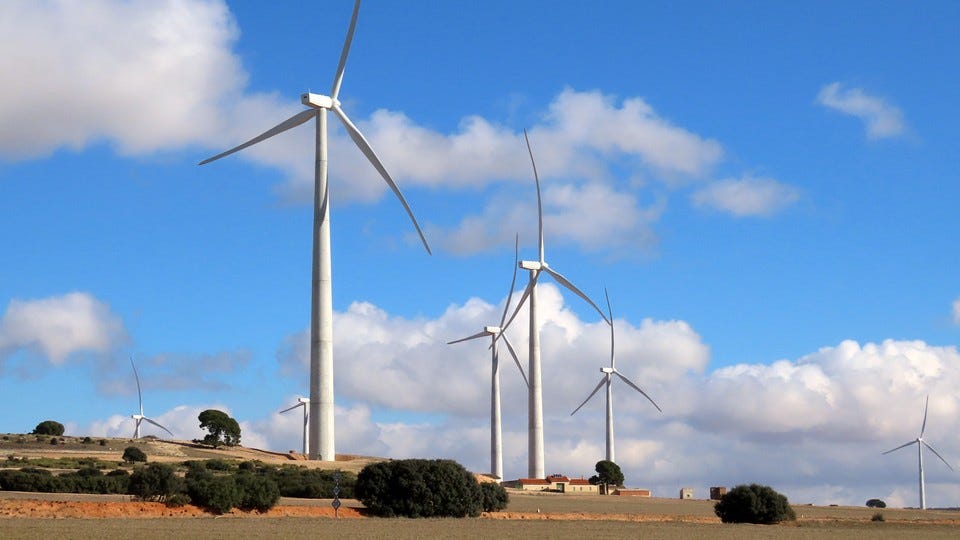
Wind turbines in the Spanish countryside near Higueruela

Last year, I spent three months on a FRONTIERS science journalism fellowship in Spain trying to understand if the clean energy transition could work better for biodiversity, people and place. I spent the first part of my time based at the Basque Center of Climate Change (BC3) in Bilbao, and the rest traveling to wind and solar farms around the country.

The question was becoming urgent. In 2023, the world’s annual renewable capacity increased by almost 50% to over 500 gigawatts. Current climate goals have that figure tripling by 2030. As a science journalist who has covered environmental issues for twenty years, I recognize both the need to quickly scale up renewables to meet the climate crisis and the risk of treating the clean energy transition as a technological problem alone. In order to succeed, mega renewable energy projects must address local concerns—ecological, cultural and economic—or risk public backlash that threatens to derail efforts. I realized this while standing with South Indian farmers who’d lost their land to a solar farm the size of Manhattan, reporting for a New Yorker feature. With global renewable energy buildout happening now, projects (and their impacts) will be in place for decades, so these controversial projects must get it right from the start. Turbines that don’t kill birds. Solar that doesn’t steal agricultural land and disproportionately hurt women. Power that is affordable. Is that possible?

The Atlantic just published my piece that emerged from that reporting and researching. It begins…

Go looking for wind farms in Spain, and you might quickly end up in Castilla–La Mancha, a region southeast of Madrid. This is the place where Don Quixote, Miquel de Cervantes’s delusional Man of La Mancha, attacked small wooden windmills he perceived as fierce giants and where today giant wind turbines have become an embedded part of the landscape.

There, I met Mayor Isabel Martínez Arnedo, who has run the town of Higueruela since 2019. The region’s distinctive wind whipped her dark curls as she stepped out of her car. “Look!” she said in Spanish. “Windmills, windmills, windmills.”

Read the full piece here.

I hope to share some more stories from my time in Spain here when time allows. Which isn’t now, but hopefully someday. But I did sit down upon a Moorish ruin on a ridge lined with wind turbines that I write about in the Atlantic piece, in the town of Higueruela, at the end of all that exploration. Here’s a video I recorded of me thinking through what I had experienced. Sorry for the whistling of the audio, and the wild hair, but well, wind. (whooosh!)

And for the science journalists out there, applications for the fourth round of the FRONTIERS Science Journalism Residency Programme are now being accepted. All levels of experience can apply.

A Better World Book Tour

  • Danica and I have kicked off our book tour for our new graphic novel, A Better World Is Possible: Global Youth Confront the Climate Crisis. Mostly, sadly, we’re doing separate events, but we’ll be together, along with two of the youth featured in the book at an all-ages book event April 14 at 6:30pm at Greenlight Bookstore in Brooklyn, NY. This event is sure to be popular, so be sure to save your spot here. You can also buy the book here and pick it up at the event.
  • Head to the website to see all the details about these other upcoming events:

How you can help!

  • If you’ve ordered a copy of A Better World Is Possible, first, THANK YOU. We hope you are enjoying it. Both Danica and I are hearing so many good things from people and reviewers. Here are ways you can help us get the word out:
  • Share kind words on Goodreads. Or on Amazon. Or wherever you can leave a review. Those stars are super helpful.
  • Take a picture of yourself with the book and tag us or invite the book & me to collaborate on the post! Here are our socials:
    • Meera Facebook: https://www.facebook.com/meerasub/
    • ABWIP Facebook: https://www.facebook.com/ABetterWorldTheBook/
    • Meera Instagram: @meerasub
    • ABWIP Instagram: @abetterworldthebook
    • Meera Bluesky: @meerasub.bsky.social
    • ABWIP Bluesky: @abetterworldbook.bsky.social
    • Meera LinkedIn: https://www.linkedin.com/in/journomeerasub/
    • ABWIP LinkedIn: https://www.linkedin.com/company/abetterworldthebook/
  • Follow us on any of those sites!
  • Also tag us if you want to share images that show how the world could be a better place if there were more of X.
  • Ask your local library to buy a copy.
  • Comment or DM me. I’d love to hear how you’re responding to the book. 🙂

More press:

  • Graphic Policy has a long positive review on YouTube with one spectacularly placed f-bomb. 🙂 He recognized what a good resource it could be for his kid but also admitted he learned a lot, too. This book was written with a YA audience in mind, but now that it’s out there, we keep hearing how not only teens are loving it, but parents can read it to their five-year-old…and learn something themselves. It’s an all-ages book.
  • I’m a member of the great organization, the National Association of Science Writers. Here’s a piece I wrote for their Advance Copy column explaining some of the craft process of collaboration.
  • And here’s another guest post in the School Library Journal Teen Library Toolbox Not Just Greta: True stories of youth acting to fight the climate crisis
  • Danica and I had a great conversation with Uma Krishnaswami for Writing with a Broken Tusk (all you Ganesha fans out there will get the reference).

Coda…

A vibrant field covered in pink and yellow wildflowers stretches toward distant blue mountains under a clear sky.
Elliot McGucken via PetaPixel

Photographer drove to Death Valley to capture exquisite images of a superbloom in Death Valley. If you are hungry for color and an riot of life and flower sex, check out more of his images here.

Keep blooming, everyone.

Filed Under: A Better World Is Possible, climate change, events, journalism, News, travels Tagged With: A Better World Is Possible, FRONTIERS, renewable energy, Spain, The Atlantic, wind turbines

happy book birthday!

March 3, 2026 By meerasub Leave a Comment

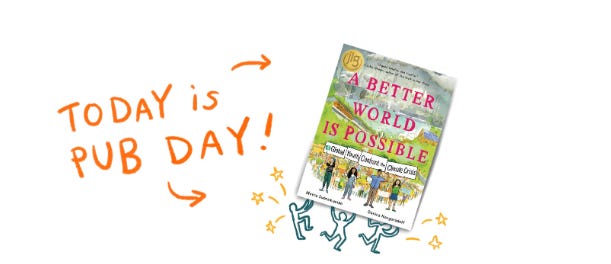
Woohoo! A Better World Is Possible: Global Youth Confront the Climate Crisis, my new graphic novel made in collaboration with Danica Novgorodoff, is OUT TODAY!

I hope you’ll order your copy of the book and/or come to one of our book release events:

TONIGHT! March 3, 2026: Titcomb’s Bookshop & Sturgis Library
5:30 pm ET | 3090 Main Street, Barnstable, MA
with Meera

March 5, 2026: Carmichael’s Bookstore
7:00 pm ET | 2720 Frankfort Avenue, Louisville, KY
Danica in conversation with Festival of Faiths Program Manager
Sally Evans & climate journalist Lyndsey Gilpin

April 2, 2026: All Peoples Unitarian Universalist Congregation
7:00 pm ET | 4936 Brownsboro Rd, Louisville, KY
Danica at All Peoples Justice Center book event on religion & climate change

April 2, 2026: University of Rhode Island Metcalf Institute
Reception at 5:30 pm ET, followed by conversation at 6:00 pm | Hope Room, URI Welcome Center, Kingston, RI
Meera in conversation with author Elizabeth Rush

April 8, 2026: MassEnergize Community Climate Leaders Annual Conference
8:00 am – 5:00 pm ET | Bentley University, 175 Forest Street, Waltham, MA
with Meera

April 14, 2026: Greenlight Bookstore
7:30 pm ET | 686 Fulton Street, Brooklyn, NY
Danica & Meera and special guests, Jamie Margolin & Shiv Soin, youth climate activists featured in book

April 18, 2026: Society of Environmental Journalists Conference
3:15 pm CT | 725 W Roosevelt Rd, Chicago, IL
Meera part of author program along with Joseph Lee & others.

See the full list of events here

(SLIGHT) SPOILER ALERT: this book ends with a view of the Grand Canyon, and the idea that while we are each as small as individual raindrops, we can come together in community to form a river—a movement, the climate movement—with immense power and agency.

Here were my first scribblings as that scene came together in my head…

Both Danica and I have made it to the Grand Canyon since we crafted that scene. To enter such deep geologic time, literally descending through millions of years of rock and earth, is to gain perspective.

Like Danica experienced, too, I was in such awe of the landscape and felt so much renewed passion to protect the natural world, which is the only world we have. School Library Journal’s review of A Better World states:

“This title not only answers the question, ‘how can I help?’ but also offers readers a glimmer of hope… This brilliantly ­illustrated ­graphic novel explores the actual crisis, as research shows, the world is facing—climate change.

By ­allowing readers to see the interconnectedness of the issues and how typical teenagers took small actions to build community and organize advocacy events on behalf of protecting our world, it is easy to understand the following quote: ‘Every single action is a raindrop. They flow together, becoming a force unstoppable as that of ­gravity. Remember that water has the power to cut through rock.’

This would be a powerful addition to any ­collection.”

I hope you will join us—in the movement, at a book event, in standing against inaction and despair, in building hope.

“Another world is not only possible, she is on her way. On a quiet day, I can hear her breathing.” —Arundhati Roy

Thank you to the everyone who helped breathe this book into life. The four powerful youth who shared their stories with us (Xiye Bastida, Jamie Margolin, Rebeca Sabnam & Shiv Soin). The whole team at First Second Books (Robyn Chapman, Benjamin A. Wilgus, Michael Moccio, Sunny Lee, Mark Siegel, Morgan Rath, & so many others). Fact-checkers (Amy Westervelt, Susan Joy Hassol, Lucy Prothero, & Rose Andreatta). And Stephen Prothero, who was there every step of the way. And finally to the readers, past, present and future. Everything is possible.

Love,
Meera

Coda….

Also, I saw the lunar eclipse this morning, bundled up in 18-degree weather, a warm coffee my husband fixed for me in my hand and his body behind me to keep me warm as we watched the nearly full moon vanish, our earth’s shadow cast across the only true earth satellite. There are dark forces at play in the world. Seek out the light and people to nurture it with. Onwards, friends.

Filed Under: A Better World Is Possible, climate change, events, journalism, News Tagged With: A Better World Is Possible, book tour, books, cape cod, climate change, journalism, luna eclipse

Hold onto the light

January 26, 2026 By meerasub Leave a Comment

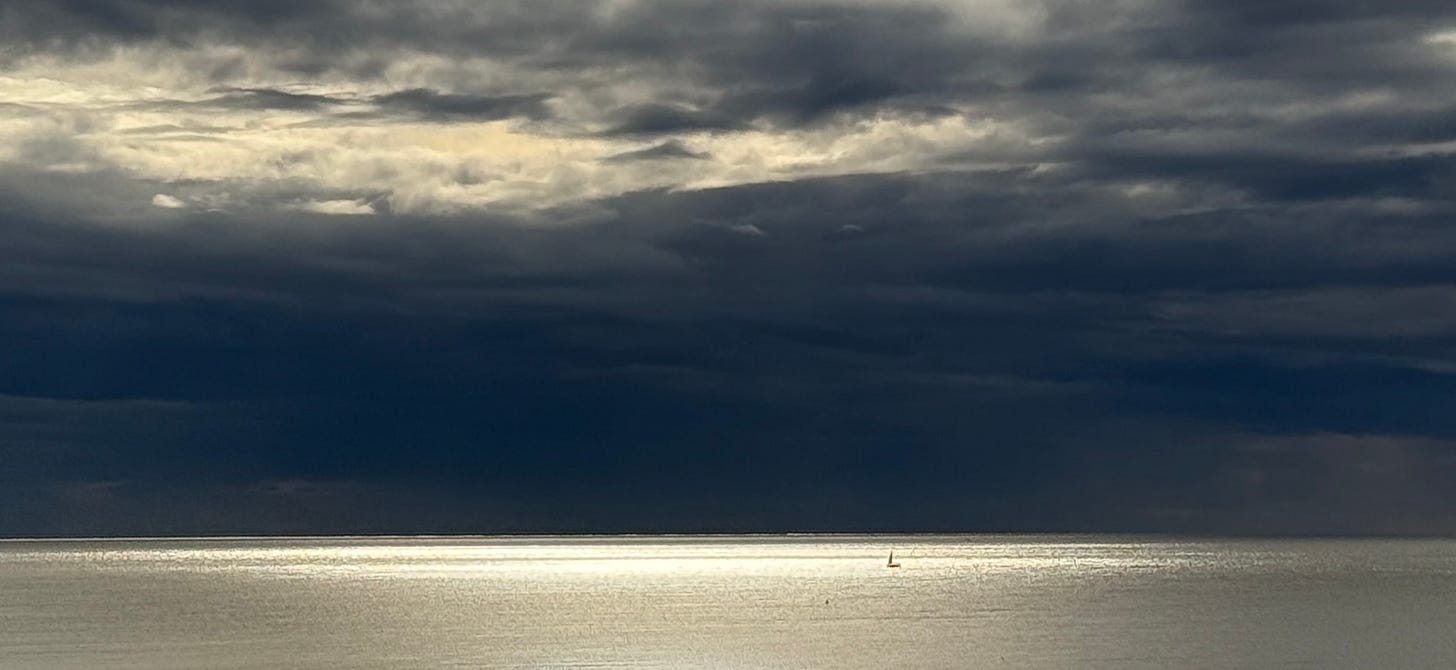
silver water with a black sky above

We are in stormy times, and I am not just talking about the snow, which blankets the world into chiaroscuro. White men in black are murdering peaceful protesters on the streets of America. Ten shots. At least. We are witnessing, in real time, the deliberate unraveling of a developed nation into something barbaric and backwards. I hold onto two things from the past week. One is the speech by Canada’s PM Mark Carney in Davos, who spoke “about a rupture in the world order,” and beckoned the middle powers to unite against the hegemony. He invoked the Czech dissident Václav Havel and the power that emerges when the greengrocer takes down the propaganda sign of political support that he never believed in. “The system’s power comes not from its truth, but from everyone’s willingness to perform as if it were true,” Carney said, “and its fragility comes from the same source.”

The second shard of light comes from seeing the thousands of people in the frigid streets of Minneapolis. Each one a version of the greengrocer, taking down the sign and revealing the fragility. No more. The statement from Alex Pretti’s parents rings out: “The sickening lies told about our son by the administration are reprehensible and disgusting.” They are not just taking down the sign. They are setting it on fire.

Those of us who write about the climate crisis struggle when our work is to “direct your attention toward the horizon,” as Emily Atkins so eloquently put it in her latest Heated Substack. But, she reminds us, climate change is state violence, too. I think of the “slow violence,” as Robert Nixon coined it, that takes lives far from phone cameras and newsfeeds. This slow violence is not nearly as slow as it used to be. Climate is the undercurrent as the hegemon invades and threatens Venezuela and Greenland in a grab for resources. It’s the water crisis fueling the unrest in Iran, where protesters demand, “Water, electricity, life – our basic right.” It’s the storm covering the country that could be worsened by the conditions created by human-caused climate change.

Still, a new generation is rising into adulthood. People go into the streets to fight for their children’s future, maybe more than their own. It is dark, but we need color. We need to keep looking to the horizon. We need to hold on to the belief that…

A Better World Is Possible

Colorful cover of A Better World Is Possible graphic novel

Pre-order today!

Book promotion is tough at times like this, but I’m still hoping you’ll hit the button and pre-order our graphic novel, A Better World Is Possible: Global Youth Confront the Climate Crisis, so when it comes out in a month, you can immediately place it in the hands of a young person you adore. An antidote to everything they are absorbing from the news shaping their young lives. People are saying nice things:

“As this lovely book points out, ‘we don’t have the luxury of time anymore.’ This book is an urgent, helpful, and hopeful portrait of what’s possible when young people come together to fight for a better world.”
~John Green, author of The Fault in Our Stars

“Novgorodoff’s watercolor style is absolutely perfect for this topic, showcasing both the power of visual comics metaphors and the beauty of the natural world.”
~Booklist, starred review

“A heart-warming and planet-cooling book about how change happens–anyone reading this will be much better prepared to help in the fight for the planet’s future.”
~Bill McKibben, author of Here Comes the Sun

When does the idea of a book begin? Artist Danica Novgorodoff began thinking about a graphic novel for young adults about climate change many years ago. I joined her in 2020, when I reconnected with Danica at a book event of our mutual friend, Jeff Sharlet, on the eve of the pandemic shutting down world, and we decided to team up. But in some ways, seeds in my mind were planted lifetimes ago, maybe at the base of the maple tree in my front yard as a kid, or in the duff of Oregon’s old-growth forests, or on the streets of Seattle during the 1999 WTO protests.

The response to crisis is to gather. Find others. “We take care of each other,” as an elder in Alakanuk, Alaska told Emily Raboteau. Collaborating with Danica over the past handful of years and immersing myself in the stories of the four climate youth we feature in the book—Jamie Margolin, Xiye Bastida, Shiv Soin and Rebeca Sabnam—has kept the light on for me, added color to my concept of a future.

cover of rrrrl girlz zine

The process brought back the joy I felt when I did a zine with girlfriends years ago, back in Oregon, before the internet changed everything. When our collective of “city babes and country chicks with shit on their minds” stayed up late with pens and scissors and magazine clippings from the 1940s and a commandeered copy machine to be creative and map out the world we wanted to live in.

tulips blooming inside, a snowy landscape beyond the window

In these dark times, keep fighting the powers that be, find the slivers of light and bursts of color, gather with your comrades, and make the world you want to inhabit.

Journalists & writer friends, take note…

  • Come study with me. I have the great good fortune of going to Sewanee, Tennessee each summer to teach creative nonfiction for the School of Letters MFA program. The setting is stunning, and the community that forms when you bring together talented faculty and just the right number of students creates a certain alchemy where good writing emerges. Feel free to DM me or director Justin Taylor to learn more. Rolling application.
  • Mid-career journalists: applications now being accepted for the University of Colorado Ted Scripps Fellowship. You can spend a year in stunning Boulder, taking classes to deepen your understanding of environmental issues. Oh, also, get paid $80,000. I’m on the Advisory Board and this is truly an amazing opportunity. Deadline: March 1
  • Do you have an ambitious reporting project about a story that uncovers the truths of the human condition? Apply now for the Matthew Power Literary Reporting Award, honoring my ole friend and Brooklyn housemate Matt, who was as delightfully obsessed with the plants in the backyard as the stories of every person he met on assignment. I still miss him dearly. {Here’s a new Atlantic story from past award winner Shayla Love} Deadline February 22
  • The Institute for Independent Journalists, founded by former Knight Science Journalism Project Fellow Katherine Lewis, is having its 2026 Freelance Journalism Conference March 5-6, a “conference for independent journalists and creators to find community and build thriving businesses.”
  • Introducing the Science Reporting Navigator from the good folks at The Open Notebook. Believing “every story is a science story,” they partnered with Relief Applications and designed a resource to help reporters who might not always be on the science beat get quickly informed. Here you can find dozens of short lessons within ten topics, such as “how to find scientific sources,” “how to navigate scientific data,” and “how to critically evaluate claims.”
  • I’ll be at two powerhouse journalism conferences this spring. Hope to see you at Boston University’s The Power of Narrative Conference (March 27-28) and/or the Society of Environmental Journalists Annual Conference in Chicago (April 15-18)

And from the Department of Good News…

  • A Better World Is Possible is #1 on Amazon in the New Releases in Teen & Young Adult Environmental Conservation & Protection. Keep those pre-orders coming to help feed the algorithmic beast (ya know, in the good way), but I encourage you to do it from your local bookshop. And give me a shout if you’d like an advance copy for review. Our spring book tour is taking shape so perhaps we’ll see on the road as the flowers emerge. More on that soon.
  • Metcalf Institute at University of Rhode Island is an incredible science communication training center. I’ve benefitted from multiple fellowships that made me a better journalist. Honored to be featured as they kick off their alumni newsletter.

I’m reading/watching…

  • While this administration continues its assault on climate action alongside its attack on citizens, thanks to Isabella Kaminski at the Guardian to remind us that there were many legal climate wins around the globe.
  • To balance most of my days, which revolve around the above, escaping into a novel is requisite. I thoroughly enjoyed the messages of loss, letting go, and transformation in Emily Habeck’s debut novel, Shark Heart. It’s a bittersweet love story that emerges when a newlywed couple faces a diagnosis: the husband is turning into a great white shark. Also, the wife makes friends with a woman pregnant with twin birds.
  • I saw the magnificent documentary Folktales at the Woods Hole about a traditional “folk school” in the Arctic wilds of Norway. The relationship between the struggling kids, their teachers and the sled dogs is breathtaking. It’s the visual version of Blair Braverman’s excellent memoir, Welcome to the Goddamn Ice Cube.

Coda…

underwater images of remoras attached to a whale

With things on land being dire these days, I have been holding on to images of water during meditations (and three-in-the-morning-try-to-get-back-to-sleep moments). So I found this video of remoras enchanting, hypnotic. Imaging clinging, (how?!), steadfast, to the back of a humpback whale, and then—just at the moment she is about to breach—releasing yourself, racing along ‘til she returns to the water. Then, reattaching. Like skipping rope. Underwater. At speed. There’s a metaphor there, of holding on, of letting go, and holding on again. Steadfast.

Stay warm, friends. Stay safe.

[Read more…]

Filed Under: A Better World Is Possible, climate change, dissent, News, peregrinations, Substack

A Better World Is Possible… Cover Reveal , limited pre-order sale, & more!

September 3, 2025 By meerasub Leave a Comment

Dearests,

It’s been a joy and delight to collaborate with the phenomenal illustrator Danica Novgorodoff on a nonfiction graphic novel called A Better World Is Possible: Global Youth Confront the Climate Crisis. And you might have felt the earth shaking beneath your feet when John Green sent me a boffo blurb for the book (more on that below), which sent me into my happy dance. This spring A Better World comes to life! Here’s… the cover!!

We aimed to make A Better World Is Possible as visually stunning a (nonfiction!) graphic novel as we could, while keeping it deeply rooted in fact-checked research about the state of the planet. Targeted to a young adult audience, it shines a light on what’s happening to our warming world, and why, and how it’s affecting the living beings who inhabit it. It shows what’s possible in terms of action and why it’s necessary. And it’s all told through the stories of four real-world youth climate activists—see them on the cover, holding their signs?—who I think you’ll find extremely inspiring. We do.

Already, we have some good news to share. A Better World is Possible was just chosen as a Junior Library Guild selection! Yup. A fine endorsement for a book that’s still running through the printing presses. Pub date is March 3, 2026.

There are others taking note, too. Like—did I mention?—John Green! This stellar human, thinker, and author of the transcendent YA novel The Fault in Our Stars and the new and important nonfiction book, Everything Is Tuberculosis, says:

“As this lovely book points out, ‘we don’t have the luxury of time anymore.’ This book is an urgent, helpful, and hopeful portrait of what’s possible when young people come together to fight for a better world.”

And indefatigable, world-famous climate activist and author Bill McKibben calls A Better World,

“a heart-warming and planet-cooling book about how change happens–anyone reading this will be much better prepared to help in the fight for the planet’s future.”

(You should absolutely be following his Substack The Crucial Years.)

Jen Wang, whose YA book Ash’s Cabin made multiple book-of-the-year lists, says:

“A comprehensive and compassionate look at the climate crisis that gives readers of all ages a sense of empowerment. A necessary read for anyone who wants to believe in the future.”

ALSO! Today through Friday (Sept. 3-5) you can preorder A Better World Is Possible for 25% off through Barnes & Noble’s preorder sale!

The discount is exclusive to B&N members and includes an additional 10% discount for Premium members—but it’s free for non-members to enroll in the “B&N Rewards” program to participate in this promotion.

A Better World Is Possible Hardcover

A Better World Is Possible Paperback

Use code PREORDER25 at checkout to get 25% off.

We invite you to check out our new website for the book, and follow us on our just-barely-beginning social media sites: Instagram, Bluesky, & TikTok. Eventually, we’ll get busy there.

📣 📣 📣 And please, as we work our way into the fall, we’re seeking any and all help in getting this book into the right hands. If you’re a librarian, a book reviewer, a young adult educator or administrator, a fabulously famous influencer or BookTokker, or if you know someone who is, write us and share their contact info. I’ve been doing environmental journalism for 20 years now, writing for places like Nature and The New Yorker, so the YA space is new to me. Will you help me find my way. 🙂

We hope you’ll enjoy this book, help spread the word of its emergence, and be in touch along the way. Thanks for your support!

with earthly love,

~Meera & Danica

Filed Under: A Better World Is Possible, climate change Tagged With: climate crisis, graphic novel

The Lady at the Entrance: On American belonging and possibility

July 6, 2025 By meerasub Leave a Comment

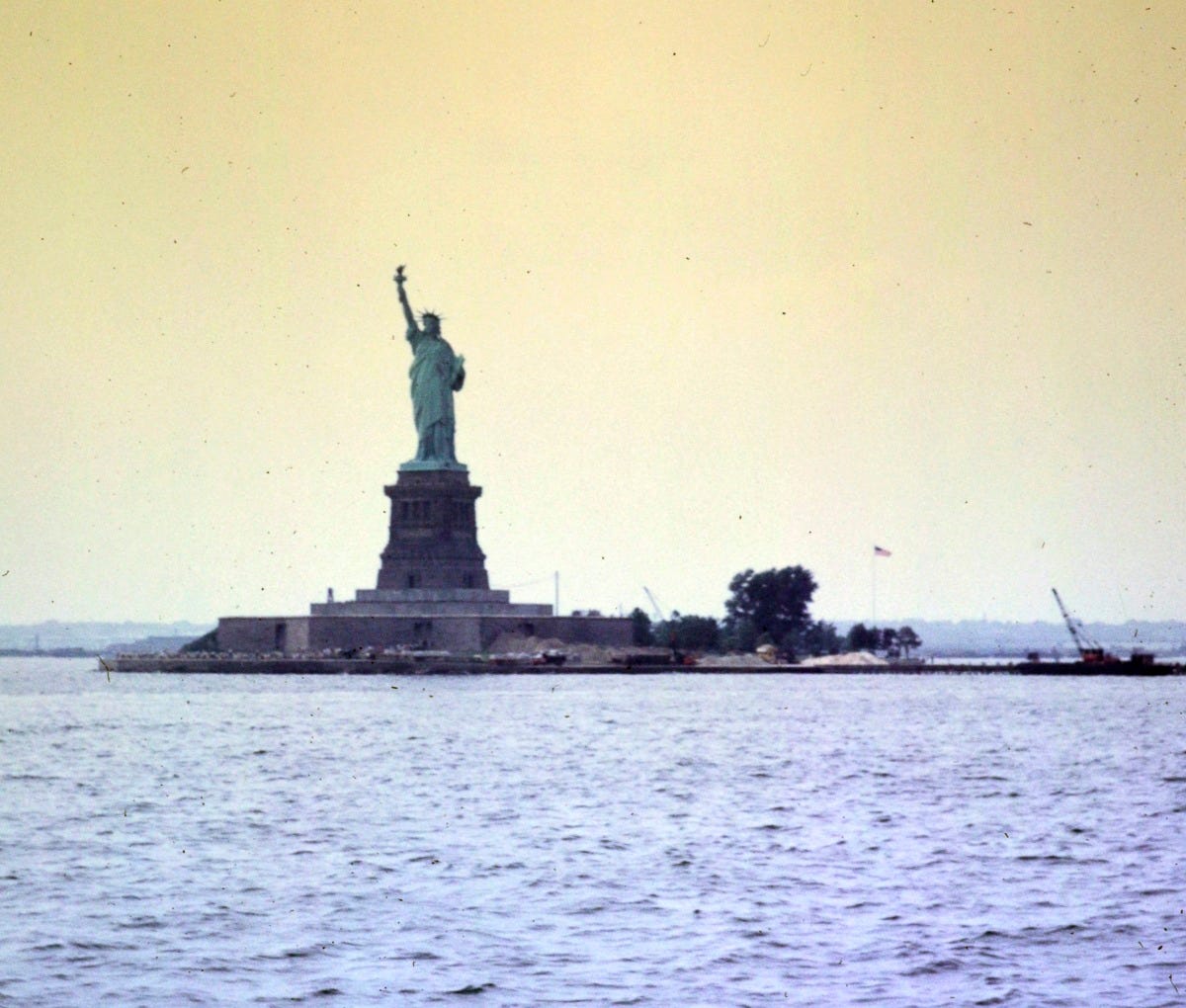
Old snapshot of the Statue of Liberty

Undated photo my dad took of the Statue of Liberty, sometime in the 1980s.

My dad reaches for words more than he used to. A few years ago, we met regularly on Zoom so I could interview him about his life. I’d given him homework on our third meeting: tell me about places that have been meaningful to you. He arrived to our fourth meeting ready with notes.

“The first places of importance, of significance,” he began, “is the lady at the entrance.”

“Wait, what does that mean?” I asked, not willing to let a single ambiguity linger.

“The freedom… What do you call that?”

Ah, I realized, drawing on the telepathy between father and daughter. The Statue of Liberty. I liked his name better. The lady at the entrance. When he arrived to New York City, with his cardboard suitcase in 1959, three weeks and a day after he left India, he didn’t go through immigration on Ellis Island, closed a handful of years earlier. But he did arrive into New York Harbor. He saw the copper-clad woman with her upheld torch standing on her wee island on the edge of an immense continent that was all possibility.

What do those of us born here see? What did I see, on our visits to the city from nearby New Jersey, where I was born? From a tour boat, with visiting relatives, when I saw the image above, that my Dad snapped? A statue I took for granted. Inert, yet eternal. I believed, as that kid, that the level of the water at her island’s perimeter that would always be static. But my faith that she’d always be standing there, greeting newcomers, was already beginning to fray.

Later generations of my Indian family have come, too. I’ve never talked about the lady at the entrance with a favorite cousin who came in the 1990s. Instead, we’d repeat lines from Eddie Murphy, who plays an African prince in Coming to America:

Good morning, my neighbors! (he cries from his fire escape in Queens)

Hey, fuck you! (shouts back a neighbor)

After the 2016 election, I traveled around America asking those in conservative communities who have faced climate impacts (floods, droughts, failed harvests), about their perceptions of climate change for an Inside Climate News nine-part series (and an Orion piece that feels positively wishful now).

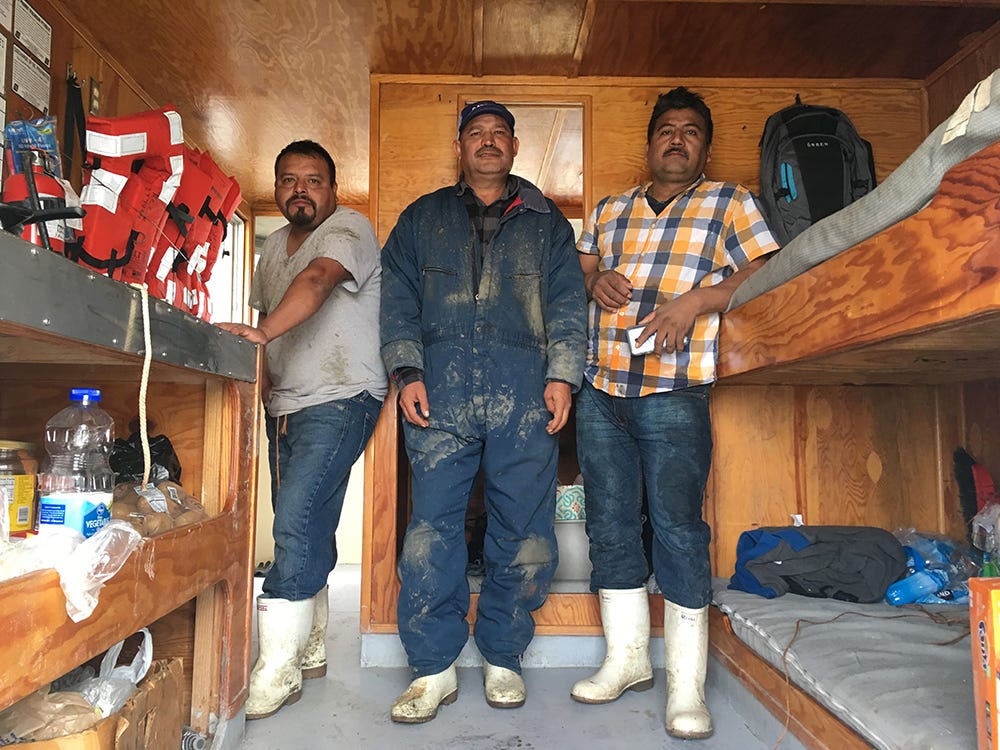
I only touched on it briefly in the pieces but multiple times, die-hard Republicans shared stories about how much they depended on their immigrant employees. They could not—no matter the pay—find local (read White) people both capable and willing to do the work that needed doing. In Georgia, that meant pruning peach trees and stacking up the limbs into massive piles in the mid-summer heat. The locals, I was told, didn’t last ‘til noon. In Texas, that meant getting on a shrimp boat that would be at sea for the next two months. The locals, I was told, showed up for departure drunk. The folks I talked to didn’t want to go on the record. But as business men, they knew who was a good worker. Some were in the country legally. Many, I imagine, were not. It saddened them that that their (White) neighbors didn’t want the work. But the reality was that they didn’t.

Misho's crew. Credit: Meera Subramanian

Oystermen in San Leon, Texas. Credit: Meera Subramanian

ICE deportations and detentions are at record levels, sweeps targeting the places people go looking for daywork—7-Elevens and Home Depots. Crackdowns in places that have been established as sanctuary cities. Good morning, my neighbors! Some arrests are made by men in plainclothes, setting the stage where anyone can impersonate an officer, can decide the fate of another, can disappear another human being. Hey! Fuck you!

Where is the lady at the entrance? Where is the recognition of who is actually doing the labor in this country, below the burning sun that beats on the agricultural fields of the Central Valley, behind the restaurant’s swinging kitchen doors and the swinging hammers clutched on rooftops?

I’m still harboring a crush on Spain, meanwhile, which is welcoming immigrants. (I get there are limitations to which immigrants, but still….) El País ran a report in 2022: “A day without immigrants,” recognizing their roles in agriculture, construction, healthcare. Recognizing that “without them, Spain simply would not function.”

No such recognition here from the powers that be. These days, it’s not just my Dad who’s struggling as they reach for words.

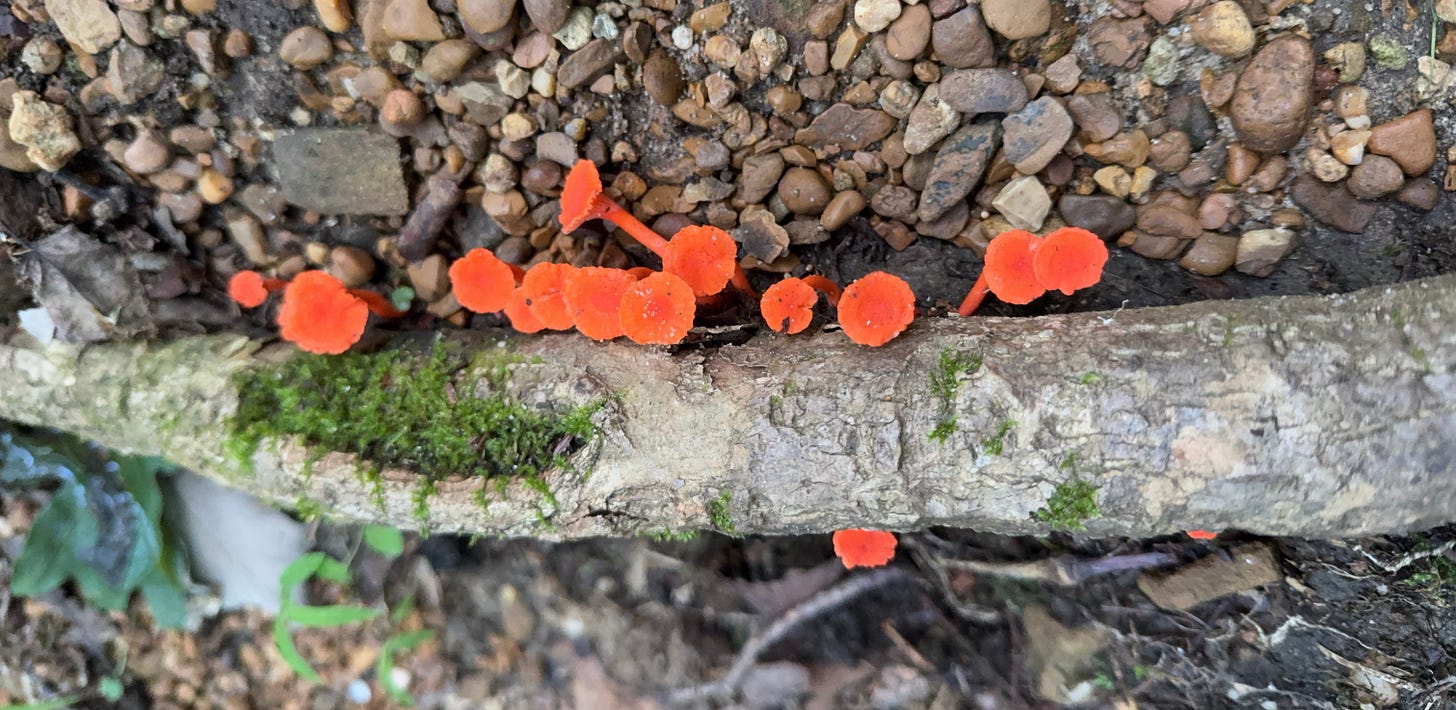
tiny orange mushrooms along a branch

Credit: Meera Subramanian

Upcoming…

  • On a lighter note…mushroom! Join Orion and the Food & Environment Reporting Network (FERN) on July 17 (2-3pm ET) to celebrate Orion’s Summer 2025 issue, The Future Is Fungi. I’ll be in conversation with FERN editor Theodore Ross and the wonderful writer Erica Berry, talking about our pieces (here & here). Register here.
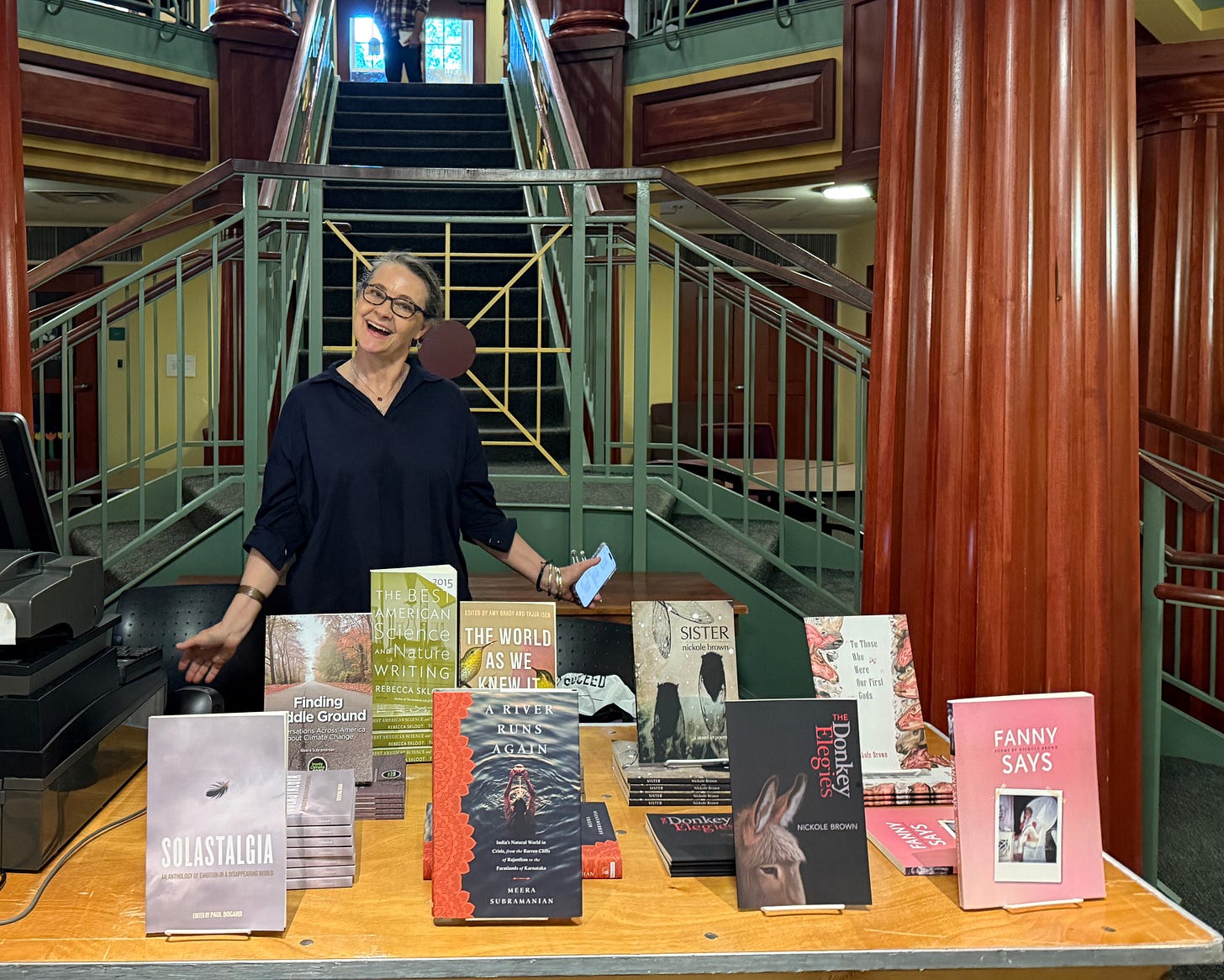
Woman smiling behind a table full of books

Lucy Murray of the University of the South Bookstore, hamming it up at the book table at the School of Letters faculty reading.

I’m reading/listening…

  • My time teaching at the School of Letters in Sewanee, TN is fast coming to a close. The students and fellow faculty are all inspiring, as are those who run the program. Assistant director April Alvarez, with a team that includes one of my former students, Sam Worley, have launched The Suitcase, a podcast that tells a fascinating story of the South in the first half of the last century through the life of Ely Green, a mixed-race man. Have a listen. More episodes coming soon.
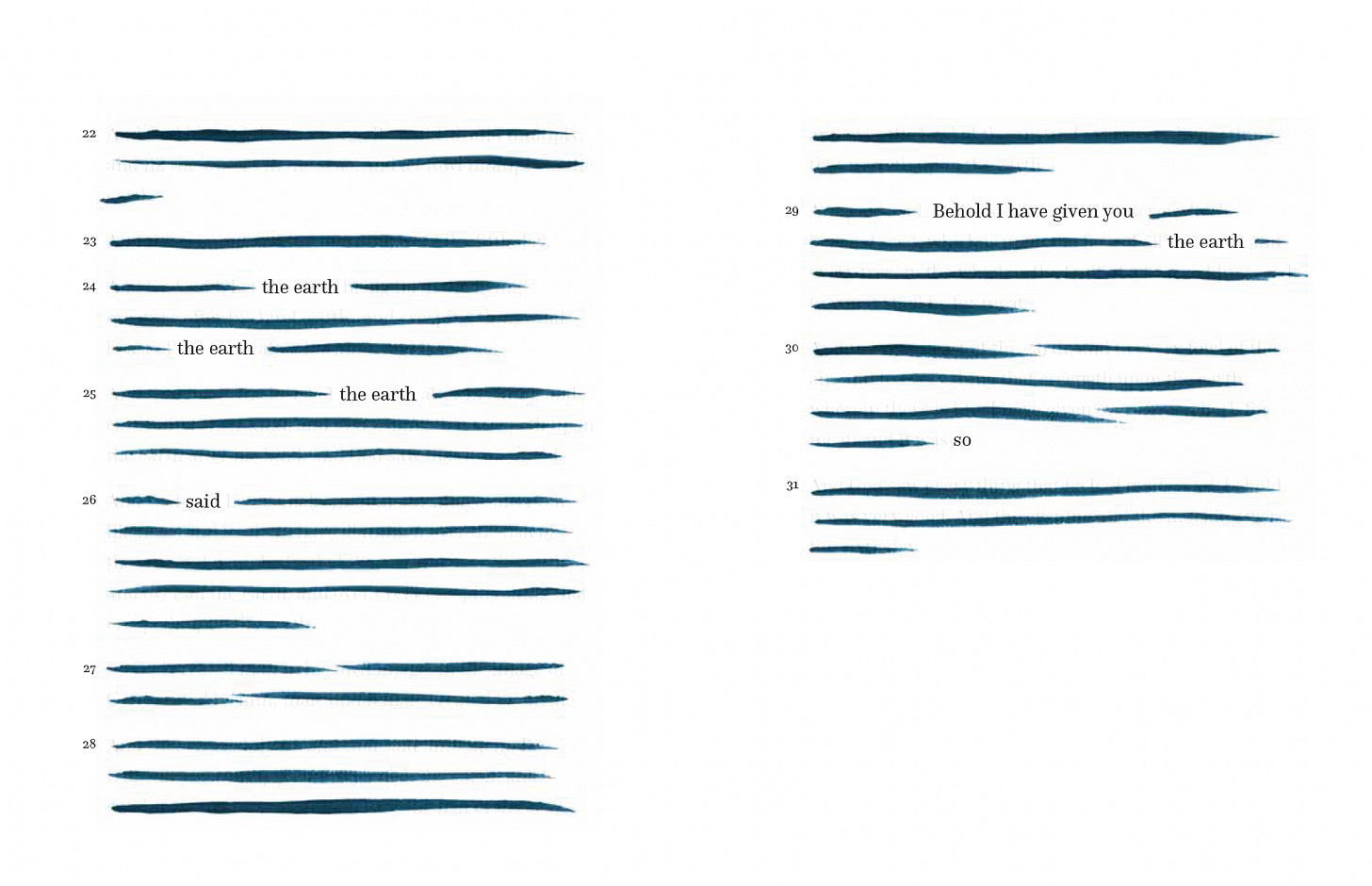
  • This year I have the delight of teaching with two new faculty, Dan Hornsby and Rebecca Gayle Howell. I deeply enjoyed Dan’s novel Via Negativa. And at the first faculty reading, Rebecca shared work from her new prose poem, Erase Genesis, forthcoming in November 2025. I’ll let Rebecca tell you what it is in her own words: she “made the poems by repeatedly erasing the first three chapters of Genesis (KJV), where the creation myths are told. Each time I came to the chapter again, a new poem emerged. Eventually, this accumulated into a new creation myth, one that seems to begin at climate change and centers the Earth’s vast and divine intelligence for interconnected being.” Oh, yes! This is going to be a gorgeous book, with an aching message. Here’s a peek:
mostly redacted text, only leaving words "the earth, the earth..." and more

Credit: Rebecca Gayle Howell

  • Thanks to Michelle Nijhuis of Conservation Works for tipping me off about Boyce Upholt’s new magazine, Southlands, which aims to capture the unique land and life of Southern habitats. (I reviewed Boyce’s book The Great River for Scientific American a couple years ago.) See what Southlands is up to and pitch in if you want to help make it happen!
  • I also had the joy of reading writer and illustrator (and one of our RESP fellows) Martha Park’s debut book, World Without End: Essays on Apocalypse and After, a literary love song to the future, beheld with an expectant hope. Daughter of a mainline Protestant preacher, native of Memphis, Martha writes of the human experience, quite literally, from the deeply personal act of giving birth to the reported inquiry into green burials in the American South, shattering the typical glass wall that separates writing about the climate crisis and writing about faith, and she does it with humility and grace. She absolutely wowed my Creative Nonfiction class when she came to visit last week. We also had a lovely conversation that was just published on Orion.
  • I tore through Alison Bechdel’s new comic novel, Spent, and am savoring Feeding Ghosts by Tessa Hull, a graphic memoir about her immigrant mother and grandmother. I taught the start of the it in my class and we keep returning to it again and again.
  • “Is nature alive?” The short answer is “Hell, yes!” but the longer answer to the question is explored in Robert Macfarlane’s new book Is a River Alive? Here’s Elizabeth Rush’s review of it: A New Concept for Fighting Climate Change.

Coda…

Sewanee environs, in various stages of life, seeding, death.

Filed Under: just another day, Substack, teaching

every day is turkey day

April 21, 2025 By meerasub Leave a Comment

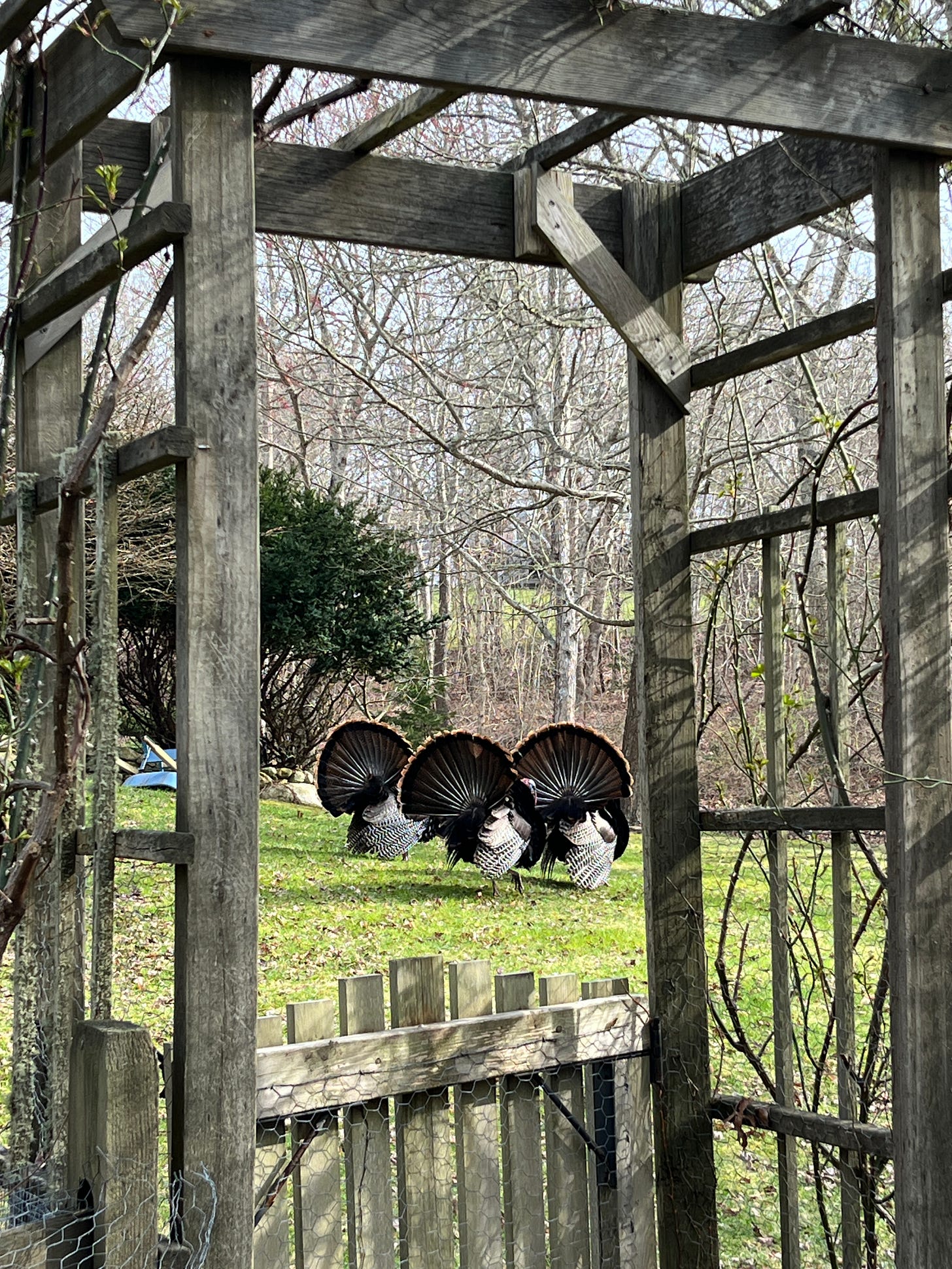
Three turkeys with tails fanned out, viewed through a garden gate

The view from my garden. Credit: Meera Subramanian

I have reluctantly returned to the country of my birth, the place that has always inspired the greatest culture shock after long travels. How quickly I’ve stopped dreaming in Spanish, as the raucous sounds of English fill my mind. Foot travel and cheap trains are replaced by big trucks riding the ass of my Prius as I drive too far to get a dozen eggs that cost six times what they did in Spain. But there are good friends, and my beloved bookshelf, and the yard is teeming with turkeys and other signs of springtime life. Together, it is the antidote to the unraveling.

Between the work of catching up—pitching stories about renewable energy in Spain, preparing for a talk (more below), handling personal crises minor and major—I watch wild turkeys loitering about Cape Cod. Or, I guess, we’re the loiterers. They bear our presence. I could watch them all day. And do.

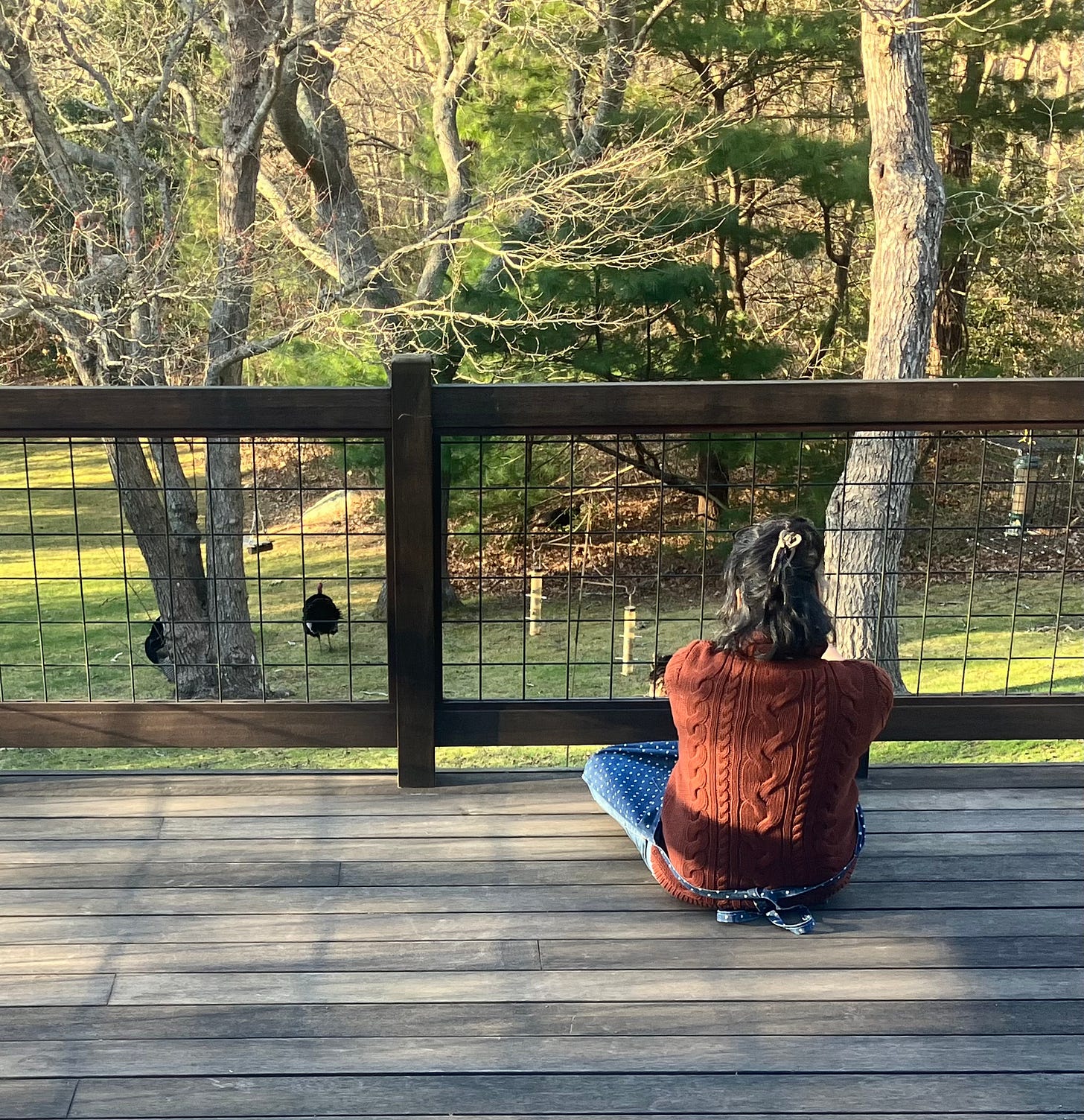
Woman sitting on deck watching turkeys in yard

Take the time to notice the wild things around us. Credit: Stephen Prothero

Tomorrow is Earth Day, something I find myself resisting—every day is earth day, damn it!—and it comes as years of scientific gains and movement towards climate goals are being bludgeoned, as human rights from clean air to due process are eroded. I gather with my fellow citizens on the rotary who hold signs mentioning kings and oligarchs tight lest they blow away in the fierce wind. My friend and I talk with Andrew, a supporter of 47, a proud participant of January 6th, his language and message perfectly honed in response to any question. “Anything you want to ask us?” I offer, but he shakes his head and responds with a sentence that drifts away in the wind, “No, I have trouble getting my thoughts together…” We’ve all learned how to talk in this age of pontification. Listening is another skill.

I gain more understanding by returning to Jeff’ Sharlet’s book The Undertow:

We say we are in crisis. The crisis of democracy—the gun—the crisis of climate—the fire, the water, the rain—the crises of our own little lives—debt and Twitter and rage, and most of all the ordinary losses of love and loved ones that feel too vast. But that word, crisis, supposes we can act. It supposes the outcome is yet to be determined. The binary yet to be toggled, a happy ending or a sad one, victory or defeat. As it we have not already entered the aftermath.

Will we save democracy or lose it? Will the earth boil, or will we all drive electric cars? Are the dead gone, or do they live in our hearts forever?

Such imaginations we have.

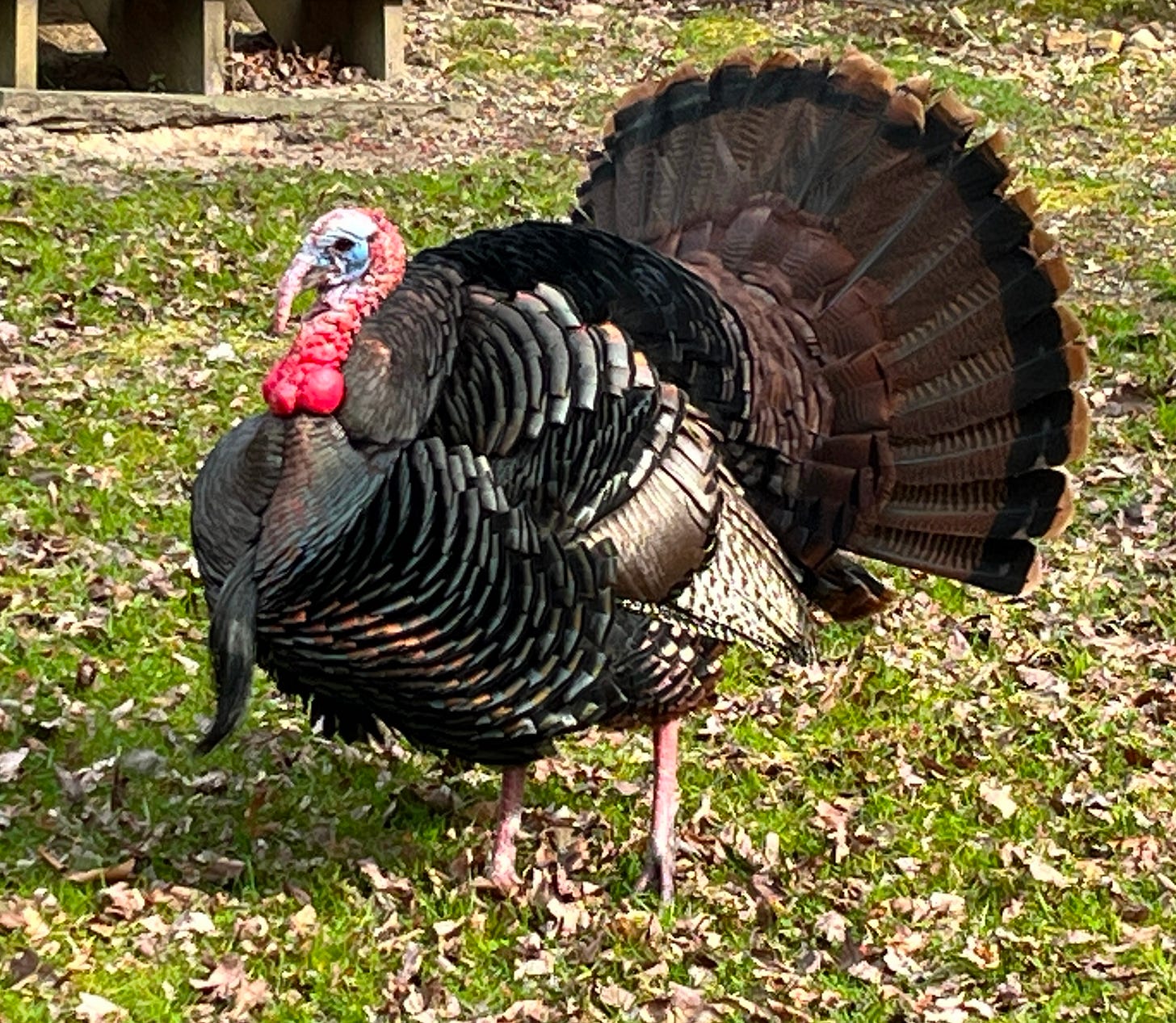
My imagination wanders, as I watch eight tom turkeys back home, spectacular tail feathers fanned in full display, wings hanging low as they shimmy, faces an explosion of blue and bright red, all glorious and grotesque. The dangling wattle known as a snood draping down over their beaks in the most impractical of ways.

Tom turkey in full display

Tom turkey in full display. Credit: Meera Subramanian

You may have heard the ole story, about Benjamin Franklin and his disappointment that the aggressive eagle had been chosen as our nation’s symbol. In 1784, he wrote in a letter to his daughter:

For my own part I wish the bald eagle had not been chosen as the representative of our country. He is a bird of bad moral character. He does not get his living honestly. You may have seen him perched on some dead tree, where, too lazy to fish for himself, he watches the labour of the fishing hawk; and when that diligent bird has at length taken a fish, and is bearing it to his nest for the support of his mate and young ones, the bald eagle pursues him, and takes it from him. . . . the turkey is in comparison a much more respectable bird, and withal a true original native of America.

I agree, even though my love of raptors is deep and slightly irrational. But even the morally bankrupt eagle only takes what she needs. Acknowledges the limits of necessity even as he steals from the osprey. But the turkeys do earn my respect as they did Benjamin’s, as they make their own way through the world. Mostly peaceful.

There’s been some fighting, too.

One male jammed his beak down the other’s throat and held it there for so long in a suffocating stalemate that I was thinking there might be a roast turkey for dinner. But one relented, and the other chased the loser away. It always seems to be the boys. The hens just want to eat in peace, and carry on with their task. I thank them for ridding our yard of ticks more than their sparring, strutting cohorts. But all play their part.

How quickly I’ve become accustomed to them. When a fox ran through the yard, they scattered, one even taking a lumbering flight to the treetops where they roost at night, (enormous black silhouettes against the skeletons of still bare oak branches and a gloaming sky draining of color). The daytime yard was empty for hours and a keening loneliness set in that only abated when I once again detected movement out of the corner of my eye.

When I went down to work in the garden to gather my thoughts, they scattered again, only to drift back up and surround me as I turned over the winter cover crop, preparing for what is to come, for another season to unfold. The work of a garden is endless. So is the work of democracy. Or for a habitable climate. I will be the first to admit it is exhausting.

Yet.

The turkeys carry on. And so do I. And so do you. Find our ways to fight and also know that we need to make time to ensure our own sustenance as well. Step away from the socials. Pick up the binoculars. Watch the natural world doing the work of living. The toms, the hens, together. They are all spectacular. These magnificently large creatures, living in our midst. Doing the work of replenishment. Eating. Courting. Creating more.

It wasn’t always like this. Native to North America, Meleagris gallopavo was domesticated by the Aztecs, who introduced them to invading Spaniards, who took them to Europe and then brought them back, while other conquerers nearly annihilated the wild ones. In the early 1800s, only about 30,000 remained, down from many millions. Today, there’s an estimated seven million in North America, in part because of the work of hunters and governments. Disappearance is one possibility. So is abundance.

No wonder I want to turn my attention to them. Especially as I prepare to share stories of disappearance and hopes of resurrection from South Asia about some other very large birds….

Talking vultures

For those in the Cambridge, Massachusetts area or who have access to a computer, I invite you to join me for a talk I’m giving this Friday evening for the Brookline Bird Club, taking place at Harvard’s Geological Lecture Hall. It’s titled South Asian Vultures: Crisis & Conservation. Here’s all the info and here’s a description:

Not too long ago, millions of vultures flew over South Asia, so abundant that no one had bothered to count them. Until the 1990s, when populations of three Gyps vultures collapsed by more than 97 per cent in a decade. It was the fastest avian decline ever recorded. Conservationists scrambled to find the cause and start captive breeding programs. What happens when South Asia’s essential clean-up crew vanishes? Cape Cod-based journalist and National Geographic Explorer Meera Subramanian has spent nearly twenty years searching for the answer to that question and discovered a story of conservation in a time of mass extinctions, a chronicle of biologists strategizing and cautiously celebrating. Join her as she shares photos and stories from covering the crisis in both India and Nepal, where the birds’ absence has had ecological, cultural and even religious implications.

Journalists & writer friends, take note…

  • The Council for the Advancement of Science Writing (CASW) is accepting entries for the fourth Sharon Begley Science Reporting Award, a career prize for a mid-career science journalist of “unflinching dedication, skill, moral clarity, and commitment to mentoring”. Prize includes a $20,000 grant. Deadline: April 30, 2025.
  • Orion Environmental Writers’ Workshop (June 15-20, 2025, The Omega Institute in Rhinebeck, New York) Join a community of writers, improve your craft, and reimagine how you think about nature. Guided by award-winning instructors, the Orion Environmental Writers’ Workshop provides an intimate space to connect with writers, artists, and editors, spark creativity, and renew, illuminate, and deepen your relationship with place. This week-long workshop is cosponsored by the Omega Center for Sustainable Living. Deadline: May 1, 2025.
  • FRONTIERS open call for application for early-career journalists Round three! This is the same fellowship I just finished up in Spain, but targeted for early-career journos. Deadline: May 6, 2025.
  • Covering Climate Now announced an updated training program, aimed at helping newsrooms grow their audiences by telling the climate story better. The program is available exclusively to journalists working for CCNow partners. For a list of the specific trainings they’re offering, free of charge and starting this spring, check out the Climate Journalism Training Catalog.

I’m reading/watching…

  • After the Deluge by Gary Greenberg in Harper’s, in which he explores some of the same possibilities I did in this piece I wrote for Orion a while ago, but from the close vantage of a small Connecticut town’s selectman responsible for trying to unite a divided populace in the aftermath of a tornado…and a flood. What climate change?
  • This consideration of life and death on a Washington farm, from my friend Christopher Solomon, in Orion.
  • I’ll keep reading Brendan Boyle’s Substack, La Comunidad, on life in Spain. On his post, What does Spain think of Donald Trump?, he captured what I experienced during my travels and conversations across the Iberian Peninsula.
  • I finished Carlos Ruiz Zafón’s Shadow of the Wind, which descended into darkness that feels like it’s getting closer to today’s America. But I’m holding onto this line, as I turn to new writing projects that still elude me: “Julián had once told me that a story is a letter the author writes to himself, to tell himself things that he would be unable to discover otherwise.”
  • I love this visual portrayal of land use made by National Geographic Explorer Dan Raven-Ellison, who traveled the length of Great Britain and captured drone footage of suburbia and bogs, fields and forests, seaside and soccer field, with each second representing a percentage of land use.
  • This morning’s post by Bill McKibben, on the death of Pope Francis, a religious leader who recognized that the real roots of the climate crisis reside in the power imbalance created by a “technocratic paradigm” and viewing the world through a reductionist lens.

Coda…

Years ago, I attended an event in Chennai, India, with Jane Goodall as part of her ceaseless work with Roots & Shoots. I went with my mom and dad, my mom’s hair long and grey and pulled back in a long ponytail that made her look like Jane. Last week, my musician friend Casey Neill saw Jane in Oregon, still ceaseless at 91 years old, and there she was as musician Dana Lyons sang this song for her. Dana’s new record is ‘Cracks in the Heartland,’ which Casey produced. Enjoy, friends.

Don’t stop, ever.

Filed Under: A River Runs Again, elemental india, events, just another day, photography, readings, Substack, travels

On the Move: Bilbao to Tarifa, in pursuit of good energy

March 15, 2025 By meerasub 1 Comment

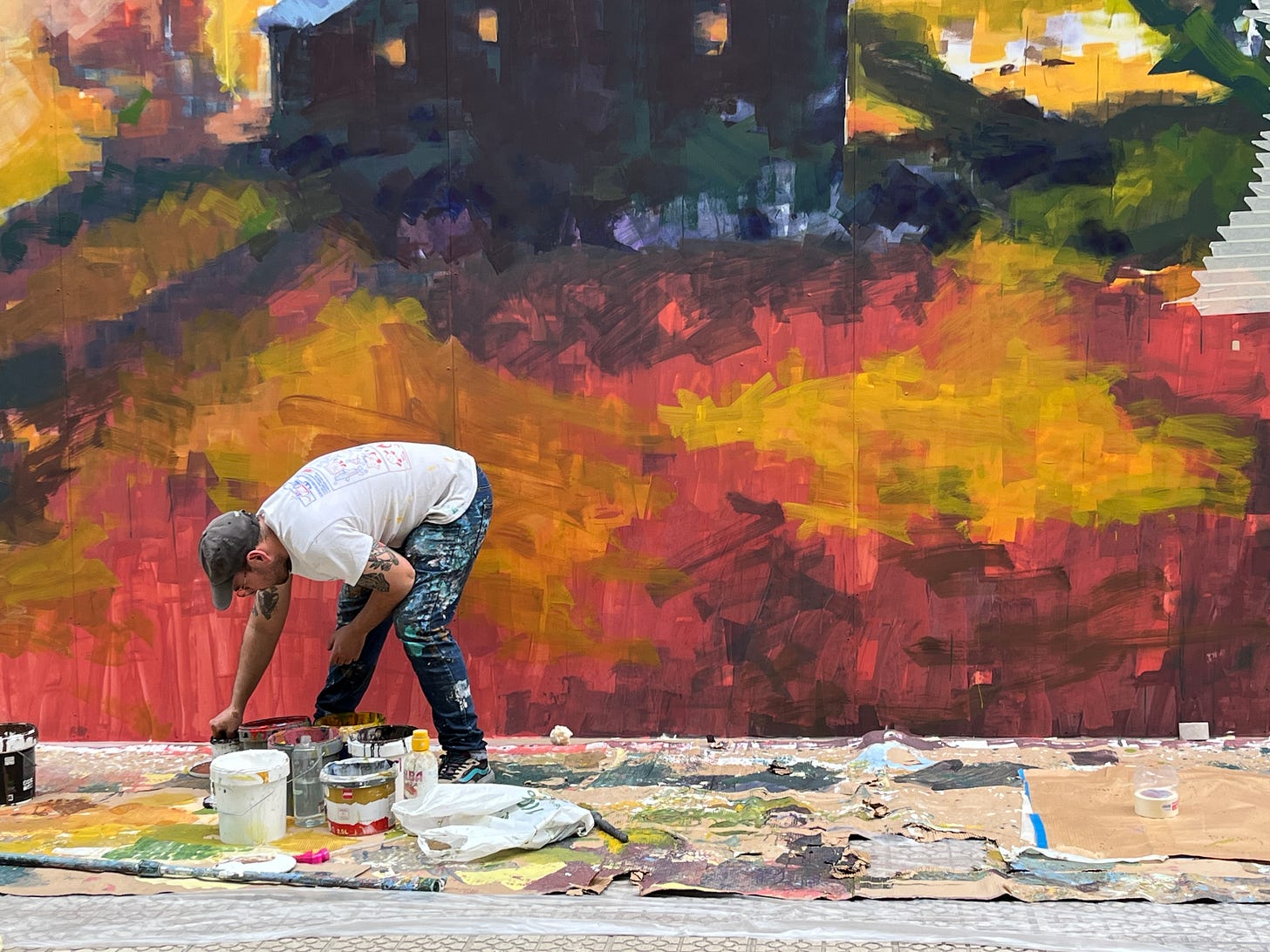
man bent over paints with a wash of color on wall behind him.

Muralist at work, Bilbao. Photo by Meera Subramanian.

{Latest Substack}

Peregrinations are underway. I’m more than two months into my FRONTIERS fellowship, the first half of which was spent in Bilbao at the Basque Center or Climate (BC3) Change. I came here with the question: can renewable energy projects be built in a way that’s better for biodiversity, people, and place?

It’s complicated.

But like the muralist I caught mid-stream as he transformed a construction blind into a work of art, it takes layers of paint, layers of understanding. I’m thankful for the FRONTIERS grant to have the time to keep digging. The researchers at BC3 helped give me a crash course in understanding the renewable energy landscape, and I’ve been busy conducting dozens of interviews, in Spanish and English, with BC3 staff as well as people all over Spain and in France. They’ve included researchers in agrivoltaics, ornithology and environmental conflict; organizations such as Greenpeace, Eudemon and Renewable Energy Foundation; political representatives such as mayors of small towns with renewable energy projects; reps from renewable energy companies; and many others.

When I arrived in Spain, Biden was still president. A week later, he wasn’t. Nowhere is far enough away from the new president’s wrath. BC3 researchers lost US partners when funding was frozen. A cousin lost his job in Bangkok related to USAID. A friend lost a year’s worth of climate work on New Jersey organic farms. A niece’s new position at NOAA as a fledging applied ecologist feels tenuous. But also, my stepdaughter, who is an environmental lawyer for Earthjustice, was part of the team that just sued Trump and the USDA to release IRA funds that were contractually promised and are now frozen. The lawsuits against the administration are piling up.

Here in Europe, the mood is jittery. (Also, I am fielding the repeated baffled question/accusation: how could you Americans have voted him in … again?!) I attended The Climate Agenda in the New European Legislature and Its Impact in the Basque Country, an event in Bilbao on January 31, when the wrecking ball was taking its first wild swings. Panelists included local politicians and journalists from other parts of Europe, offering a lens into the dynamics and tensions around renewable energy, especially in the wake of the inauguration of Donald Trump. Europe is readying itself for … well, just about anything. There is the tension between the desperate need to ramp up the clean energy transition to achieve energy independence butting against the need to divert resources to build war chests. Bolstering nuclear power keeps coming up. So does resistance:

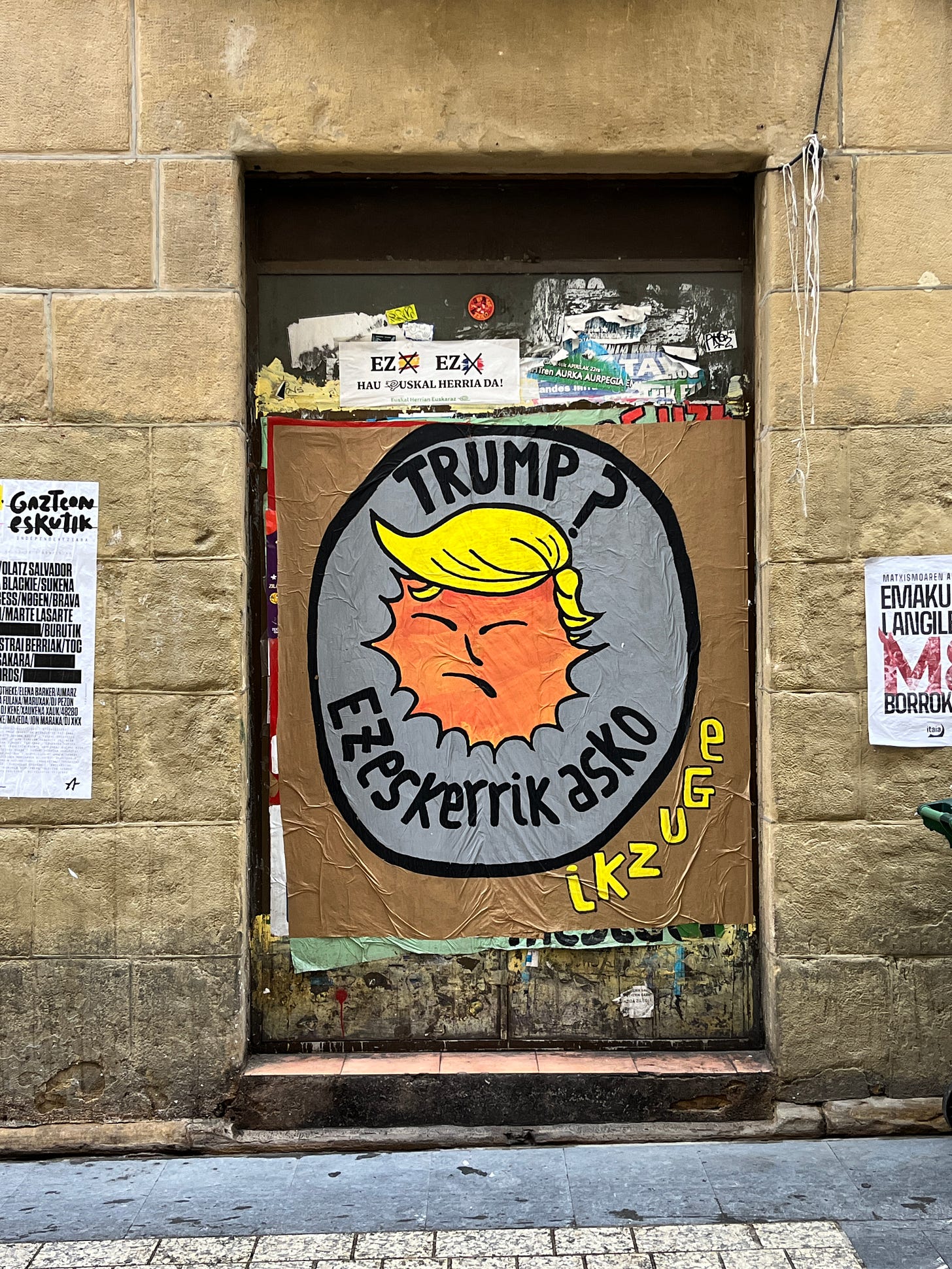
graffiti in Basque Country, Spain

Spotted on a wall in San Sebastian, a play on an anti-nukes image, “Nuclear power? No thanks,” in Basque. Photo by Meera Subramanian.

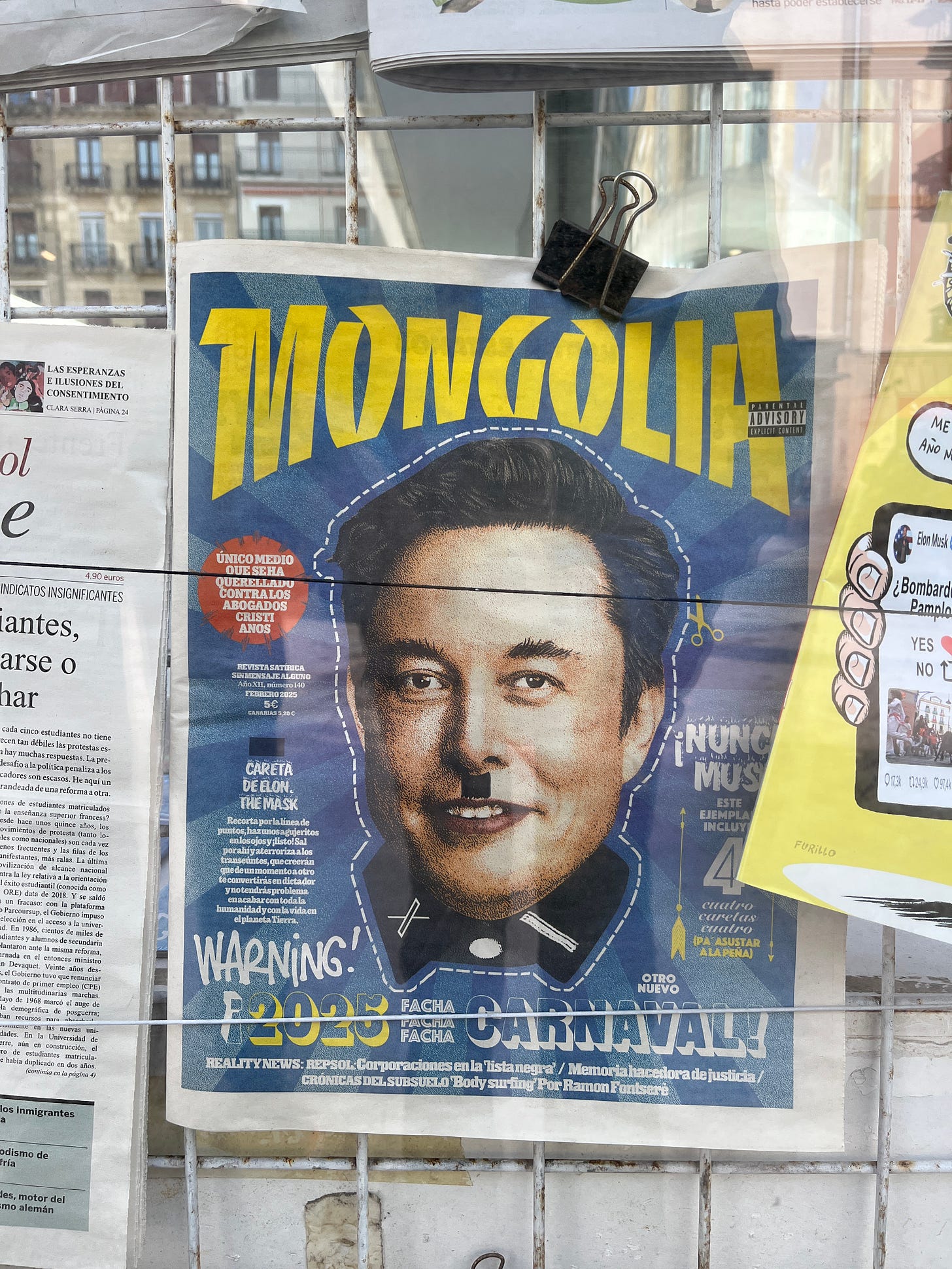
Also spotted at a news stand:

Photos by Meera Subramanian.

But I could only do so much from Bilbao. I’m spending the second half of my time here reporting, going to see solar and wind farms that are trying to do things better for birds and farmers and towns. Now, I write from Tarifa, the southernmost tip of Spain, a windy passage where Europe meets Africa, the Atlantic Ocean meets the Mediterranean Sea. It is difficult to concentrate on the screen, because I’ve come here to look at the sky, the bird migration just beginning. Wind turbines spin behind me up the hillsides of Spain, as well as across the waters of the Strait of Gibraltar, atop Morocco’s mountains. It’s a slalom course for migrating birds, but I’m here to see the efforts to lessen the impact.

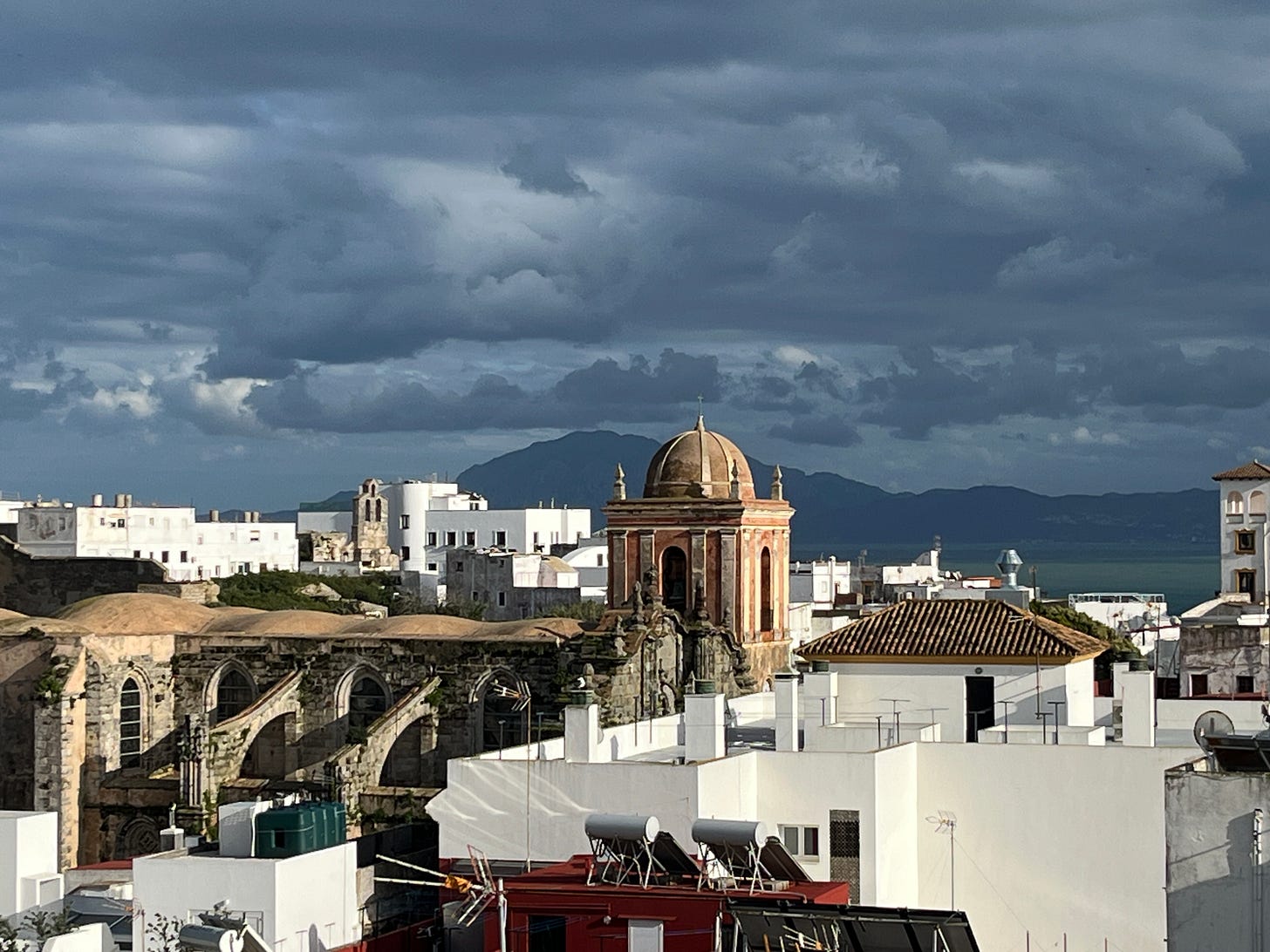
Tarifa, Spain, looking across the Strait of Gibraltar to Morocco

Tarifa, Spain, looking across the Strait of Gibraltar to Morocco. Photo by Meera Subramanian.

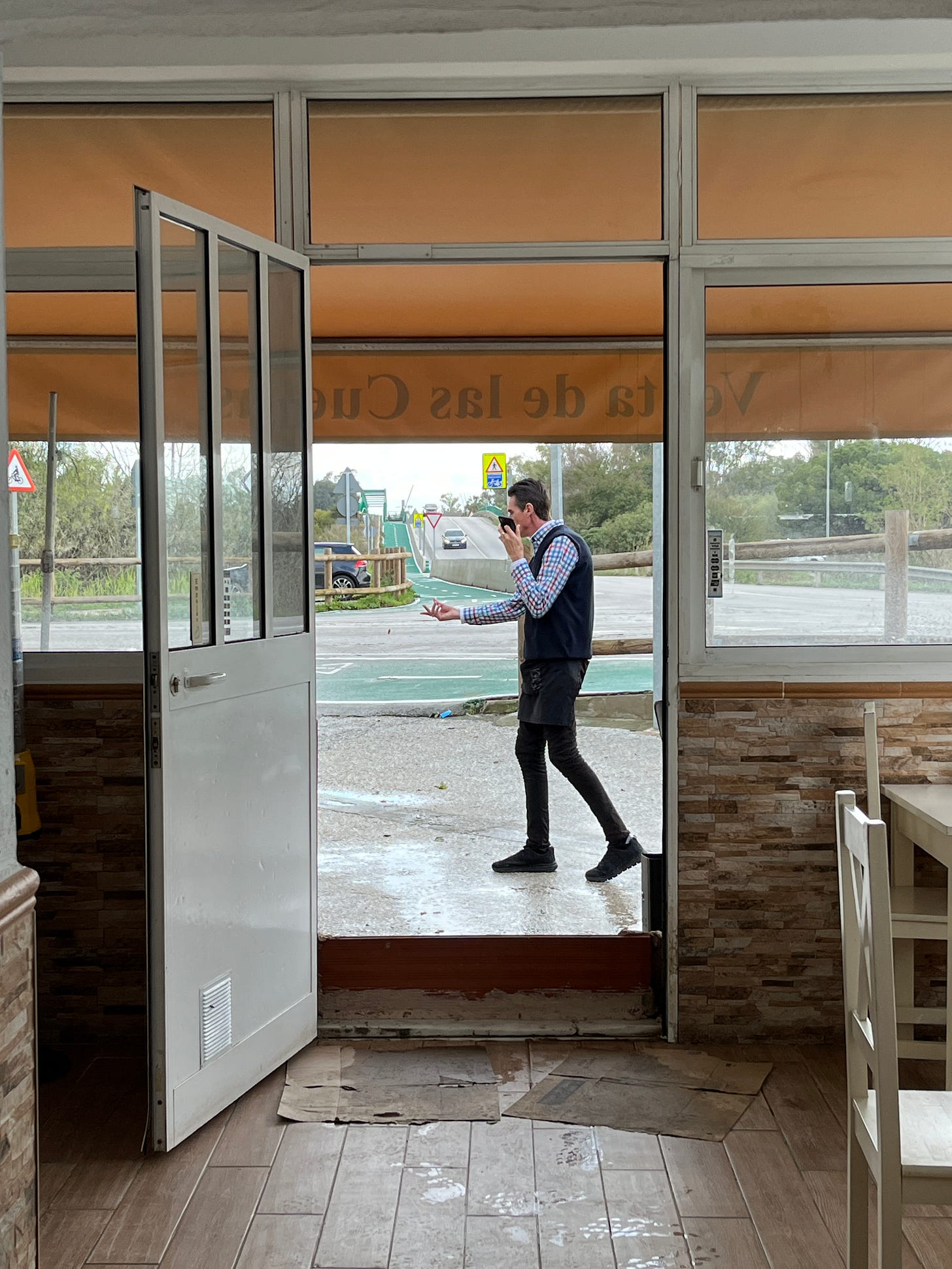
I am thankful for a moment of sun. Andalucia, like most of Spain, has been under a deluge of rain. So much that I couldn’t make it to some of the solar farms on my itinerary, so mired they were in mud. The rain is good, in some ways, needed to alleviate a drought, but it’s also coming too quick, too much, rivers rising. Causing a different type of jitters, with the Valencia floods that killed hundreds last fall still in close memory. I stopped in a cafe for a quick coffee and had to step over the barrier constructed to keep out the rain. It wasn’t enough. The man who passed me a steaming cafe con leche said that, a week and half ago, the place was filled with a half-meter of water. Too early to attribute these weeks of rain to climate change, but it fits the pattern of more extreme weather. More drought, followed by heavier, more intense rains.

man outside, and lower part of doorway blocked.

Blocked threshold to keep rain out. Photo by Meera Subramanian.

One can only hope that the lush green of this wet spring’s growth is not fuel for wildfires of the future. And that the stories I’m finding offer models that can be implemented—quick! now! yesterday!—to get off fossil fuels and onto clean energy sources in a way that doesn’t cause greater harm or collateral damage. Stay posted for more stories to come. 

Journalists & writer friends, take note…

  • Orion Environmental Writers Workshop Join a community of writers, improve your craft, and reimagine how you think about nature. March 15 (today!) for early bird tuition rate.
  • Covering Climate Now is offering a free training program aimed at helping newsrooms grow their audiences by telling the climate story better. Check out trainings on offer: Climate Journalism Training Catalog.
  • The Sharon Begley Science Reporting Award is open for entries. Deadline: April 30.
  • FRONTIERS open call for round three, specifically for early-career journalists Deadline: May 6, 17:00 (CEST).
  • Dart Center forJournalism and Trauma, the C.A.R.E.S. (Connecting Audiences, Reporters, Emotions, and Sources) Media Initiative is conducting research to better understand the resources that journalists on the climate/environment beat need to do their work. Take a moment to do this survey.
  • Trying to keep track of the Trump administration’s dismantling of climate regulations? Options include: “A Running Tally of Trump’s Climate Impacts” from Drilled, and the Climate Backtracker from the Sabin Center for Climate Change Law at the Columbia Law School.
  • NYU Stern Climate Economics Journalism Fellowship will bring a group of journalists to NYU Stern’s Greenwich Village campus, September 18–19, 2025, to learn from globally recognized experts in the emerging field of climate economics. Open to new and experienced journalists (staffers and freelancers) covering the interface between climate and the economy. Here are details and application.

And from the Department of Good News…

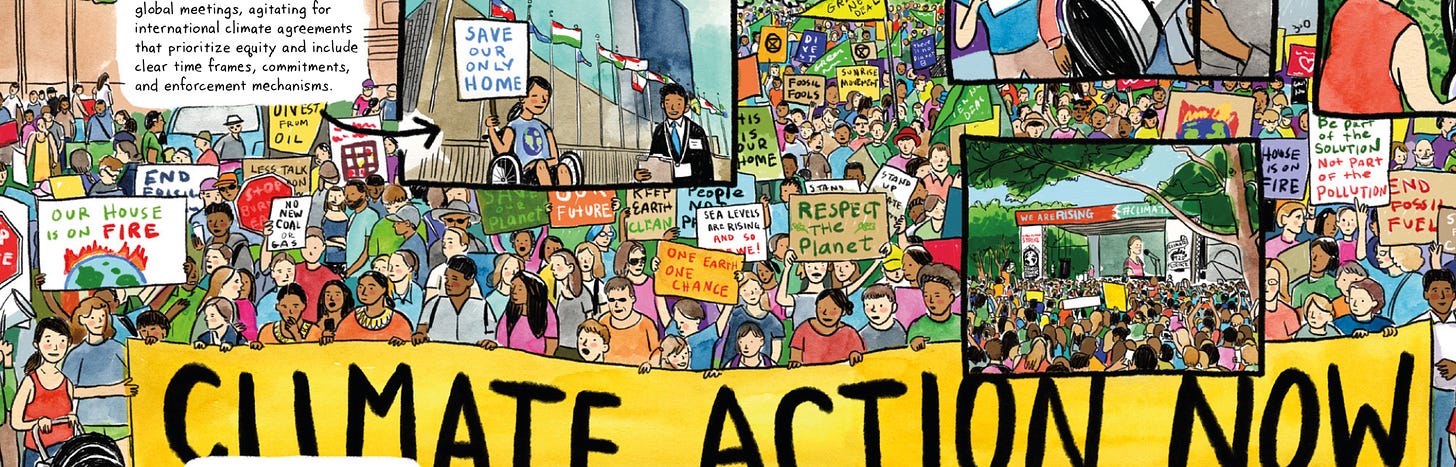
illustration of climate march

Illustration by Danica Novgorodoff

  • A Better World Is Possible, a nonfiction YA graphic novel I’ve been working on with the talented illustrator Danica Novgorodoff is working its way to publication (First Second, 2026). It reveals the pressing danger of the climate crisis through the stories of four youth climate activists who demonstrate the potential of teen power. I’m excited to announce that I received a Grant for Creative Individuals from the Mass Cultural Council that I’ll be putting towards helping this book find its way into the world. THANKS, MCC!
  • I received the Staige D. Blackford Prize for Nonfiction for my piece about the decision to donate a kidney, published in the Virginia Quarterly Review last fall. This feels deeply full circle; VQR was so generous to honor my piece about India’s vultures with this prize back in 2011. I was only a few years out of grad school, I hadn’t done any truly long-form, and VQR editor Ted Genoways took a chance on me. When that prize happened, it transformed the trajectory of my struggling freelance life. Truly. To receive the prize again, after all these years, for this piece that felt so risky in a completely different way, is the deepest of honors. Thanks to editor Paul Reyes and the whole VQR team.
  • I’m also am a True Story Award finalist, for my New Yorker piece, Consider the Vulture.
  • And I’ll be back in the US soon, for better or worse, in time to give a talk about South Asian vultures—their monumental decline and the efforts to bring them back—for the Brookline Bird Club, April 25, at the Harvard Geological Lecture Hall. In person and on Zoom. More details to come.

I’m reading…

  • To keep my reading mind in Spain, there’s been Ben Lerner’s Leaving Atocha Station, which exquisitely captured the hungry creative young mind as he makes an infinite number of poor decisions, and I’m midway through Carlos Ruiz Zafón’s Shadow of the Wind.
  • I listened to The Buried Giant, by Kazuo Ishiguro, at the recommendation of my (former) Orion editor, Sumanth Prabhaker. As our own country tumbles towards civil war (slowly, but quickening, according to Jeff Sharlet), I found this exploration of memory and forgetting—when is it necessary to wipe one’s mind clean in order to live in peace?—haunting. And, in spite of there being dragons and knight errants, it reminded me of similar themes explored in Severance, which I am totally hooked on.
  • I got an early look at Sadie Babits’ forthcoming Hot Takes: Every Journalist’s Guide to Covering Climate Change (Island Press). I had the pleasure of serving with Sadie on the SEJ Board, and she followed me as president. Now, she’s the lead climate editor at NPR. Get this book on your radar!
  • Erica Berry’s book Wolfish was a brilliant exploration of fear and wildness, and her new piece, “The Fault of Time,” in Emergence, is equally captivating. Here’s her Substack.
  • I found “The End of Children” by Gideon Lewis-Kraus in The New Yorker fascinating and as troubling as it was intended to be. It explored so many facets of the transformation underway, but I also wanted more about the infertility that may be linked to environmental factors, and also the hesitancy I have heard many younger people express about bringing children into a world increasingly ravaged by climate change and other environmental disasters. Still very much worth a read.
  • And I’ll wait to buy Sewanee School of Letter’s colleague Tiana Clark’s new book of prose poems, Scorched Earth, in person from her this summer, but I had the pleasure of hearing her read some her work in the past. You don’t have to to wait. Available at all the good places (and the bad places, too) where you can buy books.

I leave you with this, pure joy and delight of a song sung in public, crammed in a narrow alley of Old Town, just last night. The rains cancelled Carnaval in Tarifa last week, but they’re happening this weekend. The town is all dressed up. People don themed costumes with their friends and families that are about not about your single individual uniqueness, but about what you can create in concert with your community. I couldn’t catch all the lyrics of this long song, but it seemed a ballad, each stanza ending with a punchline that made the crowd laugh and led to the next round of the story. I’ll have bum-bum-bum-bum-bum running through my head for days, making me smile each time. Hope it’s contagious.

{For video go to Substack}

Be well, friends. Be fierce. Be ready.

[Read more…]

Filed Under: awards, climate change, drought, journalism, News, peregrinations, Substack, travels

Out of Order

February 4, 2025 By meerasub Leave a Comment

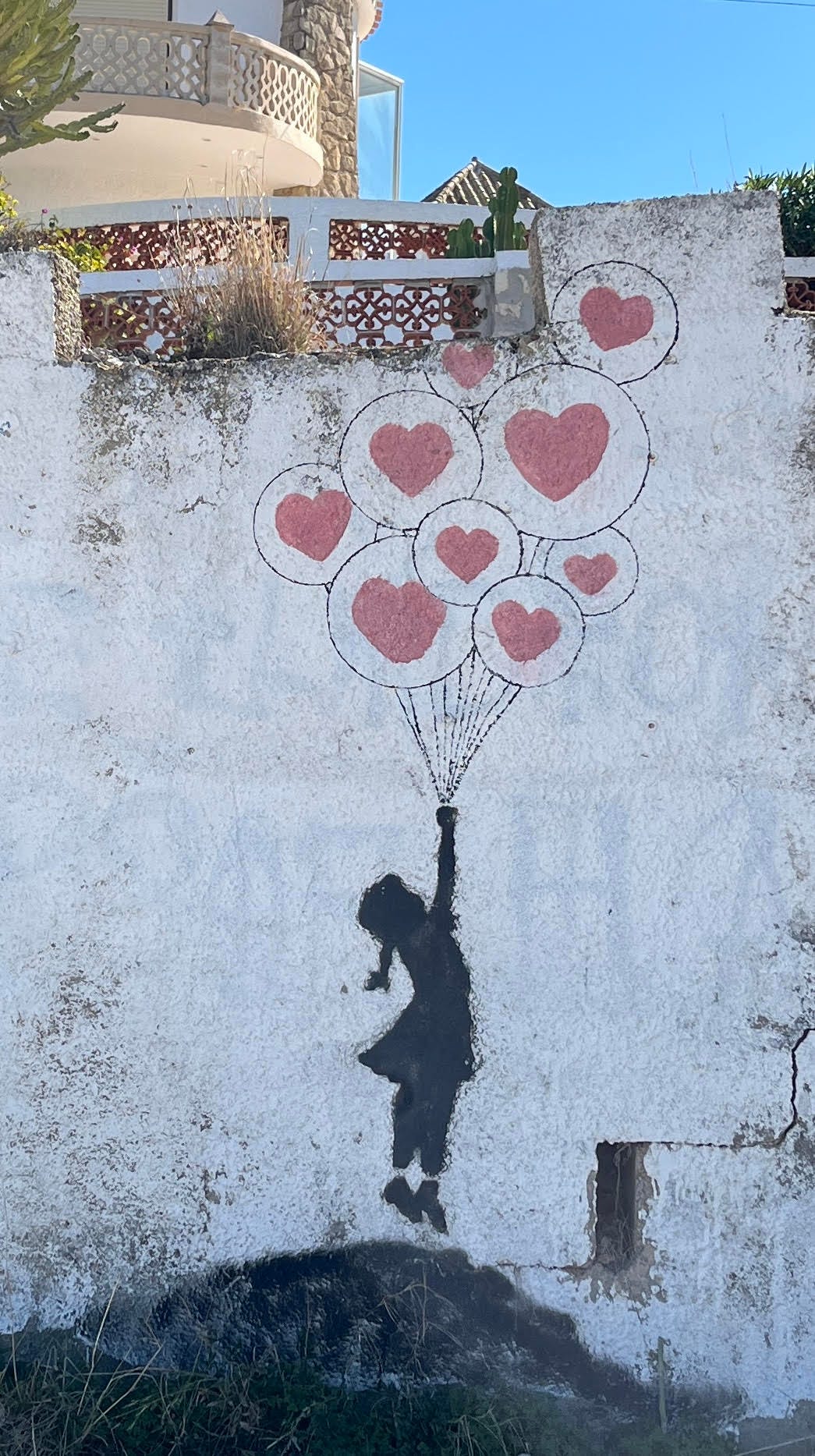
graffiti of girl being lifted by heart balloons

{latest Substack…}

Sentiments can be lost in translation, but also found. I’m out of the US but its mess spreads across the globe like its carbon emissions. The absolute least of it is was sitting in a cafe eating tortilla española and cringing as our new old president declared Spain is a BRICS nation (it isn’t). The most of it is hearing from friends and family about direct impacts: jobs lost, projects frozen, students with questionable immigration status disappeared. Last week, I stood with an Austrian woman and when the subject of our state of affairs came up, both of us speechless about the chaos the 47th has unleashed in a baker’s dozen worth of days, she said, of the country or the man, I’m not sure, that it’s “out of order.”

“Yes, yes! That’s the perfect phrase,” I exclaimed. “I’m going to use that.” And so here we are.

As I walked home afterwards, a woman alone, after midnight, feeling totally safe on the streets of Bilbao even as I walked through a group of a dozen men (oh, the sweet relief of not having cortisol continually coursing through one’s body; consider the whales; consider immigrants now being rounded up), I tumbled the phrase “out of order” around in mind. Out of order can mean broken, nonfunctional. It can indicate an experience of tumult and bedlam. It can also mean when someone steps of out of line, and acts in ways that are socially, ethically, morally improper. With the Austrian woman’s three words, she’d spoken a triple entendre.

To process this moment, I’m alternating between Jeff Sharlet’s Scenes from a Slow Civil War and Katharine Hayhoe’s Talking Climate, somehow finding solace in simultaneously recognizing how bad things are and how good they could be. Be? Maybe? Ayana Elizabeth Johnson reminds us to act locally. My form of protest is to dig deeper into my FRONTIERS fellowship work based at BC3, trying to understand all the dynamics at play in the efforts to shift our energy systems to cleaner forms of wind and solar, something that will continue to happen regardless of the white man in the White House. It’s led me to encouraging conversations about agrivoltaics in France and energy companies that build in community funds voluntarily, but also to a recurring and troubling story of conflict—a chasm between the rural and urban populations of the world—identical to what I’ve experienced in America, especially when I reported on conservative perceptions of climate change for Inside Climate News. I also attended an event, La Agenda Climática en La Nueva Legislatura Europa y su Impacto en Euskadi, The Climate Agenda in the New European Legislature and its impact in Basque Country. And we were right back to the impacts of the global shift to the far right. A sense of nervousness, geopolitics shaky, and the hope that energy independence in the form of renewables can be a part of regional security strategies.

panel discussion on climate and politics

Sweet dreams & flying machines…

There was also, last week, the horror over DC skies. Someone I love deeply and dearly has lost someone they love deeply and dearly in the unspeakable plane crash that ended in the Potomoc. She asked me for hard-won advice, knowing I have lost friends, this one, and this one, and others. Words fail, but I say something about letting the grief come when it will, to not fight it, to let it wash over you when it appears urgent and unexpected, even months, years, down the road of recovery. No, not recovery. Something else. Love and loss burnished into your being. But now the grief is immediate, and the only thing to do is take the unbidden reminder that life is short, precious. Love big. Hold loved ones close. Tell them. This is the other way we can act locally, in our most intimate lives.

Keep notice…

As I’m exploring this new place, I’m searching for slivers of joy amid all this grief and allowing myself moments to recognize them. I found one, as the sun broke through the relentless clouds of Bilbao, of the news, on Friday afternoon, when I finally made it up Etxebarri Parkea. Once a factory site that has been transformed into a park overlooking the city, its tall smokestack is a reminder of what once was. There was a pond created to support birds and critters, and a skate park for humans to play.

When I walked by the skate park, I noticed two men on skateboards, then I noticed that one was much, much older than the other. I was intrigued. Circled around the park and returned to watch him as he made a smooth steady run across the shallow end. Then, as the younger skater was leaving, the older one recruited him to help him summit the last lip of his run. “Come help me,” he said. “Stand here, with one foot here and the other there, and then when I come up, take my hand.” The young man did exactly as told. They tried it 5-6 times, and the older man never quite made it. Except that, well, he’s already made it, right?

I took a picture of them both, then handed my phone to Nico, the 26-year-old German so he can forward it to himself. And Juanjo is telling us he’s famous. “Google me!” he instructed, and indeed there he is on YouTube and TikTok. He is 87 years old, older than ages of the young skater and me, combined. Some lives are unfairly cut short. Others are long, and embraced by the bodies that contain them.

Journalists & writers friends, take note…

  • For rising juniors and seniors pursuing journalism, consider applying to the Opening Doors, a new initiative aimed at increasing diversity in public media newsrooms. The two-year program will provide skills training, mentorship, and paid internships for ten BIPOC journalism students, with a focus on science, health, and economics reporting. Apply here.
  • The Uproot Project Fellowship offers funding to seven journalists to pursue reporting projects over the course of a year. Fellows will receive up to $2,000 to cover travel and other reporting expenses for their fellowship project. Learn more about the Uproot Project Fellowship and find this year’s application here. Deadline: 11:59pm on March 1, 2025
  • And to connect with poets who are using their art to face the climate crisis, check out the Hellbender Gathering of Poets, run by my friend and Sewanee colleague Nickole Brown. They’re gearing up for a fall gathering and having inspiring events along the way.
  • The Matthew Power Literary Reporting Award is a grant of $12,500 to support the work of a promising early-career nonfiction writer on a story that uncovers truths about the human condition. Matt was one of those dear friends we lost way too early. Deadline: Feb. 19

Take care, friends. Take care of each other.

[Read more…]

Filed Under: climate change, peregrinations, photography, Substack, travels Tagged With: BC3, Bilbao, death, FRONTIERS, grief, politics, skateboarding, Spain

  • 1
  • 2
  • 3
  • …
  • 20
  • Next Page »

Follow Meera on Substack

for the very occasional bit of news.

Categories

Tags

Alaska anthology A River Runs Again Art awards birds of prey books book tour Cambridge cape cod climate change conservation death dissent Elemental India energy events Fulbright india InsideClimate News journalism kenya Knight Science Journalism middle east Nature New York City organic farming Orion peregrine falcon pesticides photography plastics politics pollution environment Princeton University radio readings renewable energy science Society of Environmental Journalists teaching travel USA vulture water

Archives by Month

Connect

  • Bluesky
  • Facebook
  • Instagram
  • LinkedIn

© 2026 Meera Subramanian. | All Rights Reserved. | Mastodon | Website design by Sumy Designs, LLC

Green_14